Nobody sets out to build a fragile integration layer. It happens one reasonable decision at a time.
Someone connects the website form to the CRM. Someone else builds a sync between the CRM and the accounting system. A third person adds a notification to a messaging channel when a large order comes in. Each takes an afternoon. Each solves a real problem. Two years later there are forty of these, built by six different people, four of whom have left, with no documentation, no error handling, and no shared understanding of which system owns the customer record.
Then one of them fails silently for eleven days and nobody notices until a customer asks why their order never shipped.
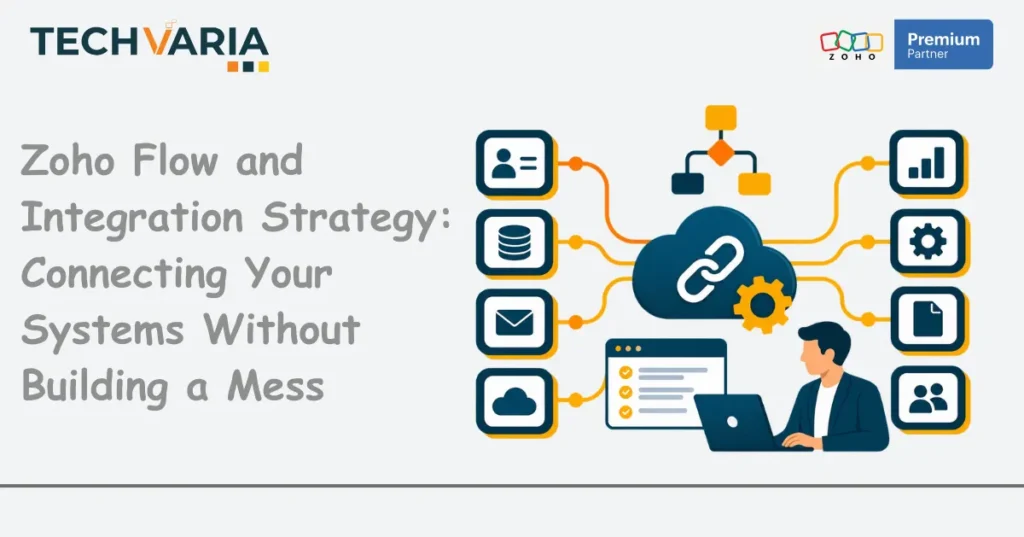
Zoho Flow is a capable integration platform, and this guide covers how it works. But the more valuable half of the subject is the part that has nothing to do with the tool: deciding which system owns which data, designing for failure rather than for the happy path, and putting enough governance in place that your integration layer is an asset rather than an accumulating liability.
It is written for IT heads, operations directors and technically-minded founders who are connecting systems now and would rather not spend next year untangling them.
The Problem: Integration by Accumulation
The symptoms show up in a recognisable order.
- Nobody knows what exists. There is no inventory of running integrations. Discovering them means asking around and hoping the right person remembers.
- Failures are silent. Most simple integrations have no error handling. When one breaks, it stops working quietly. The discovery mechanism is a customer complaint or a month-end discrepancy.
- Data conflicts have no resolution rule. The customer’s address is different in the CRM and in the accounting system. Both were updated by someone reasonable. There is no agreed answer to which is correct, so both persist and the conflict propagates.
- Duplicates multiply. A retry after a timeout creates a second record. Nobody built duplicate prevention because the happy path worked in testing.
- Everything is point to point. Six systems connected pairwise produce a tangle where a change to one requires checking five others.
- Knowledge left with the builder. The person who built the sync understood the edge cases. That understanding was never written down.
- Volume exceeded the design. An integration built when the business processed forty orders a day starts hitting API rate limits at four hundred, and the failure mode is partial rather than obvious.
Why Integration Strategy Beats Integration Tactics
Three arguments matter to the people who allocate budget.
Silent failure is the expensive failure mode. A system that crashes gets fixed within the hour. An integration that quietly stops syncing a subset of records causes weeks of accumulating data divergence that somebody eventually has to reconcile by hand. The cost is not the outage; it is the remediation and the lost trust in the data afterwards.
Manual re-entry is a hidden headcount. Most businesses running disconnected systems have someone — often several someones — whose job includes copying data between them. It rarely appears as a line item because it is distributed across roles. Quantifying it honestly is usually the strongest business case for doing integration properly.
Integration debt compounds like technical debt. Each undocumented point-to-point connection makes the next change harder. Businesses that reach forty ad-hoc integrations find that ordinary changes — adding a field, changing a process, swapping a vendor — turn into archaeology projects. Businesses that impose a modest amount of structure early avoid this entirely, and the structure costs very little at the start. It is the same asymmetry that makes any digital transformation programme cheaper to sequence deliberately than to retrofit.
There is also a straightforward data quality argument. Every manual transfer is an opportunity for a typo. Automated, validated transfers do not have bad days.
What Zoho Flow Actually Is
Zoho Flow is an integration platform — an iPaaS — that connects applications through configured workflows rather than code. A flow consists of a trigger (something happens in one application), optional logic (conditions, branches, delays), and one or more actions (do something in another application).
It connects Zoho applications to each other and to a large library of third-party services — payment processors, e-commerce platforms, messaging tools, spreadsheets, storage, marketing platforms and more — plus generic webhook and API capability for anything without a prebuilt connector.
What makes it worth considering over a general-purpose alternative is depth on the Zoho side. The connectors for Zoho CRM, Books, Desk, Inventory, People, Creator and the rest are built by the same vendor, which in practice means fewer field-mapping surprises and better handling of the object relationships that generic connectors tend to flatten.
What it is not: it is not a replacement for genuine application architecture. If you find yourself building a flow with twenty-two steps and nested conditional logic to reconstruct a business process, the answer is usually a Zoho Creator application or a proper API integration, not a longer flow.
The Four Integration Options — and When to Use Each
This is the decision most teams skip, and it is the one that determines whether the integration layer stays manageable.
| Option | What It Is | Use When | Avoid When |
|---|---|---|---|
| Native integration | Built-in connection between two Zoho apps (CRM↔Desk, CRM↔Books, People↔Payroll) | Always check first — it is free, maintained by Zoho, and survives upgrades | The standard behaviour does not match your process |
| Zoho Flow | Configured trigger-action workflows across apps | Cross-application automation, third-party connections, moderate logic, business-owned processes | Very high volume, complex transformation, or transactional consistency requirements |
| Zoho Creator app | A custom low-code application | The process needs its own data model, screens or approval logic — not just data movement | Simple field-to-field synchronisation |
| Custom API integration | Direct code against the APIs | High volume, complex transformation, strict error semantics, or an unsupported system | Something the above three handle adequately |
The rule worth adopting: always check native first, then Flow, then Creator, then custom. Each step up adds capability and adds maintenance burden. Teams that reach for custom code by default end up maintaining code they did not need; teams that force everything into Flow end up with twenty-step flows nobody can debug.
Tip: Write this decision down as a one-page standard and apply it to every new integration request. It takes an hour to produce and saves years of accumulated inconsistency.
How Zoho Flow Works in Practice
Triggers, Actions and Logic
Triggers start a flow. The main types:
- App events — a record created or updated in a connected application
- Webhooks — an inbound HTTP call from any system that can send one
- Scheduled — time-based, for batch operations and periodic reconciliation
- Polling — checking an application for changes where no push event exists
Logic elements shape what happens:
- Decisions — branch on field values or conditions
- Delays — wait a fixed period or until a specified time
- For-each loops — iterate over collections such as order line items
Actions do the work: create or update records, send emails or messages, call an external API, write to a spreadsheet, generate documents.
Choosing the right trigger type matters more than it appears. Webhooks are near-instant and efficient. Polling introduces latency and consumes quota. Scheduled flows are right for reconciliation and batch work and wrong for anything a user is waiting on.
Data Mapping and Transformation
Mapping fields between systems is where most of the configuration effort sits, and where most of the defects originate.
The recurring problems to plan for:
- Picklist mismatches. System A’s “In Progress” is System B’s “Processing”. Map explicitly; never assume alignment.
- Date and time formats, including time zones. A date that is correct in IST and wrong in UTC causes errors that are genuinely difficult to spot.
- Required fields on the destination that the source does not populate. Decide the default rather than letting the action fail.
- Relationship lookups. Linking an order to a customer requires resolving the customer first. Order of operations matters.
- Field length and type limits. Silent truncation is worse than a clean failure.
Custom Functions for the Hard Parts
Zoho Flow supports custom functions written in Deluge for logic that configuration cannot express — non-trivial calculations, conditional formatting, calls to APIs without a connector, or complex data restructuring.
Use them deliberately. A short, well-named, commented function that does one thing is an asset. A 200-line function embedded in a flow, written under deadline pressure by someone who has since left, is exactly the debt this guide is about. If the logic is substantial enough to need real code, consider whether it belongs in a Creator application where it can be tested and versioned properly — or whether you should hire a Zoho developer to build and document it as code from the start.
Designing Integrations That Do Not Break
Decide the Source of Truth First
This is the most important decision in any integration project, and it is not a technical one.
For each significant data entity — customer, product, order, invoice, employee — one system must be authoritative. Everything else receives.
A typical pattern for a Zoho-centred business:
| Entity | Source of Truth | Receives From |
|---|---|---|
| Lead / prospect | Zoho CRM | Website, campaigns, events |
| Customer master | Zoho CRM | — |
| Product / item master | Zoho Inventory or Books | — |
| Order | E-commerce or CRM, by channel | — |
| Invoice / financial record | Zoho Books | Orders |
| Support ticket | Zoho Desk | Email, portal, chat |
| Employee master | Zoho People | — |
Without this agreement, bidirectional syncs become update loops, conflicts resolve arbitrarily, and nobody can answer which value is correct. With it, most integration design becomes straightforward: data flows from the owner outward.
Prefer one-way flows. Bidirectional synchronisation is dramatically harder to reason about and should be used only where genuinely required, with explicit conflict rules and loop prevention.
Error Handling Is the Design, Not an Afterthought
Assume every integration will fail. APIs go down, rate limits trip, required fields turn up empty, records get deleted mid-process.
What a properly handled integration includes:
- Notification on failure to a monitored channel — an email nobody reads is not monitoring
- Retry logic with backoff for transient errors, and a distinction between transient and permanent failures
- A dead-letter destination — failed records written somewhere reviewable rather than lost
- A reconciliation check that periodically compares record counts between systems and flags divergence
- Logging with enough context to diagnose without reproducing
That fourth one is the most neglected and the most valuable. A scheduled flow that counts records on both sides weekly and alerts on a mismatch catches the silent failures that everything else misses.
Idempotency and Duplicate Prevention
An operation is idempotent if running it twice produces the same result as running it once. Integrations should be designed this way, because retries, duplicate webhooks and manual re-runs all happen.
Practical techniques:
- Search before create. Look for an existing record by a stable external identifier before creating a new one.
- Store the external ID. Keep the source system’s identifier on the destination record so the link is explicit and queryable.
- Use upsert patterns where the platform supports them.
- Guard against loops in any bidirectional flow — a flag or a last-modified-by check that prevents an update triggering its own echo.
Integration Governance
Governance sounds heavy. In practice it is four artefacts, and a small business can maintain all of them in an afternoon a quarter.
1. An integration register. A single document listing every running integration: what it connects, what it does, who owns it, when it was built, and how it alerts on failure. This alone prevents most of the problems in this guide.
2. A naming convention. Flows named consistently — source, destination, purpose — so the list is navigable. CRM→Books: Create Invoice on Deal Won beats New Flow 14.
3. An environment discipline. Test in a sandbox or with test records before enabling anything in production. For flows touching financial or customer-facing data, this is not optional.
4. A review cadence. Quarterly, check which flows are still needed, which are failing, and which have grown beyond what Flow should be doing. Retire what is dead.
Add to this a named owner for the integration layer as a whole. Not a committee. One person who knows what exists.
Benefits You Can Measure
- Manual re-entry hours eliminated. Quantify before and after — this is usually the headline number.
- Data entry error rate. Falls to near zero on automated paths.
- Process cycle time. Order-to-fulfilment, lead-to-assignment, ticket-to-resolution all compress when handoffs stop waiting for a human.
- Lead response time. Instant routing rather than periodic checking.
- Reconciliation effort at month-end. Falls sharply when systems agree continuously.
- Integration failure detection time. From weeks to minutes, with proper alerting.
- Time to build the next integration. Falls as patterns and standards mature.
Zoho Flow vs Zapier vs Make vs Custom Code
| Dimension | Zoho Flow | Zapier | Make (Integromat) | Custom API Code |
|---|---|---|---|---|
| Best fit | Zoho-centred businesses | Broadest app coverage, simple automations | Complex visual workflows | High volume, complex logic |
| Zoho app depth | Strongest — same vendor | Good | Good | Whatever you build |
| Third-party connector library | Large | Largest in the category | Large | N/A |
| Complex logic | Decisions, loops, Deluge functions | Limited | Strong visual branching | Unlimited |
| Error handling | Configurable | Basic | Good | Whatever you build |
| Who can build it | Business users with support | Business users | Semi-technical users | Developers |
| Cost model | Included in Zoho One; separate plans otherwise | Per task, rises steeply with volume | Per operation | Development + maintenance |
| Maintenance burden | Low | Low | Low to moderate | Highest |
| Where it strains | Very high volume, deep transformation | Complex logic, cost at volume | Zoho-specific depth | Everything is your responsibility |
The practical read: if your stack is substantially Zoho, Flow is the sensible default because the connectors are deeper and, for Zoho One customers, the licensing question largely disappears. Zapier remains attractive when you need to connect a long tail of niche applications. Make suits teams who want visual control over complex branching. Custom code is right for high-volume, high-stakes paths — and wrong as a default, because every line is something you maintain forever. Independent iPaaS peer reviews are a useful sanity check alongside your own trial.
Best Practices
- Map your data flows on one page before building anything. Boxes for systems, arrows for data, labels for what moves and in which direction. Most teams discover redundancy and contradictions immediately.
- Agree the source of truth for every entity. In writing. Signed off by the people who own those processes.
- Always check native integrations first. Free, maintained by the vendor, and they survive product updates.
- Prefer one-way flows. Add bidirectional sync only where a genuine business need demands it, and design the conflict rules explicitly.
- Build error handling into the first version. Retrofitting it after a silent failure has already cost you is the expensive path.
- Add a reconciliation flow for anything that matters. Weekly count comparison with an alert on divergence.
- Name and document everything as you build. A one-paragraph description on each flow costs two minutes and saves hours.
- Test with realistic data volumes. A flow that works on three records may behave differently on three thousand, particularly against API limits.
- Review quarterly. Retire dead flows, fix failing ones, and promote anything that has outgrown Flow to a proper application or API integration.
Common Mistakes That Create Integration Debt
- Building before deciding the source of truth. Everything downstream inherits the ambiguity.
- No error handling. The single most common defect, and the one that causes the most damage.
- Bidirectional sync by default. Creates loops, conflicts and debugging sessions nobody enjoys.
- No duplicate prevention. One timeout and retry, and you have two of everything.
- Twenty-step flows. If a flow needs that much logic, it is an application, not an integration.
- Skipping the reconciliation check. Guarantees that silent failures stay silent.
- Ignoring API rate limits. Works in testing, fails at volume, and fails partially rather than obviously.
- No integration register. Within two years nobody knows what is running.
- Building in production. Especially for anything touching invoices, payments or customer communications.
- One person owns everything, undocumented. When they leave, the integration layer becomes a black box.
Real Business Example: A Multi-Channel Retailer
Consider a consumer products company selling through its own website, two marketplaces, and a wholesale channel — around 70 staff, with Zoho CRM, Books, Inventory and Desk already in place alongside a third-party e-commerce platform, a shipping aggregator and a payment gateway.
Before
Eleven integrations existed. Four had been built by an agency two years earlier, five by an internal developer who had since left, and two by the operations manager using a trial of a general-purpose automation tool that was still running on a personal account. There was no list. Marketplace orders were downloaded as CSV twice daily and imported manually, which meant stock levels lagged by up to twelve hours and overselling happened weekly. A sync between the e-commerce platform and Books had been failing on orders containing a specific discount code for an estimated three weeks before anyone noticed, leaving roughly 200 orders unrecorded in accounting. Customer addresses differed between CRM and Books with no rule for which was correct.
What was done
The first two weeks produced no automation at all — just a data flow map and a source-of-truth decision, agreed in a workshop with sales, finance, operations and support. The decisions were unglamorous and decisive: Inventory owns stock and the item master; CRM owns the customer master; Books owns all financial records; orders are owned by their originating channel until they land in Inventory.
Then the rebuild
Native Zoho integrations were used wherever they existed — CRM to Books, CRM to Desk, Inventory to Books — replacing three custom syncs entirely. Zoho Flow handled the rest: marketplace order ingestion via webhook rather than CSV, shipping aggregator status updates back to orders and to Desk, payment gateway reconciliation into Books, and low-stock alerts to a purchasing channel. The personal-account automations were rebuilt on a company account and the personal one shut down.
Every flow got failure notification to a monitored operations channel, retry with backoff, and a dead-letter spreadsheet for records that failed permanently. A weekly reconciliation flow compared order counts across the e-commerce platform, Inventory and Books and alerted on any mismatch. An integration register was created listing all fourteen final flows with owner, purpose and alert destination.
After one quarter
Manual CSV handling disappeared entirely, returning roughly fifteen hours a week across two people. Overselling incidents dropped to near zero once stock updated on order rather than twice daily. The reconciliation flow caught two genuine failures in the first quarter — one a marketplace API change, one a rate limit during a promotion — both within a day rather than weeks. The address conflict stopped being a debate, because CRM was agreed as authoritative and Books received.
The operations manager’s observation afterwards was that the two weeks spent drawing boxes and arrows, which had felt like a delay at the time, was what made the rest of it straightforward.
Industry Use Cases
E-commerce and retail. Marketplace and storefront order ingestion, stock synchronisation, shipping status, payment reconciliation. The highest-value flows are order-in and stock-out. See e-commerce solutions.
Manufacturing. Connecting production systems, shop-floor data collection and procurement triggers to the core ERP and CRM. See manufacturing solutions.
Trading and distribution. Supplier portals, dealer order intake, logistics partner updates and multi-branch data consolidation. See trading and distribution solutions.
IT services and SaaS. Product usage events into CRM, billing platform reconciliation, support tooling and internal engineering systems. See IT services ERP.
Healthcare. Appointment systems, diagnostic platforms and patient communication — with particular care needed around data handling, access control and audit trails. See healthcare solutions.
Logistics. Carrier APIs, tracking updates, proof of delivery and customer notification chains. See logistics solutions.
Automobile and EV. Dealer management systems, service booking platforms and charging network telemetry into CRM and service records. See automobile and EV solutions.
Implementation Tips From the Field
- Spend the first fortnight mapping, not building. It feels slow and it is the reason the rest goes quickly.
- Inventory what already exists before you add anything. Including automations running on personal accounts, which are more common than most managers expect.
- Replace custom syncs with native integrations wherever possible. Free capability you are already paying for.
- Build the reconciliation flow second, not last. Right after your first real integration.
- Route all failure alerts to one monitored channel. Not to individual inboxes.
- Store external IDs on destination records. It makes every future debugging session an order of magnitude easier.
- Test against your peak-day volume. Rate limits are a promotion-day problem, not a Tuesday problem.
- Keep the integration register current. Make updating it part of the definition of “done” for any new flow.
- Schedule a quarterly review. Techvaria’s Zoho implementation audit covers integration layers specifically, because this is where undocumented drift concentrates.

Director @ Techvaria | Solutions Architect | Low-Code & AI Automation for Growth | Proven Expertise in Digital Transformation Across Industries