

Skip to content

Custom ERP for Trading Companies in Dubai

Trading companies in Dubai operate across a set of requirements that generic ERP products were not designed to handle together: multi-currency purchasing, UAE VAT on imports and local sales, customs documentation for goods moving through Jebel Ali, stock held across multiple warehouses or free zones, and supplier relationships spanning Asia, Europe, and the GCC. Techvaria builds custom ERP systems on the Zoho platform that address these requirements in a single connected environment β€” without the workarounds that appear when a product built for a different market is applied to a UAE trading operation.

Why Dubai Trading Companies Need a Different ERP Approach?

Why Dubai Trading Companies Need a Different ERP Approach?

The Dubai trading sector covers general trading, commodity distribution, import-export, and wholesale distribution businesses whose operational complexity sits well above what a standard accounting-plus-inventory package can support. The pain points are consistent: purchase orders raised in USD or AED against suppliers in China or India, goods landed through Jebel Ali or Dubai South, VAT applied correctly across taxable and zero-rated supply categories, stock tracked across a mainland warehouse and a free zone location simultaneously, and margin calculated after landed cost β€” freight, customs duty, and clearing charges β€” rather than just supplier invoice value.

Β 

When these requirements are handled across disconnected tools, the finance team is reconciling manually, the operations team is working from a different stock figure than the warehouse team, and nobody has a reliable landed cost until the month is closed. A custom ERP built specifically for the trading model eliminates those gaps at the data level rather than at the reporting level.

Business Challenges We Solve

Dubai trading companies typically reach this point through one of two routes. The first is growth: a business that managed on Tally or QuickBooks while it was small now handles forty purchase orders a week from six suppliers in three currencies, and the manual reconciliation has become a full-time job that still produces errors. The second is process complexity that the original software never anticipated: a free zone entity and a mainland entity sharing the same stock, or a business that added light manufacturing or kitting to a pure trading model and now needs production records the accounting software cannot hold.

In both cases, the problem is not that the existing software is bad β€” it is that the business has grown past what that software was designed to do.

Business Challenges Techvaria Solve for Dubai Trading Companies

How We Solve This?

The specific operational failures that bring businesses to this conversation are predictable: landed cost calculated on a spreadsheet because the ERP does not accommodate freight and duty allocation per SKU; VAT filing requiring manual extraction from multiple sources because purchases and sales live in different systems; stock availability visible in the warehouse management tool but not on the sales order screen used by the team taking customer calls; supplier payment runs requiring a bank export that the current system cannot produce in the format the bank accepts. Zoho’s platform addresses each of these directly — Zoho Books handles multi-currency purchasing and UAE VAT natively, Zoho Inventory manages warehouse locations and landed cost allocation, and Zoho Creator handles the process logic specific to a trading operation that no standard module covers out of the box.

Multi-Currency Purchase Management

Purchase orders raised in USD, EUR, INR, or CNY against supplier pricelists, with exchange rate applied at the point of goods receipt and landed cost allocated across the shipment by value, weight, or volume depending on your costing method.

UAE VAT Compliance on Import and Local Supply

VAT treatment configured correctly across standard-rated local sales, zero-rated exports, out-of-scope supplies, and reverse-charge imports with the VAT return populated automatically from transaction data rather than assembled manually each quarter.

Landed Cost Tracking Per SKU

Freight, customs duty, port handling, and clearing agent charges allocated to individual SKUs at the shipment level, so the true cost of goods is known before the invoice is raised β€” not after month-end reconciliation.

Multi-Warehouse and Free Zone Stock Control

Inventory tracked across mainland warehouse locations and free zone storage simultaneously, with stock transfer workflows between entities that trigger the correct VAT and customs treatment depending on the movement type.

Supplier and Payment Run Management

Supplier ageing, payment scheduling, and bank transfer file generation in the format required by UAE commercial banks β€” eliminating the manual extraction step between the ERP and the banking portal.

Sales Order to Delivery Workflow

Customer order acknowledgement, proforma invoice, delivery note, and tax invoice in a single connected workflow β€” with stock reserved at order confirmation and released on delivery, so the sales figure and the stock figure stay in agreement.

Customs Documentation and Clearance Tracking

Import shipment records linked to purchase orders, with customs declaration numbers, HS codes, duty calculations, and clearing agent documents attached at the shipment level for audit and reorder reference.

Management Reporting by Entity and Product Line

Gross margin by supplier, product category, and customer segment β€” with the ability to report across the mainland entity and free zone entity separately or consolidated, without a manual pivot table built outside the system.

Zoho Applications We Use for This

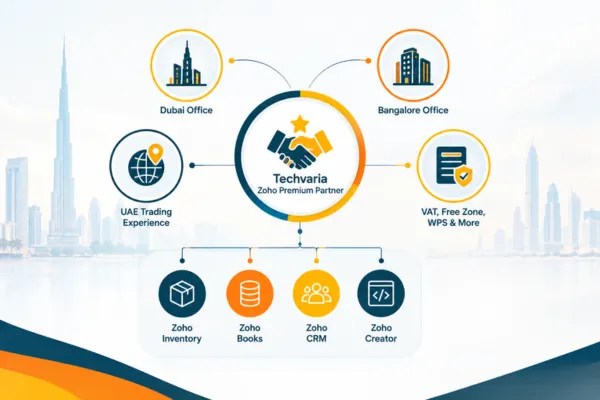
The trading ERP we build for Dubai businesses is assembled from the Zoho applications below, configured and integrated to work as a single operational system rather than separate products.

Zoho Inventory
Zoho Inventory

Purchase orders, goods receipt, warehouse locations, stock transfers, landed cost allocation, and delivery management.

Zoho Books
Zoho Books

Multi-currency accounting, UAE VAT returns, supplier payments, bank reconciliation, and financial reporting.

Zoho Creator
Zoho Creator

Custom process workflows for trading operations that standard modules do not cover, import shipment tracking, kitting, customs documentation & entity-specific approval logic.

Zoho CRM
Zoho CRM

Customer and supplier relationship management, sales pipeline, and quotation-to-order handoff into the inventory and billing workflow.

Zoho Analytics
Zoho Analytics

Cross-entity management reporting, landed cost analysis, margin by product line, and supplier performance dashboards.

Zoho Flow
Zoho Flow

Automated triggers between Inventory, Books, CRM, and external logistics or clearing agent systems where API connections handle routine data handoffs.
Who This Is For?

This build is designed for trading companies operating in Dubai and the wider UAE that have moved past the point where a standalone accounting package handles their operations adequately. General trading businesses importing from Asia and selling across the GCC. Commodity distributors managing bulk purchases with freight allocation and fluctuating currency exposure. Import-export businesses with both a mainland trading licence and a free zone presence that need those entities to share stock visibility without creating VAT compliance problems. Wholesale distributors supplying retail chains or project buyers, where pricing tiers, payment terms, and credit limits vary by customer and need to be enforced at the order stage rather than discovered at the invoice stage.

The build is also relevant for trading businesses that have added a light manufacturing or assembly step β€” kitting, repackaging, or minor fabrication β€” where the standard trading ERP cannot hold a bill of materials or a production record alongside the purchase and sales workflow. Zoho Creator extends the Zoho Inventory and Books foundation to cover that layer without moving to a full manufacturing ERP that brings complexity the business does not need.

Businesses operating across multiple GCC markets β€” Saudi Arabia, Qatar, Kuwait, Oman β€” where VAT rules differ by country and the same goods move through different regulatory environments also fall within this scope. The system is designed for that complexity from the start, not retrofitted when the business expands.

Ready to Build the Right ERP for Your Trading Operation?

A discovery session covers your current process end to end β€” purchasing, stock management, customs, sales, and finance β€” and produces a clear picture of what the system needs to do and how it connects. We scope the Zoho applications involved, identify where Creator custom logic fills the gaps that standard modules leave, and give you a realistic timeline and cost before any build commitment. Most Dubai trading ERP projects we scope are in production within eight to fourteen weeks.
Why Choose Techvaria for Your Dubai Trading ERP?

Why Choose Techvaria for Your Dubai Trading ERP?

Techvaria is a Zoho Premium Partner with offices in Dubai and Bangalore, with delivered implementations across UAE trading, distribution, and import-export businesses. Our work in this sector means UAE-specific requirements — VAT on imports, free zone entity separation, WPS-format payroll, Arabic document output, multi-currency bank reconciliation — are handled as standard configuration rather than as late-stage problems.

We integrate Zoho Inventory, Books, CRM, and Creator into a single operational system and stay involved through go-live and the first operating cycle, when the edge cases a scoping session never surfaces tend to appear.

Hear From Our Clients

Industries We Serve

Frequently Asked Questions

Yes. Zoho Books is configured for UAE VAT across standard-rated, zero-rated, exempt, and out-of-scope supply categories, with reverse-charge handling for imports. The VAT return is generated directly from transaction data. For trading companies with both taxable and zero-rated supplies — common in businesses exporting outside the UAE — the configuration requires careful setup to ensure the correct treatment is applied per transaction type, which is part of our standard implementation scope.

Yes, with the right architecture. Zoho Inventory supports multiple warehouses and locations, and stock transfers between entities are handled as inter-company transactions with the correct VAT and customs treatment applied depending on the movement type. The key design decision is whether the two entities operate as separate Zoho organisations or as locations within a single organisation — that choice has implications for reporting and VAT filing and is made during the discovery session.

Landed cost in Zoho Inventory is allocated at the shipment level across the SKUs in that shipment, using value, weight, or volume as the allocation basis. Freight, customs duty, port handling, and clearing agent charges are entered against the shipment and distributed to the inventory cost of each item before they are received into stock. This means the cost of goods figure used in margin reporting reflects the true acquisition cost rather than just the supplier invoice.

Most trading company ERP implementations on the Zoho platform run eight to fourteen weeks from signed scope to go-live. The variables are data migration complexity — primarily the supplier, customer, and opening stock data — and the number of custom Creator workflows required for processes the standard modules do not cover. Businesses with clean data and a well-defined process sit at the simpler end of this range; multi-entity operations with complex customs workflows at the longer end.

In most cases yes, provided the logistics partner has an API or can provide data in a standard format. We have integrated Creator-based import tracking workflows with third-party logistics portals and customs declaration systems via REST APIs and file-based exchange. Where an API does not exist, the workflow captures the relevant data manually through a structured Creator form attached to the purchase order and shipment record.

Tally migration typically covers opening balances, the chart of accounts, supplier and customer master data, and — where the volume is manageable — transaction history for the current financial year. The migration is scoped, cleaned, and validated before import. Tally’s data export formats are well-documented and the migration process is standard for us. The more important work is usually remapping the chart of accounts to a structure that supports the management reporting the business actually needs, which is often an improvement on what Tally was configured for.

Yes. Zoho Books supports bilingual invoice templates with Arabic and English on the same document, right-to-left text rendering, and the document layout required for UAE commercial invoices and delivery notes. This is configured as part of the standard implementation for Dubai trading clients.

Resources

Latest Blogs