

Skip to content

Zoho Creator Portal User Cost Explained

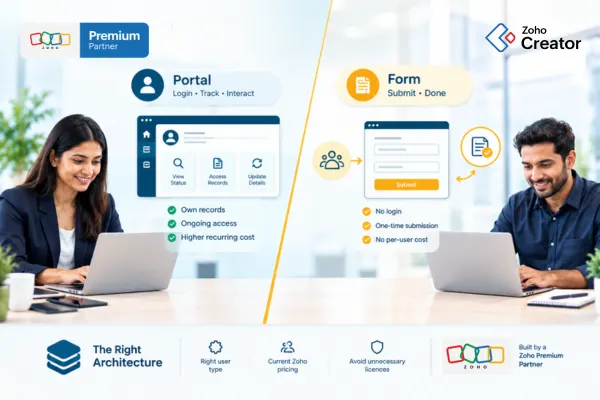
Portal users are the part of Zoho Creator pricing that most often surprises businesses after go-live, because the decision that creates the cost is made during design and its consequence appears in the renewal. The distinction is simple in principle: external parties who need to log in and see their own records require a portal user licence, while those who only need to submit information can use a stateless form and cost nothing. Getting that decision right at design time is one of the more consequential choices in a Creator project.

The Distinction That Decides Your Ongoing Cost

The Distinction That Decides Your Ongoing Cost

Zoho Creator’s licensing separates internal users from external ones, and separates external ones further by what they need to do. An internal user β€” your staff, building or using the application day to day β€” carries a standard Creator licence. An external party is different, and here the choice matters. A portal user has a login, an identity, and scoped access to their own records: they can see history, track status, return to a submission, and interact over time. That capability carries a per-user cost, typically in packs, and it scales with how many external parties you enrol. A stateless form is a public form with no login at all: someone submits information, it creates a record in your application, and that is the end of the interaction from their side. It costs nothing per submitter, however many there are.

The design question is therefore not β€œdo we want external access” but β€œdoes this external party need to see anything back?” A supplier uploading a compliance certificate needs to submit; they do not necessarily need an account. A customer tracking twenty open shipments needs to see; a form will not serve. Where a project enrols five hundred external parties as portal users when four hundred and fifty of them only ever submit, the ongoing cost is several times what it needed to be β€” and correcting that afterwards means reworking how external interaction is handled.

What’s Driving This Decision

Businesses encounter this question at two points. The first is during design, when the requirement includes external parties and the architecture has to accommodate them. Here the decision is cheap and entirely within your control, and it should be made deliberately with the recurring cost visible rather than defaulting to portal users because they are the more capable option. The second is after go-live, usually at renewal, when the portal user count has grown and the recurring figure is larger than the original expectation. At that point the options are narrower β€” reducing the count means changing how those users interact with the application, which is a development change and a change to their experience. Planning this distinction early helps avoid unnecessary portal costs and prevents expensive changes later.

What Determines Zoho Creator Portal User Costs

What Drives the Outcome

The complicating factor is that the right answer is genuinely mixed for most businesses. A distributor might need portal access for fifty trade customers who place repeat orders and track them, while five hundred occasional customers submit enquiries through a public form. A contractor might give portal logins to twenty regular subcontractors and use stateless forms for one-off suppliers submitting documents. Designing for that mix β€” rather than treating all external parties as one category β€” is what keeps the cost proportionate to the value each group actually receives. It also affects the data model, because a portal user’s records must be scoped to them, while a stateless submission needs a different mechanism to associate the record with the right party.

Whether External Party Needs to See Records Back

The core test. Submit-only interactions β€” document upload, request submission, feedback, application forms β€” are served by stateless forms at no per-user cost. Interactions requiring visibility of status, history, or prior submissions require a portal user.

Number of External Parties and Their Frequency

A small number of frequently interacting partners justifies portal licences easily. A large number of occasional submitters usually does not, and enrolling them is where costs escalate without corresponding value.

Whether Interactions Are Repeated or One-Off

A party returning weekly benefits from an account, saved context, and history. A party interacting once or twice a year gets little from a login and adds a recurring cost that continues whether they use it or not.

Data Scoping and Security Requirements

Where an external party must see only their own records, portal users provide identity-based scoping natively. A stateless form has no identity, so any return of information requires a different mechanism β€” a secure link or a token-based view.

Creator Plan Tier

Portal user availability and pricing vary by Creator plan tier, and the tier also affects automation limits and other capabilities. The plan decision and the portal decision interact and are best made together rather than sequentially.

Alternative Delivery Channels

Some interactions that seem to need a portal may work better through WhatsApp links, email status updates, or scheduled reports β€” avoiding the licence and often improving the experience for infrequent users.

Growth in External Party Count

Portal cost scales with enrolment, so a design that works at fifty external users may not at five hundred. Modelling the count at expected scale rather than at launch is what prevents the renewal surprise.

Retrofit Cost If the Decision Changes

Moving from portal users to stateless forms after launch means reworking the interaction and changing what those users can do. This is a real project, which is why the decision belongs at design time when it costs nothing to make.

Zoho Applications We Use for This

Creator is where the portal and stateless-form decision is made. The applications below either shape that decision or offer a channel that avoids it.

Zoho Creator
Zoho Creator

Portals, portal user management, stateless forms, and the data scoping that determines which is appropriate
Zoho CRM
Zoho CRM

Where external parties are also customers with CRM records, and the portal must reflect that relationship

Zoho Desk
Zoho Desk

An alternative channel for customer-facing interaction where the requirement is support rather than transactional data access

zoho books
Zoho Books

Its own customer portal for invoice and statement visibility, which sometimes removes the need for that capability in Creator

Zoho Flow
Zoho Flow

Notification-based alternatives to portal access, pushing status updates rather than requiring users to log in and retrieve them
Where This Applies?

This applies to any Creator application involving parties outside your organisation, which covers a large share of operational builds. Supplier and vendor interaction β€” compliance documents, purchase order acknowledgement, invoice submission. Customer-facing interaction β€” order tracking, service requests, document access, feedback. Contractor and subcontractor management β€” job assignment, completion confirmation, certification upload. Applicant and enrolment processes β€” job applications, membership, registration. Field and partner networks β€” dealers, agents, and franchisees submitting or retrieving information.

It applies with particular relevance where the external population is large or growing. A design that enrols every counterparty as a portal user is workable at small scale and becomes a significant recurring line item as the business grows, at exactly the point when the cost is hardest to unwind.

It also applies to businesses already running a Creator application who are reviewing their renewal. Where the portal user count has grown and a proportion of those users only ever submit information, restructuring the interaction is a defined project with a measurable return, and it is worth assessing rather than accepting the trajectory.

Ready to Get the Licensing Right?

A licensing review examines how external parties interact with your application β€” or how they will, if it is still in design β€” and identifies which genuinely need portal access and which are better served by a stateless form or a notification channel. The output is a recommended structure with the recurring cost implication stated for each option, so the decision is made on visible numbers rather than on capability alone.
Why Choose Techvaria for Creator Architecture?

Why Choose Techvaria for Creator Architecture?

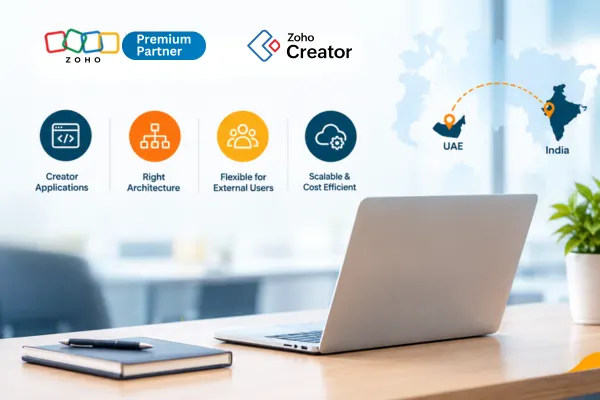
Techvaria is a Zoho Premium Partner delivering Creator applications across India and the UAE. We raise the portal versus stateless decision during design, with the recurring cost stated, because it is one of the few architectural choices that continues to cost money every year and is expensive to reverse. We design for a mixed external population rather than treating all outside parties the same, and we confirm current Zoho pricing and plan-tier capabilities at scoping rather than quoting figures that may have changed. This helps businesses choose the right interaction model for each user group, avoid unnecessary portal licences, and build an application that remains practical as external usage grows. Where requirements change, we can also reassess the architecture and identify lower-cost alternatives where appropriate.

Hear From Our Clients

Industries We Serve

Frequently Asked Questions

An external user with a login and an identity in your application, who can access records scoped to them β€” their own submissions, orders, jobs, or documents β€” and return over time to see status and history. Because they are an identified user with persistent access, they carry a licence cost, usually purchased in packs. Zoho publishes current rates and they change periodically, so we confirm them at scoping rather than quoting here.

A stateless form is a publicly accessible form with no login. Someone completes it, a record is created in your application, and the interaction ends there from their side. There is no per-user cost regardless of how many people submit. Use it wherever the external party only needs to give you information β€” document upload, request submission, application, feedback β€” and does not need to see anything back.

Not by identity, since there is no login. A confirmation screen or an emailed acknowledgement can be sent after submission, and a secure link can provide a view of a specific record without an account. What a stateless form cannot do is give someone a place to log in and see all their records β€” that requires portal access.

Pricing is per user, typically sold in packs, and varies by Creator plan tier. Because Zoho adjusts pricing periodically and it varies by region, we confirm current figures during scoping rather than publishing them. The more useful planning input is the count: model how many external parties will genuinely need portal access at expected scale, since that number rather than the unit rate determines whether the cost is proportionate.

Usually yes, by identifying which users only ever submit and moving that interaction to a stateless form or a notification channel. This is a development change and it changes what those users can do, so it needs to be communicated to them. Where a significant proportion of your portal users are submit-only, the restructuring typically pays for itself well within a year.

No. Internal staff using the application carry standard Creator user licences, not portal licences. Portal users are specifically external parties. Where a contractor or long-term external resource sits ambiguously between the two, the appropriate licence depends on what access they need rather than on their employment status, and it is worth clarifying during design.

Sometimes, and it is worth considering. Push-based channels β€” a WhatsApp message with status, an emailed report, a secure one-time link to a specific record β€” deliver information without requiring the recipient to log in and retrieve it. For infrequent external parties this is often both cheaper and a better experience than an account they will forget the credentials for.

During design, before the application is built. It affects the data model, how records are associated with external parties, and how the interaction is structured. Making it deliberately at that point costs nothing; changing it afterwards is a project. It is one of the questions we raise in the first design session on any application involving external users.

Resources

Latest Blogs