
Low-Code App Development for Manufacturing SMEs
Manufacturing SMEs are told they have two options: an ERP that costs more than the problem, or continuing on spreadsheets. Low-code is the third, and it is the one that actually matches the budget and the timeline of a plant running thirty to two hundred people. A single process β job cards, stores issue, quality records, maintenance β becomes a working application in weeks, at a cost that does not need board approval, and changes as the process changes without a development cycle each time.
Home / Low-Code App Development for Manufacturing SMEs
Why Low-Code Fits the Manufacturing SME Specifically?
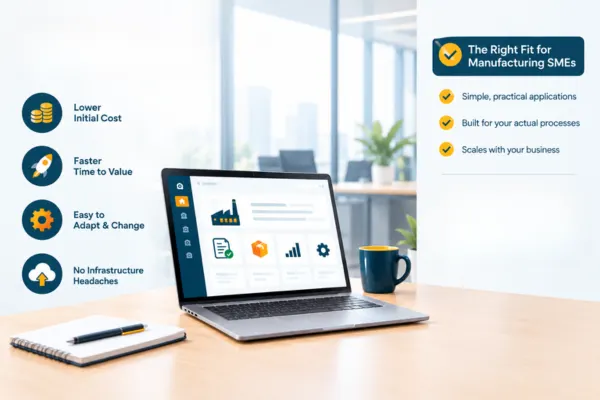
The economics of manufacturing software have historically excluded the SME. An ERP implementation is priced and scoped for a business that can absorb a six-figure programme and a year of disruption, and the production modules inside it assume a process model that a plant of forty people rarely matches. Bespoke development was the alternative, and it carried a developer dependency most SMEs could not sustain past the first year. Low-code changes the arithmetic because the infrastructure, authentication, permissions, mobile publishing, and hosting come with the platform β so development effort goes into the specific thing your plant does, and nothing else.
For a manufacturing SME this matters in three practical ways. A first application costs a fraction of an ERP phase, which means the decision sits with the managing director rather than a board. It reaches the floor in weeks, so the improvement is visible inside a quarter. And it changes quickly, which matters more in manufacturing than most sectors, because process improvements are continuous and a system that cannot keep up gets abandoned. The constraint worth naming is that low-code will not give you capacity planning, finite scheduling, or work centre loading. If those are genuinely what you need, an MRP product is the right answer and we will say so.
Business Challenges We Solve
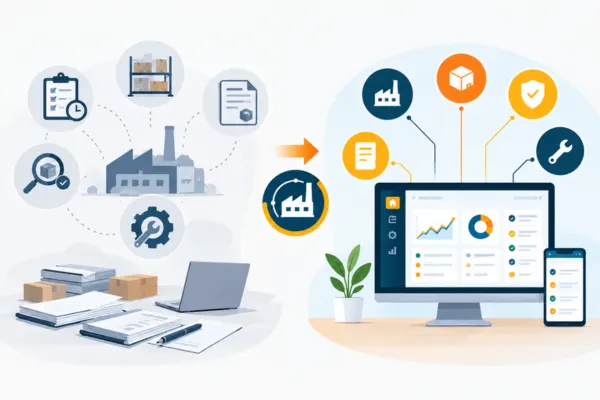
The manufacturing SME position is recognisable. The business has grown past what the office can coordinate informally, but not to the point where a systems budget exists. Production status lives with the supervisor. Material issue is on slips. Quality records are in a register. Maintenance happens when something stops. Every one of these is costing money, and none of them individually justifies the price of an ERP β so nothing gets done, and the spreadsheets grow.
The result is usually not one dramatic operational failure, but a collection of small inefficiencies that become harder to manage as volumes increase. Managers spend time chasing updates, staff re-enter information between systems, and decisions are made using data that is already out of date. A practical Zoho-based system can address these gaps incrementally, connecting the processes that need visibility without forcing the business into an unnecessarily large implementation.
How We Solve This?
The low-code answer is deliberately narrow: pick the single process costing the most, build it properly, and let the return fund the next one. A job card application that gives real work-in-progress visibility and actual job cost typically pays for itself through quoting accuracy alone. A stores issue application that records consumption against jobs surfaces material variance that most SMEs have never measured. A maintenance application that schedules by running hours converts unplanned downtime into planned downtime. Each is a contained project with a measurable outcome, built on a platform that integrates back to Tally or Zoho Books so the accounts stay where your team already works. What makes this viable for an SME rather than just cheaper is the phasing: you are never committing to more than one process at a time, and you can stop after any of them.
A Single First Process, Built Properly
One process β whichever is costing most β scoped, built, and live before anything else starts. Contained cost, contained risk, and a measurable result you can judge the next phase against.
Mobile and Offline Capture on the Floor
Native Android apps from the same build, working offline, with barcode scanning and minimal typing so data is captured at the machine, not at shift end.
Configuration Over Code Where Possible
Forms, workflows, permissions, and reports configured rather than coded, with Deluge reserved for logic that genuinely needs it β keeping build and change costs down.
Fast Iteration After Go-Live
Field additions, workflow changes, and new reports delivered in days rather than development cycles, so the application keeps pace with process improvement instead of freezing it.
Integration With Tally or Zoho Books
Operational transactions posting to your existing accounting system as correctly structured vouchers, so the plant gets its system without the finance team changing theirs.
Phase Two Scoped From Real Usage
The next process scoped after the first is in use, informed by what the floor actually did with it β which consistently produces a better second phase than planning both upfront.
Managed Infrastructure and No IT Burden
Hosting, security patching, backups, and platform maintenance handled by the vendor, so an SME without an IT function can run the system without acquiring one.
Documentation and Internal Ownership
The build documented and handed over so your team can make routine changes themselves, with us retained only for the work that needs a developer.
Zoho Applications We Use for This
Most first builds use one or two of these; the rest arrive as later phases need them.
Zoho Creator
The low-code platform for manufacturing applications, with mobile publishing and offline capture.

Zoho Books
GST-compliant accounting where the SME is moving off Tally or has no accounting platform

Zoho Inventory
Item master, purchasing, and stores where stock control is part of the first or second phase

Zoho CRM
Customer orders feeding the production plan, for SMEs where sales and production coordination is the presenting problem
Zoho Analytics
Added once two or more processes are live and cross-process reporting becomes useful

Zoho Flow
Straightforward connections to Tally, weighing equipment, or third-party platforms where an API exists

Who This Is For?
This applies to Indian manufacturing SMEs of roughly thirty to two hundred people, with a single plant or two, no internal IT function, and a real operational problem that spreadsheets are no longer containing. Fabrication and machining shops. Small plastics and rubber processors. Electrical and electronic assembly units. Food and spice processors. Textile and garment units with job work. Packaging converters. What these have in common is not sector but scale: enough complexity to need a system, not enough budget or tolerance for an ERP programme.
It applies particularly to businesses where the managing director is also the person who would sign off the project and feel the cost. A contained first phase with a visible outcome is a decision that can be made in a week; an ERP evaluation is a decision that gets deferred for a year.
It also applies to SMEs supplying larger customers who have begun asking for traceability, delivery confirmation, or quality documentation as a condition of continued business. That requirement arrives with a deadline attached, and a low-code build is frequently the only route that meets it in the time available.
Ready to Start With One Process?
Why Choose Techvaria for Manufacturing Low-Code?
Techvaria is a Zoho Premium Partner and Odoo Silver Partner with teams in Bangalore and Gujarat working with Indian manufacturing SMEs. We scope one process at a time deliberately, because an SME cannot carry programme risk and should not be asked to. We design capture for the floor rather than the office, integrate with Tally so the accounts team is undisturbed, and document the build so you are not dependent on us for routine changes. Where the requirement genuinely needs MRP depth, we will tell you and build it on Odoo instead. This approach keeps the implementation practical, focused, and aligned with the way the business already operates, while creating a clear path to expand the system as requirements and operational needs grow.
Hear From Our Clients
Industries We Serve
Frequently Asked Questions
For job cards, stores issue, quality records, maintenance scheduling, dispatch, and production status, yes β these are structured data, workflow, and reporting problems, which is precisely what low-code handles well. What it does not provide is capacity planning, finite scheduling, and work centre loading. If those are your actual requirement, MRP is the right category and we would say so rather than stretching the platform.
Scale and sequence. An ERP replaces your systems estate in a programme; this builds one process at a time and integrates with what you already run. For an SME the difference is that the decision is affordable, the outcome is visible inside a quarter, and you can stop after any phase without having committed to the rest.
Yes, and most of our manufacturing SME clients do. The operational application posts vouchers to Tally through its XML interface so there is no duplicate entry. Replacing Tally is the largest and riskiest part of most system projects and it is rarely necessary to solve a production problem.
Considerably less than an ERP phase, and we quote against a scoped process rather than from a brief. The drivers are how many forms and roles are involved, whether integration to Tally or an ERP is in the first phase, and what shop floor hardware is needed. A single well-defined process is a small, bounded project.
Four to eight weeks for a first process in most cases, with a working prototype in front of supervisors inside the first two weeks. The variable is usually not development β it is how clearly the process is defined and how available your supervisors are to validate the prototype.
Yes. The platform handles hosting, security, backups, and maintenance, so there is no infrastructure to operate. We document the build and hand over so your team can make routine changes β adding a field, adjusting a report β and we are retained only for work that needs a developer.
That depends on how capture is designed. Large touch targets, barcode scanning, minimal typing, offline operation, and testing with real operators before rollout are what determine adoption. An application that demands attention the environment does not permit produces no usable data regardless of how well it was built.
You decide. Most clients scope a second process once the first has been in use for a month or two, informed by what actually happened on the floor. Some stop after one because it solved the problem. Both are legitimate outcomes and the phasing is designed so either is available.