
Zoho Creator Webhooks: A Practical Guide
Webhooks are the difference between an integration that reacts in seconds and one that polls every fifteen minutes and is usually wrong in between. Zoho Creator handles them in both directions β sending an outbound call when a record changes, and receiving inbound calls from systems that need to push data in. Both are straightforward to set up and easy to build badly. This guide covers what actually matters: verification, retries, idempotency, and the failure modes that make webhook integrations unreliable.
Home / Zoho Creator Webhooks: A Practical Guide
Why Webhooks Fail Quietly and Polling Does Not?
A polling integration that breaks is usually noticed, because the absence of any update is visible. A webhook integration that breaks looks exactly like a period with no activity, which is why webhook failures are typically discovered days or weeks later as missing records. The mechanisms behind that are worth understanding before building one. Delivery is at-least-once, not exactly-once: the sender retries when it does not receive a success response, and a receiver that took an action and then failed to respond in time will receive the same event again β so any handler without idempotency will process the same event twice. Ordering is not guaranteed, so two rapid changes to the same record can arrive out of sequence and a handler that assumes order will write the older state last.
Receivers must respond quickly, because a sender treats a slow response as a failure and retries, which means doing the real work synchronously inside the handler is what causes duplicate processing under load. And an unverified endpoint is an open door: anything that can reach the URL can send it a payload, so without signature verification or a shared secret, a webhook handler will happily act on a forged event. None of these are exotic. They are the normal operating conditions of webhooks, and a handler written without them works fine in testing and degrades in production.
Business Challenges We Solve
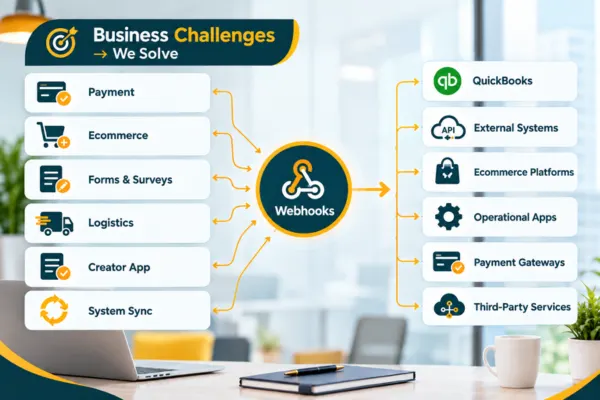
The requirements that lead to webhooks are recognisable. A payment gateway needs to confirm a transaction so a record can be marked paid and an order released. An ecommerce platform needs to push orders into an operational application the moment they are placed. A form or survey tool needs to create a record on submission. A logistics provider needs to notify a status change so a customer notification can go out. A Creator application needs to tell an external system that an approval completed, a job closed, or a document was issued. Or two systems need to stay in agreement without either polling the other. These scenarios benefit from event-driven communication, where changes are sent when they happen rather than discovered through repeated checks. This can reduce unnecessary API calls, improve response times, and keep connected systems more closely synchronised.
Whatβs Included?
The problems that follow are equally recognisable. Duplicate records appear because the sender retried after a timeout and the handler had no idempotency check. A recordβs status regresses because two events arrived out of order. The handler works under normal load and fails during a burst because the real processing runs synchronously and the response times out. Someone discovers that the endpoint accepts anything, including a payload sent by a person who found the URL in a log. And when a sender stops delivering entirely, nobody notices until a reconciliation months later shows a gap. Each of these is addressed by a specific practice rather than by better code generally, which is what this work consists of.
Inbound Endpoint Design and Verification
A Creator endpoint receiving external events, with signature verification against the senderβs secret or an equivalent shared-secret check performed before anything is written.
Idempotency on Every Handler
Each eventβs identifier is recorded and checked before processing, so redelivered events are acknowledged without repeating their effect β an inevitable part of at-least-once delivery.
Fast Acknowledgement With Deferred Processing
The handler validates, records the event, and responds immediately, while actual work runs asynchronously β so slow downstream operations cannot cause timeouts and retries.
Out-of-Order Event Handling
Event timestamps or sequence values compared against the recordβs current state, so a stale event arriving after a newer one does not overwrite the correct data.
Outbound Webhooks From Creator
Creator notifying external systems on record events, with payload design, authentication headers, response validation, and retry logic for transient failures on the receiving side.
Event Logging and Replay
Every received and sent event logged with payload and outcome, so a failure can be diagnosed from evidence and a missed batch can be replayed rather than reconstructed manually.
Failure Alerting and Delivery Monitoring
Alerting on handler failures and, importantly, on the absence of expected events β which is what turns a silent stoppage into something somebody knows about the same day.
Reconciliation Against the Source
A periodic comparison between the two systemsβ record counts and key values, so the webhook integrationβs health is verifiable rather than assumed between incidents.
Zoho Applications We Use for This
Creator sits at both ends of the event flow; the others appear according to which application holds the record the event changes.
Zoho Creator
Inbound webhook endpoints, Deluge handler logic, event logging, and outbound notification on record events

Zoho CRM
Where events must propagate between Creator and CRM, or where an external event should create or update a CRM record

Zoho Books
Payment and invoice events, where idempotency is most consequential because a duplicated financial record has real cost

Zoho Inventory
Order and dispatch events from ecommerce or logistics platforms affecting stock

Zoho Flow
Where a supported connector handles the event routing without custom endpoint code needing to be written and maintained

Zoho Desk
Support events raised from external systems or pushed outward on ticket state changes

Where This Applies?
This applies to any integration where latency matters or where polling would be wasteful. Payment confirmation, where a delay between payment and record update produces customer-facing confusion. Ecommerce order intake, where a fifteen-minute polling gap delays fulfilment. Logistics status updates driving customer notification. Form and survey submission creating operational records. Approval or job completion events propagating to downstream systems. Two-way synchronisation between Creator and a third-party platform where both sides change data.
It applies with particular force where the event has a financial or physical consequence. A duplicated notification is an annoyance; a duplicated payment record, stock movement, or dispatch instruction is a real problem, and those are precisely the integrations where idempotency is most often omitted.
It also applies as a review exercise on existing webhook integrations. Most that we are asked to look at lack at least one of verification, idempotency, and delivery monitoring, and the absence is invisible until the specific circumstance that exposes it occurs.
Need Webhooks Built or Reviewed?
Why Choose Techvaria for Webhook Integration?
Techvaria is a Zoho Premium Partner building and maintaining Creator integrations for businesses in India and the UAE. We build webhook handlers with verification, idempotency, fast acknowledgement, event logging, and absence alerting as standard, because every one of those addresses a failure mode that does not appear in testing. We log events with their payloads so that when something does go wrong there is evidence rather than speculation, and we build reconciliation so the integration can be proven healthy rather than assumed to be. This approach also makes troubleshooting faster when external systems change their behaviour or delivery patterns. We document the integration flow, error handling, and recovery process so your team can understand what is happening and maintain the connection reliably over time.
Hear From Our Clients
Industries We Serve
Frequently Asked Questions
A webhook is a call made to you when something happens, rather than a call you make to ask whether anything has happened. The direction is the difference: polling asks repeatedly and is wrong between checks, while a webhook delivers the event as it occurs. Webhooks are more efficient and far more timely; they are also harder to make reliable, because you do not control the sender.
Yes. A Creator endpoint receives the incoming request and a Deluge handler processes the payload β verifying it, recording the event, and creating or updating records. This is how payment gateways, ecommerce platforms, form tools, and logistics providers push data into a Creator application.
Yes, on record events such as create, update, or a workflow stage transition. Creator makes an outbound call to the receiving system with a payload you define and headers for authentication. The same disciplines apply in this direction: validate the response, retry transient failures, and log the outcome rather than assuming delivery.
Almost always because the handler has no idempotency check and the sender retried. Webhook delivery is at-least-once: if the sender does not receive a success response in time, it sends the event again, even when the first attempt actually succeeded. Recording each eventβs identifier and checking it before processing eliminates this.
Signature verification where the sender supports it β verifying the payload signature against your shared secret before acting on it β or a shared secret in a header where it does not. An endpoint without verification will act on anything sent to it, and the URL is not a secret once it appears in a log or a browser history.
Almost certainly that the real work is happening synchronously inside the handler. The handler should validate, record the event, and respond immediately, with processing done asynchronously. When the response is slow the sender treats it as a failure and retries, which increases load and produces duplicates β the opposite of what the handler needed.
Only by monitoring for absence, which most integrations do not do. Alerting on handler failures catches errors but not silence. A check that expects a minimum event volume in a period, or a periodic reconciliation against the source system, is what turns a silent stoppage into something detected the same day rather than months later.
Flow where a supported connector covers the requirement β it is faster to configure and there is no endpoint code to maintain. Custom webhooks where the sender is not supported, where the payload needs meaningful transformation, or where the handling logic is beyond what Flow expresses. We assess which applies rather than defaulting to custom code.