
Skip to content

Build vs Buy: How to Decide on Custom Software

The build-versus-buy decision is usually framed as a cost comparison and usually decided on the wrong information. Buying looks cheaper because the licence price is visible and the implementation, workaround, and switching costs are not. Building looks riskier because the estimate is a single large number rather than a monthly subscription. Both framings mislead. This page sets out a framework that decides on the factors that actually determine the outcome β€” process differentiation, change frequency, total cost over three years, and where the risk genuinely sits.

The Question That Resolves Most Build-Buy Decisions

The Question That Resolves Most Build-Buy Decisions

There is one question that resolves this faster than any cost model: is this process a source of competitive differentiation, or is it a commodity your business performs the same way everyone else does? Payroll, general accounting, email, and standard CRM are commodity processes β€” thousands of businesses do them identically, packaged products encode good practice, and building your own version means paying to reinvent something already solved. Buy these, and where your process differs from the product, change your process. The opposite case is the process that makes your business work the way it does: the way you quote complex jobs, the way you schedule field crews, the way you grade and price a variable product, the way you manage a supply chain nobody else has. Forcing these into a packaged product means either accepting a worse version of what you do well, or maintaining the difference in spreadsheets outside the system β€” which is what actually happens in most cases.

The related question is change frequency. A process that will look the same in five years can be bought. One that changes every quarter as the business learns is expensive to buy, because every change requires either a vendor roadmap request, a paid customisation, or another workaround. Between them, these two questions decide most cases before any cost modelling is required.

What’s Driving This Decision?

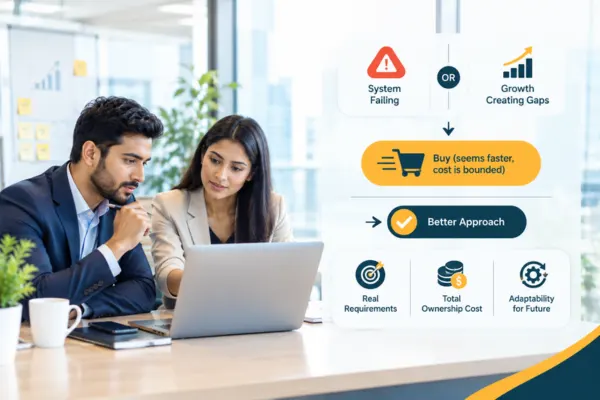
The decision usually arrives under pressure. Either an existing system is failing and something must replace it, or growth has produced a process that nothing currently supports and the gap is costing money every month. In that context the temptation is to move quickly and buy, because buying feels faster and the cost is bounded. Sometimes that is right. But businesses that have already been through one software replacement often recognise the pattern: the new product solved the previous product’s gaps and introduced its own, the workarounds reappeared in different places within a year, and the switching cost β€” migration, retraining, disruption β€” was substantially larger than the licence differential that drove the decision. The better approach is to compare options against actual requirements, total ownership cost, and how well each can adapt as the business changes.

What’s Driving the Build vs Buy Software Decision

What Drives the Outcome?

The factors that should drive it are less immediate but more reliable. How much of your requirement does a packaged product genuinely cover, assessed honestly against a demo rather than a feature list? What does the gap cost, in staff hours on workarounds and in errors and delays? What is the total three-year cost of each path, including implementation, migration, training, ongoing maintenance, and the labour absorbed by workarounds? How likely is the process to change, and what does each path cost when it does? And where does the risk actually sit β€” build risk is usually overestimated when using a managed low-code platform rather than a bespoke stack, while vendor risk in buying, including price increases, roadmap changes, and product discontinuation, is usually underestimated because it is less visible.

Process Differentiation

Whether this process is how you compete or a commodity function. Differentiated processes lose value when standardised into a packaged product; commodity processes gain from the good practice a packaged product encodes.

Genuine Fit Percentage

How much of your actual requirement a product covers, tested against your real scenarios rather than a demo of its strengths. The gap between eighty and ninety-five percent fit is where most disappointment concentrates, because that final gap is where the workarounds live.

Rate of Process Change

A stable process suits buying. A process that changes as the business learns is costly to buy, because each change requires a roadmap request, a paid customisation, or a workaround β€” and cheap to own, because changing your own application is a development task you control.

Total Cost Over Three Years

Licence plus implementation plus migration plus training plus ongoing maintenance plus the labour cost of workarounds, on both paths. This is the only comparison that reflects reality; comparing licence price to build cost systematically favours buying.

Integration Requirements

How well each option connects to the systems you are keeping. A packaged product with no usable API can cost more in manual data movement than the build it appeared to undercut.

Timeline Pressure

Buying is faster to start but not always faster to value, once implementation and process adaptation are counted. A low-code build often reaches a working first phase before a packaged implementation completes, particularly where the packaged product requires configuration by a vendor with a queue.

Internal Capability and Ongoing Ownership

Whether you have or can access the capability to own what gets built. This is a genuine build risk on a bespoke stack and a much smaller one on a managed low-code platform, where infrastructure, security, and platform maintenance sit with the vendor.

Vendor and Lock-In Risk

On the buy side: price increases, roadmap divergence, acquisition, and discontinuation, with your data and process embedded in someone else’s product. On the build side: dependency on the platform or on developers who understand the code. Neither is zero; they differ in who controls the mitigation.

Zoho Applications We Use for This

Where the assessment points to building, or to a hybrid, these are the applications typically involved.

Zoho Creator
Zoho Creator

The build platform for differentiated processes, on managed infrastructure so the ownership burden stays far below a bespoke stack

Zoho CRM
Zoho CRM

Bought as a packaged product for the commodity CRM function, extended where the sales process is genuinely differentiated

zoho books
Zoho Books

Accounting as a bought commodity function, integrated with whatever operational applications are built around it

Zoho Inventory
Zoho Inventory

Standard inventory bought and extended with Creator where the stock model has genuinely unusual requirements

Zoho Analytics
Zoho Analytics

Reporting across bought and built components, so the architecture split does not fragment management information

Zoho Flow
Zoho Flow

Connecting bought products and built applications into a coherent system
Where This Applies?

This applies to any business facing a significant software decision, but it applies with most force to mid-sized B2B operations β€” roughly twenty to three hundred staff β€” where the requirement is too specific for a small-business product and too small to justify enterprise software. Distribution and trading businesses with pricing, credit, and logistics models that differ from the standard. Manufacturers whose production process does not match what generic ERP assumes. Professional services firms whose engagement and billing models are the basis of their commercial approach. Field service and facilities operations where scheduling and job management are the operational core.

It applies particularly to businesses that have already replaced software once and are considering doing so again. That experience is genuinely useful evidence β€” if the second product also fails to fit, the pattern is more likely to reflect a differentiated process than a poor product selection, and the framework above will usually show that clearly.

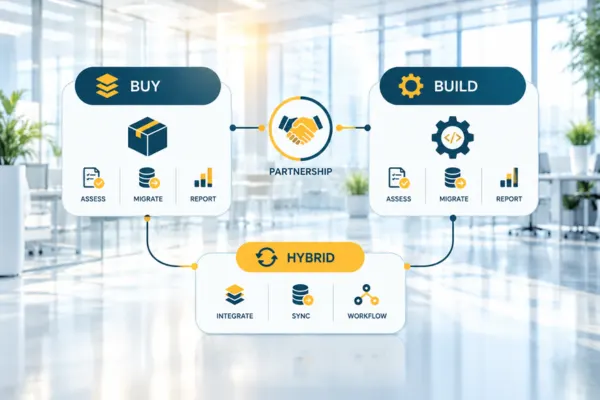
Most usefully, it applies as a hybrid decision rather than a binary one. The answer that fits the majority of businesses we assess is to buy the commodity functions β€” accounting, CRM, payroll β€” and build only the differentiated processes, integrated into them. This costs less than building broadly, fits better than buying broadly, and concentrates the build investment where it produces actual advantage.

Ready to Decide With Better Information?

An assessment works through your specific requirement: which processes are differentiated and which are commodity, what fit percentage available products genuinely offer against your scenarios, what each path costs over three years including the hidden components, and where the risk sits. The output is a documented recommendation with the reasoning shown, so it can be presented internally and challenged on its merits rather than accepted on authority.
Why Choose Techvaria for Build vs Buy Assessment

Why Choose Techvaria for This Assessment?

Techvaria is a Zoho Premium Partner and Odoo Silver Partner, so we implement packaged platforms and we build custom applications. That matters here because a firm that only builds will find a reason to build and a firm that only resells will find a reason to buy. A meaningful proportion of our assessments conclude that a packaged product fits and no build is warranted, and we say so. Where the answer is hybrid β€” which it usually is β€” we can implement both sides of it and take responsibility for the integration between them. We also assess data migration, workflow complexity, user requirements, reporting, and future changes before recommending an approach. This gives businesses a clearer view of the practical effort, ongoing costs, and trade-offs involved in each option.

Hear From Our Clients

Industries We Serve

Frequently Asked Questions

A practical test: if you adopted the way a packaged product does this, would customers notice, would margin change, or would you lose something you compete on? If the honest answer is no, it is a commodity process and you should buy. If the answer is yes β€” your quoting method, your scheduling logic, your grading and pricing approach β€” that is differentiation and standardising it has a real cost. Most businesses have two or three genuinely differentiated processes and a great many commodity ones.

At the point of purchase, usually. Over three years, frequently not β€” once implementation, migration, training, per-user licence growth, paid customisations, and the labour absorbed by workarounds are included. The comparison that misleads is licence price against build cost. The comparison that informs is total cost of ownership on both paths, and we model both explicitly during the assessment.

It is a real risk on a bespoke stack β€” a large, long, custom project with a single delivery point has a genuine failure profile. It is much smaller on a managed low-code platform delivered in phases: infrastructure and security sit with the vendor, a working first phase arrives in weeks rather than at the end, and the direction can be corrected early. Most of the risk premium people attach to building comes from the bespoke-project model rather than from the low-code one.

This is the correct question to ask and the reason we document what we build. On a low-code platform, the application is configuration and business logic rather than a bespoke codebase with framework dependencies, so another qualified developer can pick it up. On a bespoke stack, the dependency is genuinely higher. Where you plan to own the application internally, we run handover explicitly rather than treating documentation as a formality.

Yes, and this is a reasonable sequencing where the requirement is genuinely uncertain. The caution is switching cost: once data, process, and training are embedded in a product, moving away is a real project. Where a product is being bought as a trial of fit, it is worth planning the exit β€” data export, integration boundaries β€” at the start rather than discovering the constraints when you want to leave.

Usually one to two weeks including workshops with the people who run the processes concerned. Longer where several processes are in scope or where genuine product evaluation against your scenarios is included. The output is a documented recommendation with the cost model and reasoning shown, so it can stand up to internal challenge.

Then that is what we recommend, and we will identify which product category fits and what to test during evaluation. Where the product is one we implement β€” Zoho or Odoo β€” we can implement it. Where it is not, the recommendation stands on its own and you take it to the appropriate vendor. The assessment is scoped and priced as standalone work for exactly this reason.

It has one additional consideration β€” the integration between components β€” and that is a manageable, well-understood engineering task when designed deliberately with a defined system of record per field. Set against that, a hybrid avoids both failure modes of the pure approaches: paying to build commodity functions, and running your differentiated process in spreadsheets outside a product that cannot hold it. For most mid-sized businesses it is the correct architecture.

Resources

Latest Blogs