
The Part That Was Right Last Month
A batch comes off the line and fails inspection. The bracket is the wrong thickness. Engineering changed it six weeks ago: there is an email, and the drawing was updated, and the change was correct.
What did not happen is that the bill of materials was updated, or that the change reached the person who issued the works order, or that anyone decided what to do with the four hundred old brackets already in stock. So the shop floor built what the system told it to build, which was the version from before the change, and the inspection caught it only because the thickness difference was visible.
Nobody made a mistake, exactly. The change was correct, the drawing was updated, the email was sent. The failure is that the change existed in three places (a drawing, an email and someone’s memory) and in none of them was it connected to the instruction the shop floor actually followed.
This article covers what product lifecycle management governs, how engineering change orders work as a controlled process rather than as correspondence, how to design an approval route people will actually use, the effectivity decision that determines what happens to existing stock and open orders, and where documents fit. It is written for engineering managers, production heads and operations directors in discrete manufacturing.
The Business Problem: Change Managed by Correspondence
- The authoritative version is ambiguous. The drawing says one thing, the BOM says another, and the person on the line has a printed copy that says a third. Everyone is working from something; nobody is working from the same thing.
- Changes reach the system late or never. Engineering makes a change and tells production. Whether it reaches the bill of materials depends on someone remembering to make that edit, and on them making it correctly.
- There is no record of why. A dimension changed eighteen months ago and nobody can say whether it was a customer requirement, a supplier substitution, a cost reduction or a correction. That matters when a customer asks, when a failure is investigated, or when someone proposes changing it back.
- Approval is informal. A change that affects cost, quality, a customer specification or a regulatory position gets made by whoever is competent to make it, which is reasonable until it is not.
- Existing stock and open orders are an afterthought. The change is made; the four hundred old parts in the rack are a separate conversation that happens later, if at all.
- Documents multiply. Drawings in a folder, a revision in someone’s email, a marked-up print on the shop floor. Each is a plausible authority and none is definitive.
- Traceability fails at the worst moment. A customer asks which revision was in the units shipped in March. The honest answer is a reconstruction rather than a record.
What Uncontrolled Change Costs
- Scrap and rework. The most visible cost, and the easiest to attribute once you look. Parts built to a superseded revision are scrap, rework, or a concession that someone has to authorise.
- Warranty and field failure. Worse than scrap because it reaches the customer. A change that did not propagate becomes a product in service that does not match its specification.
- Inventory written off. Components superseded by a change, with no decision taken about them, discovered later as obsolete stock.
- Audit and certification findings. Any quality system that requires controlled documents and demonstrable change control will find an email-based process immediately. For businesses holding certifications, this is not a theoretical risk.
- Customer confidence. Being unable to answer “which revision did we receive?” is a credibility problem out of proportion to the underlying issue.
- Engineering time spent on archaeology. Reconstructing what changed and why, from emails and drawings, is work that produces nothing and happens repeatedly.
What PLM Actually Governs
PLM in an ERP context (in Odoo, it sits alongside the Manufacturing application) is narrower and more useful than the term suggests. It is not a design tool and it does not replace your CAD system. What it governs is the controlled transition of a product definition from one state to another.
- Versioned bills of materials. The BOM becomes something with revisions rather than something that is edited in place. The current version is unambiguous, and previous versions remain retrievable.
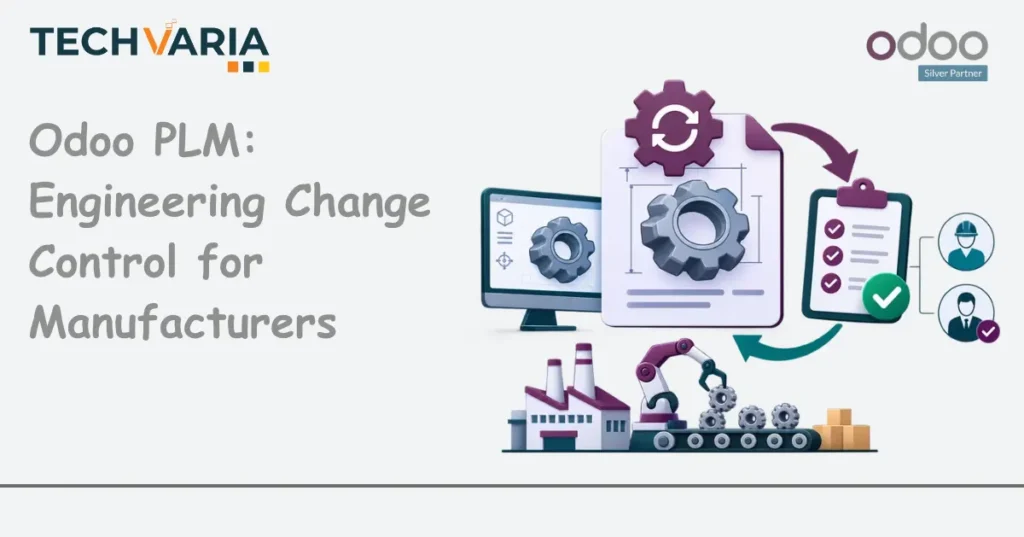
- Engineering change orders. A change is an object (raised, described, justified, reviewed, approved, applied) rather than a message. The object carries its own history.
- Approval routing. Who must agree before a change takes effect, which can and should differ by change type.
- Effectivity. When the change takes effect, and what happens to existing stock, open manufacturing orders and open purchase orders.
- Attached documents. Drawings and specifications associated with the version they belong to rather than with a folder.
- The audit trail. What changed, who approved it, when it took effect, and why, retained rather than reconstructed.
The usual caveat: PLM appears in Odoo’s own edition comparison under supply chain, which means availability depends on your edition. Confirm your position before scoping, since this determines whether the capability is available to you at all.
How Engineering Change Orders Work
The mechanism is a controlled lifecycle, and its value lies in being an object rather than a conversation.
- A change is raised with a stated reason. Cost reduction, quality correction, customer requirement, supplier substitution, obsolescence, regulatory. The category matters because it should drive the approval route.
- The proposed change is made against a new version, not the live one. This is the structural point: the current definition remains intact and in use while the proposed one is prepared. Nothing in production changes until the change is approved and applied.
- The change is reviewed by the people it affects. Engineering for technical correctness, production for manufacturability, purchasing for supply implications, quality for specification and certification impact, finance where cost is material.
- On approval, it is applied, and the new version becomes current. The previous version remains retrievable, which is what makes historical traceability possible.
- The change carries its own record. What was changed, by whom, approved by whom, when, and why. That record is the thing an auditor or a customer actually asks for.
What this changes in practice. The shop floor instruction is generated from the BOM, and the BOM only changes through this route. That closes the gap in the opening example: the change cannot exist in a drawing and an email without reaching the works order, because the works order derives from the thing the change updates.
Designing the Approval Route
This is where change control succeeds or becomes a thing people work around.
Differentiate by Change Type
A typographical correction to a description and a dimensional change affecting a customer specification should not follow the same route. Businesses that apply one heavyweight route to everything find that people stop raising small changes formally, which defeats the purpose.
A workable structure:
- Minor: descriptive or administrative, no form, fit or function impact. Single technical approver.
- Standard: affects cost, supply or manufacture but not customer specification. Engineering plus production plus purchasing.
- Major: affects form, fit, function, customer specification, safety or a regulatory position. Full review including quality, and customer notification where contractually required.
Name Roles, Not People
Approval routes built on individuals break when those individuals change job or go on leave. Build them on roles, with defined deputies.
Set a Response Expectation
An approval step with no time expectation becomes a queue, and a queue is what drives people back to email. If a change type routinely sits for weeks, either the route is wrong or the resourcing is.
Define the Urgent Path Explicitly
Production stoppages happen and a change will sometimes need to move in hours. The answer is a defined expedited route with a named authoriser and a mandatory retrospective review, not an informal exception, which is how control erodes.
Decide Customer Notification as Part of the Route
Where contracts require notification or approval of changes, that obligation belongs inside the change process. Finding out afterwards that a customer should have been told is an expensive way to learn it.
Effectivity: The Decision Everyone Underestimates
Approving a change is the easy part. Deciding when it takes effect, and what happens to everything already in motion, is where the practical work sits, and it is the part most often left undecided.
Four questions have to be answered for every change that affects a physical part:
What Happens to Existing Finished Stock?
Ship it, rework it, scrap it, or ship it under a documented concession. This is a commercial and quality decision, not an engineering one.
What Happens to Component Stock That Is Now Superseded?
Use it up first, return it to the supplier, scrap it, or keep it for service and spares. “Use up existing stock then switch” is extremely common and it needs to be an explicit instruction, because it means both versions are live simultaneously for a period.
What Happens to Open Manufacturing Orders?
Let them complete to the old revision, or stop and rebuild them to the new one. The answer depends on why the change was made: a cost reduction and a safety correction deserve different treatment.
What Happens to Open Purchase Orders?
Amend them, cancel them, or let them arrive and handle the stock question above.
Why this matters more than it appears. A change applied with immediate effect and no stock decision creates the exact problem it was meant to solve: a mismatch between what the system says and what is physically present. The common failure is approving the change on Tuesday and discovering the stock question on Thursday, by which time someone has already made an undocumented decision about it.
The practical control: make the four questions mandatory fields on the change, not an afterthought. A change that cannot be approved until the stock disposition is stated is a change that will not create a stock problem.
Documents, Drawings and the Single Source Question
Change control fails when the authoritative document is ambiguous, and most manufacturers have at least three candidates.
- Decide which system holds the master. Your CAD system holds the model. Your ERP holds the BOM and the manufacturing instruction. These are different things and both are legitimate; what matters is that everyone knows which answers which question.
- Attach documents to the version, not to the product. A drawing associated with a product is ambiguous as soon as there are two revisions. A drawing associated with revision C is not.
- Control what reaches the shop floor. Printed drawings on a shop floor are uncontrolled copies the moment a revision changes. If printed copies are necessary, there must be a defined process for withdrawing superseded ones, and if that process is unrealistic, the honest answer is to display the current revision electronically instead.
- Keep superseded versions retrievable. You will need them for warranty investigation, customer queries and service parts, and the ability to produce them quickly is often the first thing an auditor tests.
Change Control Approaches Compared
| Consideration | Email and drawings | Spreadsheet change log | PLM in the ERP | Dedicated PLM platform |
|---|---|---|---|---|
| Where the current definition lives | Ambiguous | The BOM, updated manually | The versioned BOM, updated through the change | The versioned BOM, with CAD integration |
| How change reaches production | By someone remembering | By someone remembering | Through the change applying to the BOM the works order derives from | Same, plus deeper design integration |
| Approval record | Email thread | A row in a file | On the change object | On the change object |
| Reason for change | Occasionally in the email | Sometimes a column | A required attribute | A required attribute |
| Previous revisions | Folder of files | Not retained | Retained and retrievable | Retained with full design history |
| Stock and open order disposition | Decided ad hoc, later | Decided ad hoc, later | Part of the change decision if designed in | Part of the change decision |
| CAD integration | Manual | Manual | Varies; typically file attachment | Native and deep |
| Best fit | Nothing beyond prototyping | Very small product ranges | Most discrete manufacturers | Complex design-led products, deep CAD dependency |
Best Practices
- Make reason-for-change a required attribute, from a controlled list. It is the single most useful field in the whole process.
- Differentiate approval routes by change type. One heavyweight route for everything guarantees informal workarounds.
- Build routes on roles with named deputies, not on individuals.
- Make stock and open-order disposition mandatory before approval: finished stock, component stock, manufacturing orders, purchase orders.
- Define the expedited path formally, with a named authoriser and a mandatory retrospective review.
- Attach drawings to the version, not the product.
- Decide which system is master for which question, and tell everyone.
- Control or eliminate printed drawings on the shop floor.
- Include customer notification in the route where contracts require it.
- Report change cycle time and the proportion using the expedited path. A rising expedited proportion means the standard route is too slow.
Common Mistakes
- Editing the live BOM directly. Removes the before-state, the approval and the reason in one action.
- One approval route for every change. Minor changes stop being raised formally, and the record becomes incomplete.
- Approving without deciding stock disposition. Creates exactly the system-versus-reality mismatch the process exists to prevent.
- Approval routes built on named individuals. They break at the first holiday.
- Uncontrolled printed drawings. The most common cause of the wrong revision being built, and the hardest to see.
- No reason recorded. Eighteen months later nobody can say why, and the change gets questioned or reversed on a guess.
- Treating PLM as a CAD replacement. It is not one; it governs the transition of the definition, not the design of it.
- No expedited path. Urgent changes bypass the process entirely, and the bypass becomes the norm.
- Assuming availability without checking the edition. PLM sits in Odoo’s supply chain category, where availability differs by edition.
An Illustrative Scenario: A Sheet Metal Fabricator
The following is a composite illustration drawn from patterns common to discrete manufacturers. It is not an account of a specific Techvaria client, and no figures below come from any real engagement.
Consider a sheet metal fabricator producing enclosures and assemblies to customer drawings, with an in-house design function and around two hundred active part numbers.
The Trigger
A customer audit asked for the change history on a part and for evidence of who had approved a dimensional change made the previous year. The change had happened, the part was correct, and the evidence was an email chain and a dated drawing file. The finding was not that anything was wrong; it was that the business could not demonstrate control.
What the Review Found
Three things. Bills of materials were edited directly, so there was no before-state and no approval record. Reason for change was recorded nowhere systematically, so several changes could not be explained a year later. And printed drawings were in use on the shop floor with no withdrawal process, meaning superseded revisions remained physically present and usable.
The quality manager also noted that stock disposition was decided informally after the fact. Twice in the preceding year, superseded components had been discovered in stock months after the change that superseded them.
What Was Implemented
Change types first, defined before any configuration: minor, standard and major, with routes built on roles and defined deputies. Reason for change became a required attribute from a controlled list, which took a short workshop to agree because the categories mattered more than anyone expected.
Changes moved to a versioned model, prepared against a new version with the current one remaining live until approval. Stock and open-order disposition became mandatory before approval could be given, covering finished stock, component stock, manufacturing orders and purchase orders.
An expedited route was defined with a named authoriser and a mandatory review within a week, because the production manager was clear that urgent changes would otherwise go round the process.
Printed drawings were the hardest part. The eventual answer was to display the current revision at each work centre electronically and to remove printed copies entirely, which required a conversation about screens on the shop floor that was not originally in scope.
After Two Quarters
The audit question became answerable from a record rather than a reconstruction. More usefully to the business, the reason-for-change data began to show a pattern: a disproportionate number of changes categorised as supplier substitution, concentrated on a small number of components, which prompted a sourcing review that nobody had thought to run.
The engineering manager’s own assessment was that the mandatory stock disposition field was the change that made the most practical difference, because it moved a decision that had always been made late and informally to a point where it had to be made deliberately.
Industry Use Cases
- Discrete manufacturing and fabrication. The core case: customer drawings, frequent revisions and a shop floor that builds from an instruction. See manufacturing solutions.
- Automotive and component supply. Change control is usually a contractual requirement rather than a preference, with customer notification obligations attached. See automobile and EV solutions.
- Electronics and assembly. Component obsolescence drives a high rate of supplier-substitution changes, which makes reason categorisation particularly valuable. See IT services and ERP.
- Medical devices and healthcare products. The most demanding environment for demonstrable change control, where the record is a regulatory artefact rather than a convenience. See healthcare solutions.
- Construction products and building systems. Specification changes driven by project requirements, where effectivity decisions interact with committed project orders. See construction.

Mustufa Rahi is an Odoo Certified Functional Consultant and ERP expert at Techvaria with 15+ years of experience in implementation, automation, and business process optimization, helping organizations scale efficiently.

