
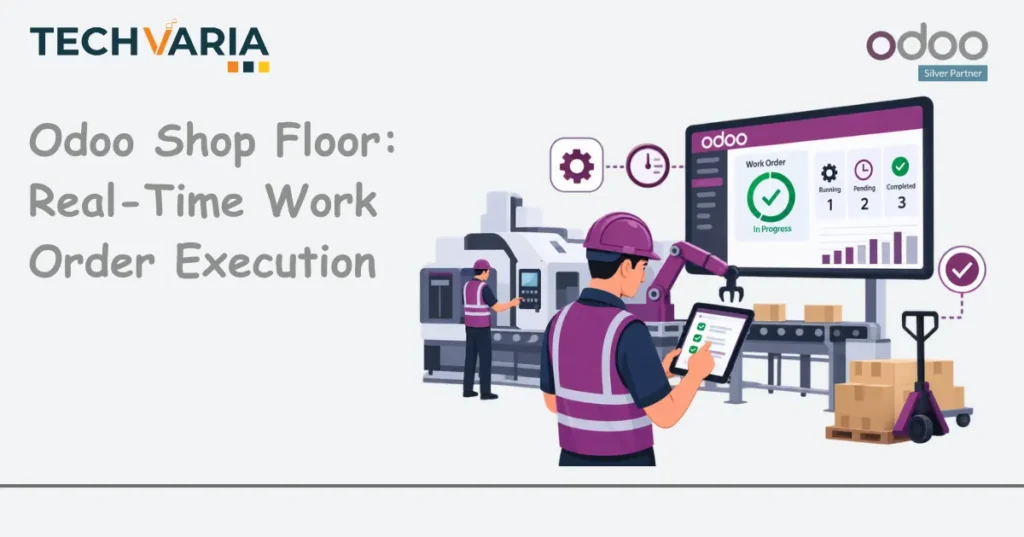
The Figure Nobody Has Until Six O’Clock
Ask a production manager at two in the afternoon how many units are part-finished on the line and where they are, and in most plants the honest answer is an estimate.
The information exists. It is written on paper travellers moving with the work, in a supervisor’s head, and on a whiteboard that was accurate this morning. What it is not is available: not as a number anyone can look at, and not in time to do anything with.
So decisions that depend on it get made on estimates. Whether to accept a rush order. Whether a job will make its promise date. Whether to move an operator to a different cell. Each is a reasonable decision made from a guess, and the guess is usually close enough that nobody questions the process.
Then a batch fails inspection and the question becomes how many units were affected and when the problem started. At that point the gap between what the plant knows and what the plant can prove becomes expensive.
This article covers what changes when execution is captured where it happens, the four things to fix before putting any device on a line, how to design an operator interaction people will actually use, capturing quality and scrap at source, and the reporting that becomes possible afterwards. It is written for plant managers, production heads and manufacturing engineers.
The Business Problem: Execution That Reports Itself Afterwards
- Work in progress is invisible between reporting points. The system knows a manufacturing order was released and will know when it is completed. Between those two events, the work exists on paper.
- Completion is reported in batches, late. A supervisor enters the day’s output at the end of the shift, often from paper, often partly from memory. The data is retrospective and its accuracy depends on transcription.
- Operation times are estimates rather than measurements. Routing times were set at implementation from standards or from someone’s judgement, and have never been compared to what actually happens.
- Scrap and rework are recorded loosely. Scrapped parts are noted on the traveller if the operator remembers, and the reason is usually a word. Analysis of why things fail is therefore impossible.
- Downtime is not captured at all. A machine stops, someone fixes it, work resumes. Unless it was dramatic, nothing records that it happened or for how long.
- Material consumption is assumed from the BOM. What was actually used is assumed to be what should have been used, which means genuine variances are invisible until a stock count finds them.
- The data arrives too late to act on. The core problem. Information about this morning, available tomorrow, is a record rather than a control.
What Delayed Visibility Costs
- Promise dates made on estimates. Sales commits to a date based on a view of capacity and progress that is hours or days old. Some of those commitments are wrong, and the plant absorbs the consequence.
- Problems found at inspection rather than at the operation. A process drifting out of specification continues until a downstream check catches it. Everything built in between is scrap, rework or a concession.
- Standards that nobody trusts. Routing times that have never been validated produce costing and capacity planning that the plant quietly works around, which undermines both.
- Expediting as a routine activity. When progress is invisible, the way to find out whether a job will make its date is to ask someone to go and look. In many plants this is a daily activity consuming supervisory time.
- Improvement based on opinion. Without measured downtime, scrap reasons and operation times, process improvement is driven by whoever argues most persuasively rather than by where the losses actually are.
- Traceability gaps. Where a customer or a regulator asks what happened to a particular batch, a paper trail is a reconstruction rather than a record.
What Shop Floor Execution Changes
The change is narrow and structural: the operator interacts with the system at the point of work, so the system knows what is happening while it is happening.
- Work orders are presented at the work centre. The operator sees what to do next, in sequence, with the instructions and documents attached to the current revision.
- Start, pause and completion are recorded as events. This produces actual operation times as a by-product, without anyone filling in a timesheet.
- Quantities are confirmed at the operation. Good quantity, scrap quantity, and the reason for scrap, entered by the person who saw it happen.
- Material consumption is recorded rather than assumed. Where components are consumed at an operation, recording it there makes variance visible immediately rather than at the next count.
- Work in progress becomes a live figure. The question at two in the afternoon has an answer.
- Documents reach the operator at the current revision. Which, as covered in the companion article on engineering change, is the other half of the wrong-revision problem.
The usual caveat: manufacturing capability and the specific execution interface vary by Odoo version and edition. Confirm what is available in your own instance before scoping, rather than assuming any particular behaviour.
The Four Things to Fix Before You Buy a Tablet
This is the section that saves projects. Putting devices on a line that is not ready produces a fast version of bad data.
Routings Must Reflect How Work Is Actually Done
If the routing says three operations and the line runs five, the operator is being asked to report against a fiction. They will either report inaccurately or stop reporting. Walk the process and correct the routings first; this is usually the largest piece of preparatory work and the one most often underestimated.
Work Centres Must Match Physical Reality
A work centre that represents a department rather than a station cannot tell you where anything is. Granularity is a design decision: too coarse and the data is useless, too fine and the operator spends their time reporting. The right level is usually the point at which work physically queues.
Bills of Materials Must Be Accurate at the Operation Level
If components are consumed at specific operations, the BOM needs to say so. Otherwise material reporting is meaningless and the operator is asked to confirm consumption that does not match what they are doing.
Scrap Reasons Must Be a Defined, Short List
Agreed with quality and production together, before go-live. A free-text field produces data nobody can analyse; a list of thirty reasons produces data nobody will enter accurately. Between eight and fifteen, each meaningful to the person selecting it, is the practical range.
A fifth, which is not configuration: decide what the data will be used for before you collect it. Operators notice immediately whether the information they enter is ever discussed. Data collected and never used is data that degrades within a month, and the degradation is rational rather than obstructive.
Designing the Operator Interaction
The quality of the data depends almost entirely on this, and it is usually designed by people who will never use it.
- Minimise the number of interactions per job. Every tap is time not spent working, and operators are correct to resent interactions that produce nothing. Start, complete, quantity, scrap with reason. That is close to the practical minimum and it is usually enough.
- Make the device reachable without leaving the station. A shared terminal at the end of an aisle means batched entry at shift end, which is the paper problem with extra steps.
- Design for gloves, noise and poor light. Interfaces designed at a desk fail on a shop floor for entirely physical reasons. Large targets, high contrast, minimal typing.
- Default aggressively. The expected quantity, the current operation, the logged-in operator. The interaction should be confirmation rather than data entry wherever possible.
- Make scrap reporting as easy as good-quantity reporting. If scrap is harder to record than good output, scrap gets under-reported, and scrap data is the most valuable thing you will collect.
- Decide how to handle interruptions. Breaks, shift changes, machine stoppages, waiting for material. If there is no sensible way to record “stopped and why”, the time gets absorbed into the operation and your measured times become meaningless. This is the detail most often missed.
- Involve operators in the design, and pilot on one cell. Not as consultation theatre: they will tell you within an hour which interactions are unworkable, and that hour is cheaper than discovering it across the plant.
Capturing Quality and Scrap at the Point They Happen
Scrap recorded at the end of a shift is a number. Scrap recorded at the operation, with a reason, is a diagnosis.
- Record it where it happens, by the person who saw it. A supervisor aggregating scrap at shift end cannot know which operation produced it or why, and the reason degrades to whatever is plausible.
- Keep the reason list short and meaningful. Each reason should correspond to something a person could act on. “Operator error” is not such a reason; “wrong tool fitted” and “material out of specification” are.
- Separate scrap from rework. They have different costs and different responses, and conflating them hides the difference between a process that fails and a process that needs a second pass.
- Capture in-process checks at the operation they belong to. Where a check is required between operations, recording its result where it happens is what makes the drift visible before the downstream inspection catches it.
- Report scrap by reason and operation weekly. This is the output that justifies the data collection, and it needs to be visible to the people who entered it. A Pareto of scrap reasons is usually the most actionable single report a plant can produce, and it is impossible without capture at source.
The Numbers You Can Report Once Execution Is Captured
- Actual versus planned operation times, by operation and work centre. The basis for correcting routings, and therefore for costing and capacity planning that people trust.
- Work in progress by location, live. The two o’clock question, answerable.
- Scrap and rework by reason, operation and period. The improvement agenda, ranked.
- Downtime by reason and work centre. Only available if interruptions are capturable, which is why that design detail matters.
- Throughput by work centre and shift. Where the real constraint is, as opposed to where everyone assumes it is.
- On-time completion against the promised date, with the cause of lateness attributable to an operation rather than to the job as a whole.
- Material variance at the operation. Actual consumption against the BOM, visible immediately rather than at a count.
A caution worth stating. More measurement is not automatically better. Pick the four or five numbers that will change a decision, report them consistently, and discuss them where operators can see that they are being used. A dashboard with twenty metrics that nobody acts on produces exactly the same data degradation as no dashboard at all.
Execution Approaches Compared
| Consideration | Paper travellers | Shift-end batch entry | Shop floor execution at the work centre | Full MES with machine integration |
|---|---|---|---|---|
| When the system learns | At completion | At shift end | As it happens | As it happens, including machine signals |
| Operation times | Estimated | Estimated | Measured as a by-product | Measured, including machine cycle |
| Work in progress visibility | None between reporting points | Daily | Live | Live |
| Scrap reason quality | Whatever is written | Aggregated and degraded | Captured at source by the person who saw it | Captured at source, sometimes automatically |
| Downtime capture | None | None | Possible if designed in | Automatic from machine state |
| Document revision control | Uncontrolled printed copies | Uncontrolled printed copies | Current revision presented at the station | Current revision presented |
| Implementation effort | None | Low | Moderate, mostly in routings and work centres | High, including machine connectivity |
| Best fit | Nothing, beyond job shops with very low volume | Small plants with stable, simple flows | Most discrete manufacturers | High-volume, automated or heavily regulated production |
Best Practices
- Correct routings and work centres before anything else. Reporting against a fiction produces fiction, faster.
- Set work centre granularity at the point where work physically queues.
- Agree a short scrap reason list with quality and production together, before go-live.
- Keep the operator interaction to four actions or fewer per job.
- Put the device within reach of the station, or accept batched entry.
- Make scrap as easy to record as good output.
- Design interruption and downtime capture explicitly, or your measured times will quietly include waiting.
- Pilot on one cell with its operators before extending to the plant.
- Decide the four or five numbers you will act on, and report them where operators can see them.
- Review routings against measured times after a quarter, and correct the standards rather than ignoring the variance.
Common Mistakes
- Deploying devices before fixing routings. The most common and most expensive sequencing error in this area.
- Work centres that represent departments. The data cannot answer where anything is.
- Free-text scrap reasons. Unanalysable, and therefore collected for nothing.
- Too many interactions per job. Operators optimise for getting work done, and will batch or skip reporting that costs them time.
- Shared terminals away from the station. Reintroduces the delay the project was meant to remove.
- No way to record an interruption. Waiting time disappears into operation times and the measurement becomes useless.
- Collecting data nobody discusses. Degrades within weeks, and rationally so.
- Excluding operators from the design. They know within an hour what will not work; finding out later costs the project.
- Measuring twenty things. Pick the few that change a decision.
- Leaving printed drawings in place. Execution capture does not fix the wrong-revision problem on its own.
An Illustrative Scenario: A Components Manufacturer
The following is a composite illustration drawn from patterns common to discrete manufacturing. It is not an account of a specific Techvaria client, and no figures below come from any real engagement.
Consider a components manufacturer running two production cells and a finishing area, making to order with batch sizes from tens to a few hundred.
The Trigger
A recurring argument about capacity. Sales believed the plant had room for more work; the plant said it did not. Neither could evidence their position, because the only data available was completed output and a set of routing times that had been set at implementation and never validated.
What Walking the Process Found
The routings described three operations where the cells actually ran five, because two steps had been added over the years and never reflected in the system. Work centres were defined at cell level, so the system could not distinguish between work queued at the first station and work waiting at the last. The bill of materials did not specify which operation consumed which components. And scrap was recorded as a single figure per job, with the reason written on the traveller if at all.
In other words, every one of the four prerequisites needed work before any device could usefully be deployed.
What Was Implemented
Routings corrected first, by walking each cell with the supervisors. This took longer than the rest of the project and produced the most immediate value, because the corrected routings alone changed the capacity picture.
Work centres were redefined at the point where work physically queued, which produced more work centres than the original design and gave the plant a location for every piece of work in progress. Components were assigned to the operations that consume them. A scrap reason list of eleven entries was agreed in a workshop between quality and production, with the production manager insisting that every reason be something an operator could point at.
The interaction was designed with two operators in the room and piloted on one cell for three weeks. The original design had six interactions per job; the piloted version had four, having removed a confirmation step and defaulted the expected quantity.
Interruption capture was added after the pilot, because the measured operation times in the first fortnight were obviously including waiting time and nobody could tell how much.
After Two Quarters
The capacity argument resolved itself, though not as either side had expected: measured times showed that one operation in the finishing area was taking considerably longer than its standard, and that the constraint was there rather than in either cell.
The scrap-by-reason report became the weekly improvement agenda. Its first finding was that a substantial share of scrap concentrated on one reason at one operation, which turned out to have a fixture cause that had been intermittently known about for a long time and never quantified.
The production manager’s own view was that the device was the least important part of the project, and that correcting the routings would have been worth doing even if nothing else had followed.
Industry Use Cases
- Discrete manufacturing and fabrication. The core case: defined operations, batch work, and a shop floor that currently runs on paper. See manufacturing solutions.
- Automotive components. Traceability obligations make execution capture a requirement rather than an improvement, with batch-level records expected by customers. See automobile and EV solutions.
- Electronics assembly. High operation counts and small components, where operation-level material consumption matters more than in heavier manufacturing. See IT services and ERP.
- Medical devices and healthcare products. The most demanding traceability environment, where the execution record is a regulatory artefact. See healthcare solutions.
- Construction products and prefabrication. Project-linked production where on-time completion against a site date is the dominant measure. See construction.

Mustufa Rahi is an Odoo Certified Functional Consultant and ERP expert at Techvaria with 15+ years of experience in implementation, automation, and business process optimization, helping organizations scale efficiently.

