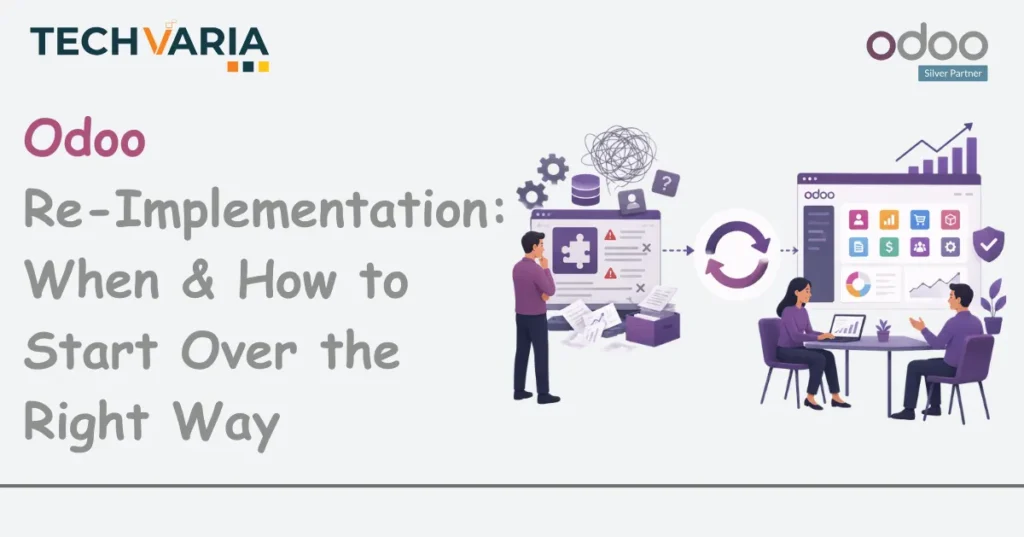
Nobody talks about ERP failure the way they talk about ERP success. But the reality is that a significant percentage of ERP implementations — including Odoo implementations — do not deliver the business value they promised. They go live technically, but operationally the business hasn’t changed. Users work around the system rather than through it. Data quality is poor. Reports can’t be trusted. Finance spends as much time reconciling as before.
When that happens, businesses face a difficult choice: invest more money trying to patch an implementation that was built on the wrong foundation, or make the harder call to re-implement properly. Most delay the decision. The businesses that eventually make the call to re-implement — deliberately and with proper methodology — almost universally report that they should have done it sooner.
This guide is for business leaders who are living with an underperforming Odoo instance and trying to decide whether to fix it, extend it, or restart. It covers how to recognise when re-implementation is the right answer, what typically causes first implementations to fail, how to approach a re-implementation project differently, and what a successful restart looks like in practice.
The Warning Signs: How to Know Your Odoo Implementation Has Failed
Many businesses operate on a failing ERP implementation for years without formally acknowledging it. The signs are usually present from the first few months but are rationalised as ‘teething problems.’ These are the patterns that indicate the problem is structural, not temporary:
- Users have created parallel spreadsheet systems to get work done — the ERP is a record-keeping formality rather than an operational tool
- Month-end financial close requires extensive manual intervention to correct ERP-generated figures
- Data migration from the original go-live introduced errors that were never fully resolved — the opening balances have been wrong from day one
- Key modules were ‘switched off’ or left unconfigured after go-live because they ‘weren’t working right’ and there was no time to fix them
- The implementation partner is no longer engaged and nobody internally fully understands how the system was configured
- Reports cannot be trusted — different people pull different figures from the same system
- User adoption is below 50% — a significant portion of the team has found ways to avoid using the system
- The system has never been upgraded from the original version — customisations make upgrading feel too risky
According to a 2024 Panorama Consulting ERP Report, 53% of ERP implementations experience significant scope or timeline overruns, and 36% of businesses report that their ERP system does not meet their original business requirements three years after go-live.
Why Odoo Implementations Fail: The Real Reasons
Odoo is a capable platform. When implementations fail, the root causes are almost never the software — they are process, people, and methodology failures that no software can compensate for.
1. Insufficient Process Mapping Before Configuration
The most common failure root cause. Configuration started before the business processes were properly documented and agreed. The result is an ERP that reflects what the consultant thought the business did, not what it actually does. Workarounds accumulate from week one.
2. Inadequate or Inaccurate Data Migration
Opening balances that don’t reconcile. Customer records with duplicate entries. Product master data with incorrect costs. Stock counts that were never verified before migration. Every data quality problem introduced at migration persists and compounds — it doesn’t self-correct.
3. Over-Customisation Without Architecture
The business asked for every current process to be replicated in Odoo exactly as it existed in the old system. Developers built custom modules to accommodate every edge case. The result is a brittle, unmaintainable system where even minor Odoo updates require custom code review.
4. Insufficient Change Management
The technical configuration was delivered on time. The business wasn’t ready. Users weren’t trained adequately for their specific roles. The ‘why’ behind process changes wasn’t communicated. Adoption never reached operational levels.
5. Wrong Implementation Partner
The partner had Odoo technical experience but not the industry or business model knowledge to configure the system for the client’s actual operational reality. Or the partner was too junior to push back on decisions that would create problems post go-live.
6. Rushed Go-Live
A deadline was imposed — financial year end, a board commitment, a contractual date — that forced go-live before the system was genuinely ready. Critical configurations were deferred. Testing was shortened. The system went live with known problems.
Re-Implementation vs. Remediation: How to Choose
The decision is rarely purely technical. The clearest signal for re-implementation is when the implementation partner or an independent auditor concludes that the root cause problems — data quality, configuration architecture, process mapping — cannot be efficiently resolved by building on the existing foundation.
| Situation | Recommended Approach |
|---|---|
| Core data model is structurally wrong (e.g., wrong accounting setup, wrong cost valuation method) | Re-implementation |
| Key modules never configured or configured incorrectly from the start | Re-implementation |
| User adoption below 40% with entrenched workarounds | Re-implementation |
| Parallel spreadsheet systems have become the operational reality | Re-implementation |
| Specific modules underperforming but core data is reliable | Remediation (targeted fix) |
| Process gaps that can be addressed through reconfiguration or automation | Remediation |
| User training gaps with otherwise sound configuration | Remediation + training |
| Performance or upgrade issues with sound configuration underneath | Technical remediation |
The Odoo Re-Implementation Methodology: Doing It Right This Time
Phase 1: Diagnostic Audit (Weeks 1–3)
Before any re-implementation work begins, a thorough audit of the existing system is essential. This covers:
- Data quality assessment — what is salvageable, what needs to be re-entered or corrected
- Configuration review — what was configured correctly and what is the source of problems
- Custom code inventory — what customisations exist, why they were built, and whether they’re still necessary
- Process documentation — the actual current-state business processes, not the intended future state
- User interviews — understanding the real operational pain points and workarounds
Tip: The diagnostic audit phase is non-negotiable. Businesses that skip it and go straight to re-configuration typically reproduce the same problems with different symptoms. The audit is where the root causes are identified — everything after is treating those root causes specifically.
Phase 2: Future-State Process Design (Weeks 3–6)
Re-implementation is an opportunity to redesign processes, not just re-implement them. This phase involves:
- Process workshops with department heads to define how the business should operate in Odoo — not how it currently does
- Configuration decisions documented and signed off before development begins
- Customisation review — each existing custom module evaluated against whether standard Odoo can now achieve the same outcome (Odoo’s capabilities evolve with each version)
- Data cleansing plan — specific actions required to bring data to acceptable quality before migration
Phase 3: Clean Configuration (Weeks 6–12)
Configuration in the re-implementation is built on a fresh Odoo instance — not on the existing production environment. Key discipline:
- Configuration is fully tested in a staging environment before any data migration
- Custom development is minimal and documented with clear business justification
- Each module is signed off by the relevant business owner before moving to the next
Phase 4: Data Migration with Verification (Weeks 10–14)
Data migration in a re-implementation requires more rigour than the original implementation:
- Opening balances are reconciled and signed off by the finance team before migration
- Stock counts are physically verified before import
- Customer and vendor records are de-duplicated and validated
- A minimum of two trial migrations are run before the live migration — checking all figures balance
Phase 5: Structured User Training (Weeks 13–15)
Training in re-implementation is role-specific, not generic:
- Each team receives training on only the modules and workflows relevant to their function
- Training uses the company’s actual data and processes — not demo data
- Trained users complete practice scenarios before go-live
- Super-users in each department are designated as the first line of support
Phase 6: Managed Go-Live and Stabilisation (Weeks 15–18)
- Go-live date is not fixed in advance — it is contingent on readiness criteria being met
- Intensive support for the first four weeks post go-live
- Weekly steering committee reviews for the first three months
What Successful Re-Implementations Look Like
A regional trading company had gone live on Odoo 15 three years earlier. The implementation had been rushed to meet a financial year deadline. Inventory valuation was set up incorrectly (average cost instead of FIFO, which their product category required). Multiple workarounds had accumulated. The finance team ran a parallel spreadsheet for inventory costs.
After a re-implementation on Odoo 18 with a new partner:
- Inventory valuation corrected — FIFO implemented with verified opening costs
- Finance team’s parallel spreadsheet eliminated — finance director reported saving 12 hours per month
- User adoption reached 94% within 60 days of go-live — up from 48% on the original implementation
- First month-end close post go-live completed in 4 days — previously taking 11 days with extensive manual reconciliation
- Management reporting became reliable enough to base commercial decisions on — a capability the business had never had from Odoo
Best Practices for Avoiding Re-Implementation in the First Place
- Choose an implementation partner with demonstrated experience in your specific industry and business model — not just Odoo technical competence
- Invest in process mapping before any configuration begins — this phase is the highest-leverage investment in the entire implementation
- Conduct a physical stock count and financial reconciliation before data migration — never migrate unverified data
- Budget adequately for training — the training budget is typically underestimated by 40–60% in failed implementations
- Define go-live readiness criteria before the project begins — the date is a target, not a commitment, until criteria are met
- Build a post go-live support plan into the contract — the first 60 days after go-live are where most implementation problems emerge
Conclusion
A failed or underperforming Odoo implementation is not a reason to abandon Odoo — it is a reason to implement it properly. The businesses that have invested in Odoo re-implementation with the right methodology and the right partner consistently report outcomes that far exceed their original implementation goals, precisely because they bring the benefit of knowing exactly what didn’t work the first time.
The decision to re-implement is a difficult one. It requires acknowledging that significant money was spent without full return, and that more investment is needed. But the alternative — continuing to operate on an unreliable, poorly-adopted ERP while the business grows around it — compounds the problem every month.

Mustufa Rahi is an Odoo Certified Functional Consultant and ERP expert at Techvaria with 15+ years of experience in implementation, automation, and business process optimization, helping organizations scale efficiently.