
Skip to content

Custom Freight Forwarding Software

Freight forwarding runs on the shipment file — the single record that has to hold the booking, the parties, the containers, the documents, the milestones, the charges in and out, and the margin. When that file lives across email, a spreadsheet, and a shared folder, the operational cost is constant: documents chased, statuses guessed, and margin discovered after the job closes. Custom freight forwarding software built to your job flow puts the file in one place, and does it without the licence weight of enterprise forwarding platforms.

Why Forwarders End Up Building Rather Than Buying?

Why Forwarders End Up Building Rather Than Buying?

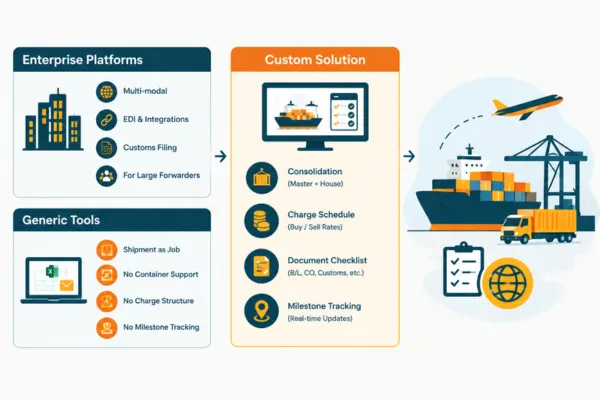
The freight software market splits awkwardly for small and mid-sized forwarders. At the top are enterprise platforms with genuine depth β€” multi-modal, EDI, carrier integration, customs filing β€” priced and scoped for large forwarders with systems teams. At the bottom are generic tools that treat a shipment as a job record and have nowhere for containers, house and master bills, or a charge structure with buy and sell rates per line. In between sits the majority of forwarders, running the operation on Excel and Outlook because neither option fits.

The specific mismatches are consistent. Generic products cannot represent a consolidation where one master bill carries several house shipments for different customers. They have no structure for a charge schedule with agreed sell rates by customer and negotiated buy rates by supplier, which is where the margin actually sits. They cannot hold the document set β€” bill of lading, packing list, certificate of origin, customs entry, delivery order β€” as a checklist with status against a shipment, so document chasing stays manual. And they have no milestone model, so customer status enquiries are answered by someone opening an email thread. A custom application built on Zoho Creator holds these properly, sized and priced for a forwarder of ten to a hundred staff.

Business Challenges We Solve

The operational pattern is recognisable in most forwarding offices. A shipment’s current status lives in whoever is handling it, so a customer call routes to that person or gets an uncertain answer. Documents arrive by email and sit in inboxes rather than against the shipment, so a missing certificate of origin is discovered at the port. Charges are recorded as they arrive — some in the accounting system, some on the operator’s spreadsheet — so job margin is calculated after closing and sometimes not at all. Supplier invoices arrive weeks later and cannot be checked against what was quoted, so overcharges pass unnoticed. Customers ask for tracking and receive an emailed update, which consumes staff time proportional to customer count. Consolidations are tracked in a separate spreadsheet because nothing else can represent one master bill against multiple house shipments.

Custom Freight Forwarding Software Challenges we solve

How We Solve This

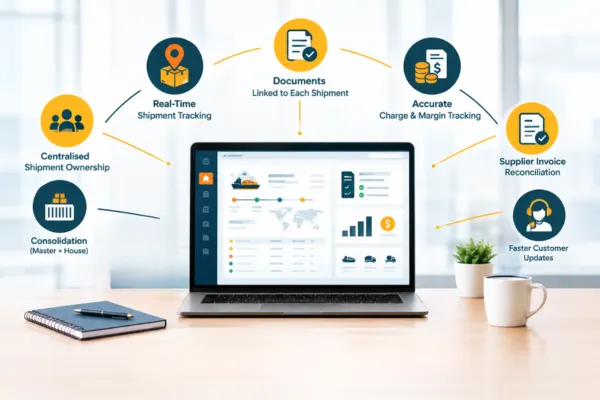
The application addresses these by making the shipment file the system of record. Every shipment carries its parties, mode, route, containers or packages, milestone dates, document checklist, and charge lines with buy and sell rates. Milestones update from operator entry or, where carrier data is available, from integration, and the current status is therefore a system fact rather than a person’s knowledge. Documents attach to the shipment against a checklist, so what is outstanding is visible without asking. Charges are captured as they are incurred with the quoted sell rate alongside, so estimated margin is live throughout the job and variance against quote is visible before the job closes rather than after. A customer portal exposes status and documents directly, removing the routine enquiry traffic entirely.

Shipment File as the Central Record

One record per shipment holding shipper, consignee, notify party, agent, mode, route, vessel or flight, containers or packages, weights and volumes, references, and the full activity history in one place.

Milestone Tracking and Status Visibility

Defined milestones by trade lane and mode β€” booking, pickup, gate-in, loaded, departed, arrived, customs cleared, delivered β€” with dates captured and current status derived, so anyone can answer a status question without asking the handler.

Document Checklist and Repository

Required documents defined by shipment type, tracked as a checklist with status, and stored against the shipment with version control β€” so outstanding documents are visible and nothing is chased from an inbox.

Job Costing with Buy and Sell Rates

Charge lines carrying both the quoted sell rate to the customer and the expected buy rate from the supplier, with actuals recorded as invoices arrive β€” giving live estimated margin during the job and variance against quote at close.

Consolidation and House/Master Bill Structure

One master bill carrying multiple house shipments for different customers, with charges apportioned and each house shipment tracked and invoiced independently while the consolidation is managed as a unit.

Quotation and Rate Management

Customer rate agreements and supplier tariffs held as structured data, driving quotation generation and pre-populating charge lines so quoted and booked figures come from the same source.

Customer Tracking Portal

A scoped portal where customers view their shipment status, milestones, and documents directly β€” removing routine status enquiry traffic and giving a service capability most small forwarders cannot otherwise offer.

Accounting Integration and Invoicing

Customer invoices generated from the shipment’s charge lines and supplier invoices recorded against them, posting to Zoho Books or an existing accounting system, so operational and financial records agree by construction.

Zoho Applications We Use for This

Creator holds the shipment file itself and everything hanging off it; the other products cover invoicing, the customer relationship, service enquiries, reporting and the outside connections.

Zoho Creator
Zoho Creator

The shipment file, milestones, document checklist, job costing, consolidation structure, and customer portal.

Zoho Books
Zoho Books

Customer invoicing, supplier bill recording, multi-currency handling, and receivables management.

Zoho CRM
Zoho CRM

Customer and agent relationships, quotation pipeline, rate agreements, and business development activity.

Zoho Desk
Zoho Desk

Where customer service enquiries are handled as tickets linked to the relevant shipment.

Zoho Analytics
Zoho Analytics

Margin by trade lane, customer, and mode; volume trends; and supplier cost analysis.

Zoho Flow
Zoho Flow

Connections to carrier or tracking data sources, agent systems, and customs platforms where APIs are available.

Where This Applies?

This applies to freight forwarders and logistics providers of roughly ten to a hundred staff β€” too large for spreadsheets, not large enough for an enterprise forwarding platform. Sea freight forwarders handling FCL and LCL with consolidation. Air freight forwarders with house and master airway bill structures. Customs brokers managing entries and documentation alongside forwarding. NVOCC operators managing their own bills of lading. Project cargo and breakbulk specialists where every shipment is bespoke and the charge structure differs each time. Domestic transport and multimodal operators combining road movement with port handling.

It applies with particular relevance to forwarders in India and the UAE, where trade volume and the number of parties per shipment make document management and status visibility a disproportionate share of operational effort. It also applies where the forwarder operates across multiple branches or entities, since consolidated visibility across offices is one of the capabilities that spreadsheets cannot provide at all.

It also applies to forwarders whose customers are beginning to expect tracking as a baseline service. Larger competitors offer portal visibility as standard, and answering status enquiries by email is both a cost and a competitive disadvantage. A customer portal is frequently the capability that justifies the project commercially, independent of the internal efficiency gains.

Ready to Get the Shipment File in One Place?

A discovery session covers your job flow from enquiry through quotation, booking, execution, documentation, and invoicing β€” including the parts currently held in email and spreadsheets. We scope the shipment structure, milestone model, document requirements, charge and rate handling, and portal scope, and give you a realistic timeline. Most freight forwarding builds reach production in ten to sixteen weeks depending on mode coverage and integration scope.
Why Choose Techvaria for Freight Software?

Why Choose Techvaria for Freight Software?

Techvaria is a Zoho Premium Partner with teams in India and Dubai building operational applications for logistics and trading businesses. Freight forwarding is a domain where the data model decides whether the system works — a shipment structure that cannot represent a consolidation, or a charge model without buy and sell rates, produces an application people work around within months.

We design that structure against how your business actually books and costs jobs, integrate it with accounting so margin is real rather than reconstructed, and build the customer portal as part of the system rather than as a separate exercise.

Hear From Our Clients

Industries We Serve

Frequently Asked Questions

Yes, and this is a core requirement we design for explicitly. One master bill carries multiple house shipments for different customers, with charges apportioned across them. Each house shipment is tracked, documented, and invoiced independently while the consolidation is managed as a single unit for carrier and port purposes. Generic job-based products cannot represent this, which is one of the main reasons forwarders end up building.

Yes, and live rather than retrospectively. Each charge line carries the sell rate quoted to the customer and the expected buy rate from the supplier, with actuals recorded as supplier invoices arrive. Estimated margin is visible throughout the job and variance against quote is flagged at close. This is usually the capability that surprises forwarders most, because jobs that were assumed profitable frequently are not once late supplier charges land.

Yes, through a scoped portal showing their shipments, milestone status, and documents. This removes most routine status enquiries and gives a service capability that smaller forwarders otherwise cannot match against larger competitors. Access is restricted so each customer sees only their own shipments.

Where carriers or tracking aggregators expose an API, yes — milestone updates can be pulled automatically rather than entered. Coverage varies considerably by carrier and trade lane, so in practice most implementations combine automated updates where available with operator entry where they are not. We assess which of your carriers and lanes can be automated during scoping.

Required documents are defined by shipment type as a checklist, tracked with status, and stored against the shipment with version control. Outstanding documents are visible on the shipment and can be reported across all open jobs, so chasing happens from a list rather than from memory. Documents can also be exposed to the customer through the portal where appropriate.

Yes. Each mode has its own milestone set, reference structure, and document requirements, configured accordingly, while sharing the same shipment file, costing model, and customer records. Multimodal shipments combining a sea leg with road delivery are handled as a single file with the appropriate legs rather than as separate jobs.

It integrates with Zoho Books natively. Where you use another accounting system, integration depends on what API it exposes — most modern platforms are straightforward, and Tally is handled through its XML interface. Invoices generated from shipment charge lines post to the accounting system so the operational and financial records agree without duplicate entry.

Ten to sixteen weeks for most freight forwarding builds. The variables are how many modes are in scope, whether consolidation handling is required, the extent of carrier integration, and whether a customer portal is included in the first phase. Single-mode operations without consolidation sit at the shorter end; multi-mode with consolidation, portal, and carrier integration at the longer end.

Resources

Latest Blogs