
PowerApps Licensing Cost and the Alternative Worth Pricing
Most people arriving at this question have already built something in Power Apps, on SharePoint, using the licence that came with Microsoft 365. It works. Then the app needs a real database, or a connection to the ERP, or a custom connector β and the quote for rolling it out to the whole team arrives with a number nobody budgeted for.
This page sets out what Power Apps actually costs, where the cost appears without warning, and how to compare it honestly against Zoho Creator. It is a pricing page, not a takedown: there are situations where Power Apps is the correct and cheaper answer, and those are named here too.
Home / PowerApps Licensing Cost β and the Alternative Worth Pricing
What Power Apps Costs Today
Microsoftβs published list pricing, at the time of writing:
| Plan | List price | What it covers |
|---|---|---|
| Power Apps Developer Plan | Free | Three developer environments, 250 MB Dataverse database, up to 750 automation flows monthly β non-production |
| Power Apps Premium | $20.00 user/month, paid yearly | Unlimited Power Apps and Power Pages for that user, prebuilt, custom and on-premises connectors, 250 MB Dataverse database and 2 GB file capacity |
| Power Apps Premium, 2,000+ seat minimum | $12.00 user/month, paid yearly | Same entitlements, enterprise volume, minimum 2,000 licences |
| Dataverse database capacity add-on | $40.00 per GB/month, paid yearly | Additional database storage beyond what the licences include |
Microsoftβs own note on that page is worth repeating: prices shown βare for marketing purposes only and may not be reflective of actual list price,β and they vary by region and agreement. Treat the figures above as the shape of the cost, and confirm your own numbers against your Microsoft agreement before you commit to either platform.
Where the Cost Actually Appears
The sticker price is rarely the surprise. Three things are.
The standard versus premium connector line
Apps built on the connectors that come with Microsoft 365 β SharePoint lists, Excel on OneDrive, Outlook β run on the seeded rights in your existing subscription. Cross into premium territory and every user of that app needs a Power Apps licence. Premium territory is not exotic: SQL Server, Dataverse, Salesforce, HTTP calls and any custom connector all sit on that side of the line.
That is why so many Power Apps projects are cheap in the pilot and expensive at rollout. The proof of concept ran on a SharePoint list. The production version needs a real database or a connection to the ERP, and the licensing model changes underneath the project rather than at a moment anyone planned for.
Per-user, multiplied by everyone who touches the process
At $20 per user per month, a 25-person team is $500 a month β $6,000 a year, before the app exists. Fifty users is $12,000 a year. A hundred is $24,000. The volume tier that brings it to $12 per user requires a 2,000-licence minimum, which is not a mid-market option.
The multiplier that catches people is scope. An operations app is rarely used only by the operations team: the warehouse scans, supervisors approve, finance checks, and increasingly a contractor or customer wants to see status. Every one of those is a licence, and there is no lighter tier for a person who submits one form a week.
Dataverse storage, charged separately
Dataverse capacity beyond the per-licence entitlement is $40 per GB per month. For a records-heavy app with attachments β photos from site, scanned documents, signed PDFs β storage is not a rounding error, and it is billed on top of every seat.
Why This Isn't a List of Ten Alternatives?
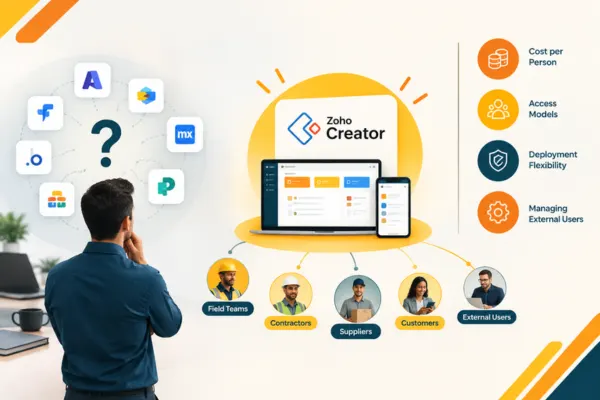
There are plenty of low-code platforms and plenty of listicles ranking them. That ranking becomes useful only when you know which constraints actually matter. For a business asking this specific question, two usually bind: the cost per person of putting an operational app in front of everyone who touches the process, and what happens when people outside your Microsoft tenant need in.
Those constraints change the comparison quickly. A platform can look strong on features yet become expensive when apps need to reach field teams, contractors, suppliers, customers or other external users. Licensing, access models, deployment flexibility and the effort required to manage those users matter alongside functionality.
Narrow it to those realities and the field is short. We build on Zoho Creator, and we will say so up front. The reasoning below is what you should argue with.
The Alternative: Zoho Creator
One licence, no connector cliff. The distinction that drives Power Apps cost — standard connectors free, premium connectors licensed — does not exist in Creator. Connecting to a SQL database, calling an external API or integrating another system does not change what a user costs. That removes the specific failure mode where a pilot’s economics do not survive contact with production.
External users are priced as external users. Customers, contractors and field partners access a Creator app through portal licensing rather than a full seat. If your Power Apps rollout stalled because giving fifty subcontractors access was unaffordable, this is the line item to compare — and Power Pages capacity should be priced against it rather than against the internal seat cost.
Storage is not a separate meter to watch. Attachment-heavy processes — site photos, signed documents, delivery proofs — do not carry a per-gigabyte add-on that scales independently of users.
The maths, structured. Take your real user count, split into people who need to create and edit records and people who only need to view or submit, and price each group on both platforms at current list rates. Add Dataverse capacity for the storage your app will actually hold. Add any Power Pages capacity for external users. Then add the switching cost below to the Creator column, because a fair comparison includes it. For most mid-sized teams the crossover is not close; for a 15-person internal-only app on SharePoint data, it often is.
Where Power Apps Is the Right Answer?
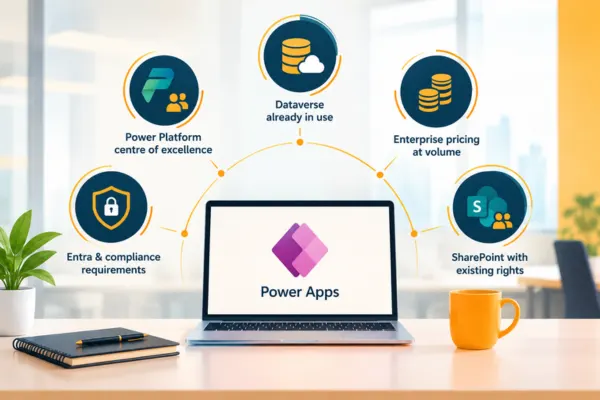
If your data already lives in Dataverse, if your organisation runs a Power Platform centre of excellence, if governance and identity are built around Entra and your compliance posture depends on staying inside the Microsoft tenant, or if you have negotiated enterprise pricing at volume β Power Apps is the correct choice and switching would be an expensive way to make a small saving.
The same is true for an app used by a handful of people on SharePoint data, where the seeded rights genuinely cover it. Cost is one input, not the decision.
Power Apps also makes sense when Microsoft 365 integration, existing security policies, familiar administration, and established internal skills matter more than licence savings. If your users already work extensively in Teams, Outlook, SharePoint, or Excel, keeping the app within that ecosystem can reduce adoption friction and ongoing support overhead.
The Switching Cost, Stated Plainly
Any honest comparison includes the cost of moving, and it is not zero.
- Rebuild, not conversion. Power Fx formulas, canvas app screens, Dataverse tables and Power Automate flows have no export path into another platform. Screens are redesigned, logic is rewritten in Deluge, flows are rebuilt as workflows.
- Data migration. Tables are extracted, cleaned and imported parents-first, with keys preserved so relationships can be audited back to source. Files stored against records migrate as their own verified pass.
- Integrations. Anything the app talks to has to be reconnected and tested, whether that is the ERP, the accounting package or a line-of-business system.
- Retraining. Modest, but real, and it lands on the people already using the app daily.
- Parallel running. Both systems run for an agreed window before cutover, which means paying for both briefly.
Set that one-time cost against the annual licence difference. If the payback is inside a year, the case is straightforward. If it is three years out, staying put is the better commercial decision and we will tell you so.
Get the Comparison for Your Situation
Hear From Our Clients
Industries We Build Low-Code Apps For
Frequently Asked Questions
Microsoft’s published list price is $20.00 per user per month for Power Apps Premium paid yearly, with a $12.00 per user per month tier that requires a minimum of 2,000 licences. There is a free Developer Plan for non-production use. Microsoft notes that published prices may not reflect actual list price in your region or agreement, so confirm against your own Microsoft contract.
Almost always the premium connector line. Apps on SharePoint, Excel in OneDrive or Outlook run on the rights seeded in Microsoft 365; the moment the app uses SQL Server, Dataverse, a third-party system or a custom connector, every user of it needs a Power Apps licence. Pilots tend to sit on the free side of that line and production apps rarely do.
Additional database capacity beyond the entitlement included with your licences, listed at $40.00 per GB per month paid yearly. It matters most for apps holding photos, scans and generated documents, and it is charged on top of per-user licensing.
For most mid-sized teams putting an operational app in front of everyone involved, yes — largely because there is no premium connector cliff and external users are priced as portal users rather than full seats. For a small internal app on SharePoint data covered by seeded rights, Power Apps can be cheaper. The comparison is worth doing with your real user split rather than a headline rate.
There is no automated conversion between the platforms, so screens, Power Fx logic and Power Automate flows are rebuilt while data is migrated with verification. The one-time cost depends on app complexity, integration count and data volume. The right test is payback period: annual licence saving against one-time rebuild.
Yes, and many businesses do — keeping Power Apps where it fits the Microsoft estate and moving the apps whose economics do not work, particularly those needing external access. They can be integrated so data flows between them.
Only at the specific apps where the licensing model is the constraint — typically the ones with a large or partly external user base and modest complexity. If your data is in Dataverse and your governance is built on the Power Platform, moving core apps out is usually a false economy.