
Skip to content

Zoho Creator App Development Cost

Anyone quoting a Zoho Creator app before understanding what it must do is guessing. The honest answer is that cost is driven by a small number of specific factors β€” process clarity, integration count, role complexity, data migration, and mobile requirements β€” and that a properly scoped estimate is available within a short conversation. This page sets out what those drivers actually are, how licence cost works alongside development cost, and where Creator budgets most commonly overrun, so you can assess a quote you receive from anyone.

Why Creator Costs Vary So Widely Between Projects?

Why Creator Costs Vary So Widely Between Projects?

Two Creator applications with the same number of forms can differ in cost by a factor of four, and the reason is rarely the forms. Cost concentrates in three places that are invisible when a project is described casually. The first is process definition: an application built against a documented, agreed process moves straight into design, while one built against a process that three departments describe differently absorbs weeks of discovery β€” and that discovery has to happen whether it is scoped or not. The second is integration: every external system connection carries API review, authentication, field mapping, error handling, reconciliation, and testing, and a single non-Zoho integration can equal the effort of several forms.

The third is permission and approval complexity: two roles with straightforward access is quick, while eight roles across three entities with conditional approval routing by value and department requires careful design and exhaustive testing of every path. Understanding this is what lets you compare quotes meaningfully β€” a low quote usually reflects a narrower reading of these three factors rather than better pricing, and the difference tends to surface as change requests later.

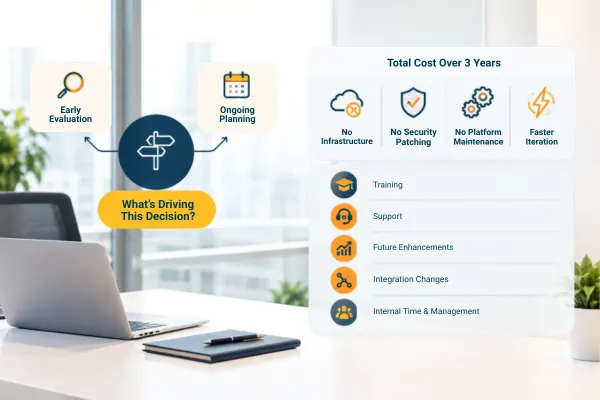
What’s Driving This Decision?

Businesses ask about Creator cost at two different moments, and the useful answer differs between them. The first is early evaluation, comparing Creator against custom development, a packaged product, or continuing with the current workaround. Here the relevant figure is total cost over three years rather than build cost, because Creator’s economics come substantially from what you do not pay afterwards β€” no infrastructure, no security patching, no platform maintenance, and considerably faster iteration when the process changes. A build-cost-only comparison systematically favours whichever option defers the most cost, which is usually the wrong signal. It is also important to account for training, support, future enhancements, integration changes, and the internal time required to manage the system as the business grows.

What Determines Zoho Creator App Development Cost

What Drives the Outcome?

The second moment is budgeting for a decided project, where the question is what a specific application will cost. Here the answer depends on scope, and the responsible approach is to scope before quoting rather than the reverse. Two components make up the total: development effort, which is a one-time project cost driven by the factors above, and Zoho Creator licensing, which is an ongoing per-user subscription determined by how many internal users need access and whether external parties require portal access or can be served by stateless forms. That second distinction has a material effect on ongoing cost and is worth deciding deliberately at design time, since retrofitting it afterwards means reworking how external submissions are handled.

Process Clarity Before the Build Starts

The largest single variable. A documented process with its exceptions identified moves directly into design. An undefined one requires discovery workshops across the departments involved, which is real cost regardless of whether it appears as a line item.

Number and Type of Integrations

A Zoho-to-Zoho connection is straightforward. External ERP, banking, or logistics integrations require API assessment, authentication, field mapping, error handling, and reconciliation β€” often a significant part of the application effort.

Role Count and Permission Depth

Cost rises with the number of distinct roles and with field-level rather than record-level permission requirements. Multi-entity structures where users see only their own entity’s data add design and testing effort disproportionate to their apparent simplicity.

Approval Workflow Complexity

Sequential approval is quick. Conditional routing that varies by value, entity, department, and requester seniority, with escalation on delay and delegation during absence, requires Blueprint design and testing of every possible path.

Data Migration Scope and Quality

Clean master data in a structured format is predictable task. Data requiring deduplication, reformatting, and decisions about historical scope frequently costs more than application build. Assessing data readiness early is cheapest way to avoid a surprise.

Mobile and Offline Requirements

Publishing to mobile is included in the platform. Applications requiring reliable offline capture, sync conflict resolution, and field testing under real connectivity conditions add a design and testing cycle that web-only builds do not carry.

Reporting and Dashboard Depth

Standard operational reports are quick. Cross-application reporting, complex aggregations, and dashboards requiring Zoho Analytics rather than native Creator reporting add both development effort and a separate licence consideration.

Licence Model: Internal Users vs External Access

Ongoing cost depends on user count and external user needs. Portal users carry a per-user licence cost, while stateless forms allow submissions without one. The choice depends on whether users need history access or only submission.

Zoho Applications We Use for This

Which applications a project involves affects both development effort and ongoing licence cost.

Zoho Creator
Zoho Creator

The core platform; licensed per user, with pricing tiers determining available features such as portal users and higher automation limits

Zoho CRM
Zoho CRM

Where integration is required, adding development effort and its own licence if not already in place

zoho books
Zoho Books

Accounting integration, similarly adding effort and licence where not already deployed

Zoho Inventory
Zoho Inventory

Stock integration for applications handling physical goods

Zoho Analytics
Zoho Analytics

Added where reporting exceeds native Creator capability; a separate licence and a distinct development component

Zoho Flow
Zoho Flow

Sometimes reduces development cost by handling straightforward integrations that would otherwise require custom Deluge

Where This Applies?

Cost expectations differ by application category, and these bands are a reasonable planning guide. A single-process application β€” an asset register, a leave or expense workflow, a vendor compliance tracker, an inspection app β€” with a handful of forms, one approval flow, a few roles, and no external integration sits at the lower end of both effort and timeline.

A multi-process application with several roles, one or two integrations, dashboard reporting, and mobile deployment β€” a job card system, a delivery and dispatch workflow, a project timesheet and utilisation tracker β€” sits in the middle band and typically represents the most common project shape we scope.

An enterprise build spanning departments, with multi-entity structure, several external integrations, complex conditional approvals, substantial data migration, and mobile rollout to field teams sits at the upper end. These are frequently better delivered in phases, which changes the cash flow profile as well as reducing risk: the first phase delivers the highest-value capability and its cost is committed against a defined scope, with later phases scoped once the first is in use.

Ready for a Real Number?

We do not quote from a description. A scoping session maps the process, counts and assesses the integrations, establishes role and approval complexity, and reviews data readiness β€” and produces a scoped estimate with the assumptions stated, so you can see what would change the number. Where the scope is larger than the budget, we identify what a phase one would cover and what it would cost, rather than quoting a figure that requires later change requests to become real.
Why Choose Techvaria for Zoho Creator Development?

Why Choose Techvaria for Zoho Creator Development?

Techvaria is a Zoho Premium Partner delivering Creator applications across India and the UAE. We scope before quoting and state the assumptions behind every estimate, because a quote that omits the integration effort or the data migration is not a lower price β€” it is an incomplete one. Where a requirement is better served by a different approach, including one that costs us the project, we say so at the scoping stage. We build documented, maintainable applications on the assumption that you should be able to take them elsewhere if you choose to. This approach also gives you a clear view of what is included, what may change, and where future costs could arise. Our focus is on practical solutions that remain reliable and adaptable as your business grows.

Hear From Our Clients

Industries We Serve

Frequently Asked Questions

It depends on the drivers above rather than on application size alone, which is why we scope before quoting. A simple single-process application with no external integration and clean data is a small, well-bounded project. A multi-process build with external integrations, complex approvals, and data migration is a substantially larger one. A short scoping conversation produces a specific figure with the assumptions stated.

Two components. Zoho Creator licensing, charged per user on a subscription basis with tiers that affect available features β€” Zoho publishes current rates and they change periodically, so we confirm them at scoping rather than quoting them here. And optional ongoing support, typically a retained monthly allocation covering enhancements and issue resolution. There is no infrastructure or platform maintenance cost, because that sits with Zoho.

At build time, Creator is generally lower because the infrastructure layer already exists. Over three years the gap widens, because custom applications carry ongoing developer cost for dependency management, security patching, server maintenance, and every logic change. The comparison that misleads is build cost alone. The one that informs is three-year total cost including maintenance and the cost of changing the application as the process evolves.

Usually because of what each has assumed rather than what each charges. A quote that assumes a documented process, no data cleanup, and a straightforward integration will be lower than one that has assessed those and found otherwise. Ask any quote what it assumes about process definition, integration effort, data migration, and post-go-live support β€” the differences typically resolve there.

In order of frequency: requirements added after kickoff, process ambiguity discovered mid-build, data that needed more cleaning than expected, and integrations where the API behaved differently from its documentation. The first is managed by defining a clear phase one and holding additions for a later phase. The others are managed by scoping properly, which is why we invest in that stage.

Yes, portal users carry a licence cost. This is why the decision between portal access and stateless forms matters. If external parties only need to submit information β€” a supplier uploading a document, a customer submitting a request β€” a stateless form serves that without a licence. If they need to log in and see their own history or track status, a portal user is required. Getting this decision right at design time can materially change ongoing cost.

Sometimes, and it can work well. A common arrangement is that we design the data model, build the complex logic and integrations, and your team handles report configuration and subsequent minor changes. This requires that the handover and documentation support it, which we build for. What tends not to work is splitting the core build itself, where divided ownership of the data model creates more cost than it saves.

No formal minimum, but very small requirements are sometimes better served by configuration within an existing Zoho application than by a new Creator build. If that is the case, we will say so β€” it is a shorter engagement and a better outcome for you than building an application you did not need.

Resources

Latest Blogs