

Zoho Creator App Rescue and Audit
Creator applications rarely fail suddenly. They degrade β a workflow that fires twice, a report that times out, a permission that lets the wrong person see the wrong record, a scheduled function that stopped running months ago and nobody noticed. By the time someone calls it broken, the original builder has usually moved on and nobody can explain what the application actually does. Our audit maps the build, identifies why it is failing, and gives you an honest recommendation: repair, restructure, or rebuild.
Home / Zoho Creator App Rescue and Audit
Why Creator Applications Break Down Over Time?
The pattern behind most failing Creator applications is the same, and it is not incompetence. The application was built quickly to solve an immediate problem, it worked, and it grew β more forms, more users, more records, more rules added by different people over two or three years, each solving that dayβs requirement without visibility of the others. Nothing was documented, because at the start there was nothing complicated enough to document.
The specific failure modes that emerge are predictable: a data model designed for a simpler version of the process, where a field now holds three meanings depending on context; Deluge with no error handling, so a failed API call leaves a partially written record and no alert; workflow rules triggering each other in loops that were harmless at low volume and are not at high; unbounded loops in scheduled functions that hit execution limits once the record count grew; and permission structures built by copying an existing role rather than designing one, so nobody can say with confidence who can see what. None of these are visible in month one. All of them are structural, which is why patching individual symptoms tends to produce a new symptom rather than a fix.
Business Challenges We Solve
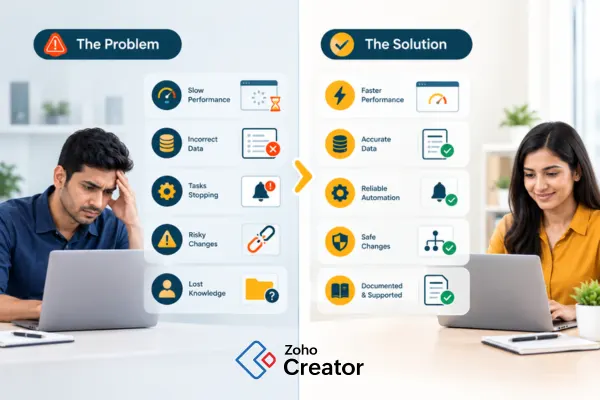
Businesses come to us with symptoms rather than causes. The application is slow β reports take minutes, forms hang on save, the mobile app times out. Data is wrong β records duplicate, totals do not reconcile, a status field shows a value the workflow should not permit. Things stop happening β reminders that used to send do not, an integration that used to sync has silently stopped, a scheduled function fails without anyone knowing. Changes are risky β a small modification breaks something unrelated, because nobody knows what depends on what. And the knowledge has left: the person who built it is gone, there is no documentation, and the current team is reluctant to touch anything. These problems need careful investigation before any changes are made. The underlying issue may sit in Deluge scripts, workflows, data structures, integrations, permissions, or application design rather than in the symptom itself. Our audit process traces these dependencies, identifies what is actually failing, and provides a clear path to stabilise the application before further development continues.
Whatβs Included?
Our approach is to map before changing. The audit reads every form, field, workflow rule, Blueprint configuration, scheduled function, permission set, and Deluge function in the application, and produces a dependency map showing what triggers what. That map alone frequently identifies the cause of several reported symptoms at once β most commonly, the same logic implemented in three places with small differences, producing inconsistent results depending on which entry point was used. From there we distinguish what can be repaired in place from what requires restructuring, and where the data model itself is the constraint we say so, because continuing to patch a fundamentally wrong structure is the most expensive path available.
Full Application Inventory
Every form, subform, report, page, workflow rule, Blueprint stage, scheduled function, connection, and permission set catalogued β the baseline picture that almost never exists when we arrive.
Data Model Review
Form relationships, lookup structures, and field usage assessed against what the process now requires, identifying where the original design has been stretched beyond what it can carry.
Deluge Code Review
Every function read and assessed for error handling, execution-limit exposure, trigger loops, duplicated logic, and hardcoded values that will fail as the environment changes.
Dependency and Trigger Mapping
A documented map of what fires what β the artefact that makes the application safe to modify again, and usually the single most valuable output of the audit.
Performance Diagnosis
Identifying the causes of slowness: unindexed lookups on large datasets, reports aggregating too many records, per-record loops instead of batches, and synchronous API calls during saves.
Permission and Security Review
Role structures and field-level permissions tested against what each role should actually be able to see and do, with findings on over-permissioned roles and data exposure.
Integration Health Check
Every connection tested β authentication validity, error handling, retry behaviour, and whether failures are visible β including the integrations that have quietly stopped working.
Prioritised Remediation Plan
Findings ranked by severity and effort, with a clear recommendation on repair versus rebuild for each area, and a realistic estimate for each remediation item.
Zoho Applications We Use for This
An audit usually extends beyond Creator itself, because most failing applications fail at their boundaries.
Zoho Creator
The primary subject: forms, Deluge, Blueprint, reports, pages, portals, permissions, and scheduled functions
Zoho CRM
Where the application syncs customer or deal data, a frequent source of duplication and sync conflict findings

Zoho Books
Accounting integrations where financial records are being created or updated by Creator logic

Zoho Inventory
Stock integrations where quantity discrepancies commonly trace back to Creator workflow errors

Zoho People
Employee and hierarchy data referenced by approval routing, a common cause of routing failures when the hierarchy changes

Zoho Flow
Where Flow automations run alongside Creator logic, often duplicating actions the Deluge already performs

Where This Applies?
This applies to any Creator application in production that is no longer reliable, no longer maintainable, or no longer understood. Applications built by a former employee or a previous partner, with no documentation and no handover. Applications that have grown from a small internal tool into something the business now depends on, without the structural work that transition should have included. Applications experiencing performance degradation as record volume has grown past what the original design anticipated. Applications where a single change reliably breaks something else, so the team has stopped changing anything.
It applies equally to applications that work but cannot be extended. A business wanting to add a process, a role, or an integration to an existing Creator app, and finding that the current structure will not accommodate it, is facing the same underlying question β and the audit answers it before money is spent building on a foundation that cannot hold the addition.
It also applies as due diligence. Businesses inheriting a Creator application through an acquisition, a partner change, or a departing developer benefit from establishing what they actually have before they depend on it. This is the least expensive time to run the audit and the point at which the findings are most useful.
Ready to Find Out Whatβs Actually Wrong?
Why Choose Techvaria for Creator Rescue Work?
Techvaria is a Zoho Premium Partner and a significant share of our Creator work is on applications we did not build. Reading unfamiliar Deluge, reconstructing an undocumented data model, and deciding honestly between repair and rebuild is a distinct skill from greenfield development, and it is one we do regularly. We do not require you to move your wider Zoho relationship to us, and we will tell you when a rebuild is the cheaper option even though a repair engagement would be the easier sale. Premium Partner status gives us escalation access into Zoho engineering for the findings that turn out to be platform behaviour rather than build errors. Our approach is focused on understanding the application before making changes, reducing unnecessary disruption, and giving you a clear technical view of what should be fixed, improved, documented, or rebuilt.
Hear From Our Clients
Industries We Serve
Frequently Asked Questions
A documented inventory of the application, a dependency map showing what triggers what, a code review with specific findings against each function, a performance diagnosis, a permission and integration review, and a prioritised remediation plan with effort estimates. The dependency map is usually the most immediately valuable item, because it makes the application safe to modify again.
Most audits take one to two weeks depending on application size and complexity. A small application with a handful of forms can be assessed in a few days. A multi-process application with dozens of forms, extensive Deluge, and several integrations takes longer, primarily because tracing dependencies through undocumented logic is careful work rather than fast work.
Yes, including when that is the less convenient answer. The determining factor is usually the data model: if the underlying structure can support what the business now needs, repair is almost always cheaper. If the structure itself is the constraint β fields carrying multiple meanings, relationships that should have been one-to-many built as flat fields β continued patching costs more over two years than rebuilding does now. We show the reasoning rather than just the conclusion.
Yes, and most clients proceed to remediation with us. The two are scoped separately and deliberately, so the audit produces an honest assessment rather than one shaped by a remediation quote. If you would rather have your own team or another partner carry out the fixes, the audit output is written to support that.
No, rarely. Performance issues in Creator most often trace to specific, fixable causes: reports aggregating across too many records without filters, loops processing records individually where a bulk operation would work, synchronous external API calls inside save actions, and lookups against large datasets without appropriate filtering. These are usually repairable in place. Performance problems that are genuinely structural come from the data model, and those we would flag as such.
This is common and is one reason we test every connection during the audit. Integrations fail silently when there is no error handling or logging β a credential expires, an API changes, and the sync simply stops. The remediation adds failure logging and alerting so the next failure is visible immediately rather than discovered months later as missing data.
We need read access to the application and its configuration to conduct the audit. For remediation, we typically work in a development or sandbox environment rather than directly in production. Access scope is agreed at the start and limited to what the work requires.
The audit is a technical assessment, not a performance review. Nearly every application we audit shows the same patterns, and they come from the same cause: building incrementally under time pressure without the structural work that growth should have triggered. The findings are written to be actionable, and where your team will carry out the remediation, they are written to be useful to them.