

Skip to content

Zoho CRM Reimplementation Services

A Zoho CRM that isn’t working usually isn’t a Zoho problem β€” it’s an implementation problem. Duplicate records nobody trusts, workflows that fire in the wrong order, a pipeline structure that stopped matching how your sales team actually sells, reports managers have quietly stopped looking at. None of that means the platform failed. It means the configuration underneath it needs to be rebuilt around how the business actually runs today.

Techvaria reimplements Zoho CRM for businesses whose original setup has drifted, broken, or never matched their process to begin with. As a Certified Zoho Premium Partner, we audit what’s actually happening inside your CRM, decide what genuinely needs rebuilding versus what can be repaired, and reconstruct it without your team losing access to the system they depend on every day.

Zoho CRM Reimplementation When You Need It

Zoho CRM Reimplementation: When You Need It

Most businesses don’t reach for reimplementation as a first instinct β€” they patch. A validation rule here, a new field there, a workaround for the report that stopped making sense. That’s the right instinct for small problems. It stops being the right instinct once the patches themselves have become the problem.

A few patterns tell us a business is past the point where another small fix will help: sales reps have quietly gone back to spreadsheets for parts of their process because the CRM has become more friction than help; nobody on the leadership team fully trusts what the dashboards say anymore, so decisions get made from gut feel or a manually rebuilt Excel version of the same numbers; and every new requirement gets bolted on as another workflow rule or custom field, because nobody wants to touch the core structure for fear of breaking something else.

If any of that sounds familiar, we’ve written a more detailed breakdown of the specific warning signs in 10 Key Signs Your Business Needs CRM Reimplementation. This page is about what we actually do once you’ve recognized them.

Reimplementation vs. Fixing It Yourself: What Actually Needs to Change

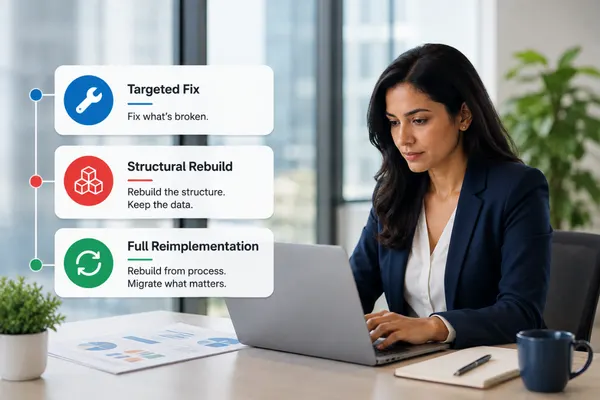
Not every broken Zoho CRM needs to be rebuilt from the ground up, and treating every problem as a full rebuild wastes time and budget on parts of the system that are actually fine. We scope every engagement into one of three levels of intervention, based on what the audit actually finds.

Targeted Fix. The core structure β€” modules, pipeline, data model β€” is sound, but specific pieces are broken: a handful of conflicting workflow rules, a permission structure that’s fallen out of step with team growth, a couple of reports nobody trusts. These get fixed directly without touching what’s working.

Structural Rebuild. The data itself is largely usable, but the configuration around it doesn’t match the business anymore β€” pipeline stages that don’t reflect the real sales process, modules built for a business model you’ve since moved away from, automation logic too tangled to trace. This is rebuilt from the process down, while preserving the underlying data.

Full Reimplementation. Data quality is compromised at the structural level, adoption has collapsed to the point where the CRM isn’t actually the system of record anymore, or the original implementation was built for a business that no longer resembles what you run today. This starts from a re-documented process and rebuilds the CRM around it, migrating and cleaning the data that’s actually worth keeping.

We tell you which of these three your business needs after the audit β€” not before, and not by default toward the most expensive option.

Why Zoho CRM Implementations Break Down

We’ve reimplemented enough CRMs to see the same handful of root causes repeat, almost regardless of industry.

The configuration was never built around a documented process. Most failed implementations weren’t built from a mapped-out sales process β€” they were built from assumptions, or from whatever the previous vendor thought a CRM should look like. The pipeline, the fields, and the automation all reflect someone’s guess at how the business sells, not how it actually sells.

Historical data went in dirty and stayed dirty. When legacy data is imported without deduplication, validation, or a real mapping exercise, the CRM inherits every quality problem the old system had β€” and then compounds it, because nobody trusts data enough to clean it later.

Automation got layered on before the process was stable. Workflow rules and Blueprints built on top of a process that was still being figured out tend to accumulate contradictions β€” rules that fire against each other, triggers that duplicate tasks, automations nobody remembers the original purpose of.

Training covered features, not the actual job. A generic product walkthrough teaches people what buttons exist. It doesn’t teach a sales rep how their specific deal process is supposed to flow through the system, which is usually why adoption never really took.

Nobody owned it after go-live. Implementation projects have a defined end date; CRM health doesn’t. Without an ongoing owner checking data quality, retiring outdated automations, and adjusting the structure as the business changes, drift is the default outcome, not the exception.

Our Zoho CRM Reimplementation Process

Whichever level of intervention your business needs, we run it through the same five phases, scaled to scope.

1. Architecture Audit & Diagnostic

We map what’s actually configured in your Zoho CRM today β€” modules, fields, pipelines, workflow rules, Blueprints, permission structure, integrations β€” against how your business genuinely sells and operates. We also assess data quality directly: duplicate rate, incomplete records, and whether reports are internally consistent. This phase produces the honest answer to which of the three intervention levels above your business actually needs.

2. Process Re-Mapping

Before any reconfiguration happens, we document your current sales and operational process directly with the people who run it β€” not the process as originally assumed, but how deals, leads, and customer records actually move through the business today. This becomes the blueprint the rebuilt CRM is designed around, rather than another layer of configuration built on outdated assumptions.

3. Data Cleanup & Consolidation

Duplicate records are identified and merged, incomplete fields are flagged and addressed, and inconsistent formatting across departments is standardized. Where full reimplementation is warranted, this is also where we decide what historical data is worth carrying forward versus what should be archived rather than dragged into the rebuilt system.

4. Reconfiguration & Rebuild

Modules, pipelines, workflow rules, Blueprints, and permission structures are rebuilt or restructured according to the re-mapped process. Conflicting or redundant automations are retired rather than layered around. Dashboards and reports are redesigned to reflect the metrics your team actually needs to make decisions, not just the ones that were easy to configure originally.

5. Testing, Phased Rollout & Adoption

Rebuilt workflows are tested against real scenarios before anyone depends on them. Rather than a single disruptive cutover, we roll changes out in phases where possible, and training is built around your team’s actual redesigned process β€” not a generic Zoho walkthrough. We also put a lightweight governance structure in place so the same drift that caused this project doesn’t quietly start again.

What We Fix During Reimplementation

Data quality and duplication. Deduplication, validation rules, and standardized field formatting so the data in the CRM is something your team can actually act on without double-checking it.

Conflicting workflows and over-automation. Automation logic mapped and rationalized so triggers don’t fire against each other or generate duplicate tasks β€” outdated rules are retired, not left running alongside new ones.

Misaligned permissions and roles. Role, profile, and field-level access restructured to match your current team, not the team size and structure the CRM was originally configured for.

Reporting that doesn’t reflect reality. Dashboards rebuilt around outcome metrics β€” deal velocity, pipeline health, forecast accuracy β€” instead of activity counts that look busy but don’t tell leadership anything decision-useful.

Fragile or broken integrations. Connected systems reviewed and reconnected properly, replacing manual data transfers and workaround exports that accumulate when an integration breaks and nobody fixes it at the root.

Low adoption and workaround habits. Interface and process changes β€” Canvas views, conditional layouts, role-based dashboards β€” designed to make the CRM easier to use than the spreadsheet your team has been quietly relying on instead.

Missing modern capability. Where the original implementation predates features your business now needs β€” mobile-ready layouts, AI-assisted scoring through Zia, deeper Blueprint-driven process control β€” these get built into the rebuild rather than left as a future project.

Zoho CRM Reimplementation Cost & Timeline

Cost and timeline depend entirely on which of the three intervention levels your business needs, which is exactly why we scope this after the audit rather than quoting a number up front.

What drives the cost:

  • Intervention level β€” a targeted fix is a fraction of the cost and time of a full reimplementation
  • Data volume and quality β€” the worse the duplication and inconsistency, the more cleanup work is required before rebuilding can start
  • Number of users and roles β€” permission restructuring and training both scale with team size
  • Integration count β€” each connected system adds review, reconfiguration, and testing work
  • Customization depth β€” heavily customized modules and Blueprints take longer to re-map and rebuild than a relatively standard setup

Rough guide by intervention level:

  • Targeted Fix: typically a matter of one to a few weeks, addressing specific broken components without touching the overall structure
  • Structural Rebuild: usually spans several weeks to a couple of months, depending on how much of the pipeline and automation needs re-mapping
  • Full Reimplementation: generally runs a few months, comparable in scope to a fresh implementation, since it includes re-documenting process, cleaning historical data, and rebuilding the system around it

We give you an honest recommendation on which level actually applies to your business, including cases where the answer is a smaller, cheaper fix than you expected β€” we don’t default every engagement toward the most expensive option.

How We Reimplement Without Disrupting Live Operations

The businesses that come to us for reimplementation are, almost by definition, already depending on a CRM that isn’t working well β€” which makes the idea of touching it further understandably uncomfortable.

We work in a sandboxed environment first

Structural changes are built and tested in a Zoho sandbox or a parallel environment before anything touches your live, in-use system.

We roll out in phases, not a single cutover

Where the scope allows, changes go live module by module or team by team, so a problem in one area doesn’t take down everything your team relies on at once.

We test automation against real scenarios before go-live

Rebuilt workflow rules and Blueprints are run against realistic test cases to confirm they behave correctly, rather than discovering conflicts after your team starts depending on them.

We keep your original configuration recoverable

Nothing is deleted outright during the rebuild β€” the prior state remains available as a reference and fallback until the new configuration is confirmed to be working.

Post-Reimplementation Support

A reimplementation that isn’t followed by ongoing ownership tends to drift right back to where it started β€” which is why this isn’t structured as a one-time project that ends at go-live.

Adoption monitoring

Usage tracked in the weeks after rollout to catch friction points before they turn into workaround habits.

Governance structure

A lightweight ongoing process for data quality checks, automation review, and configuration changes, so the drift that caused this project doesn’t quietly restart.

Team training

Role-specific training built around your actual rebuilt process, not a generic product walkthrough.

Ongoing Zoho support

Continued configuration, integration, and optimization support as your business and process continue to evolve.

Ready to Fix What’s Actually Broken?

A Zoho CRM reimplementation done right means your team trusts the data again, your workflows do what they’re supposed to without contradicting each other, and the system reflects how your business actually runs today β€” not an assumption made when it was first set up. Get a free reimplementation assessment: we’ll audit your current setup, tell you honestly whether you need a targeted fix or a full rebuild, and give you an actual timeline and cost either way.

Why Businesses Choose Techvaria for Zoho CRM Reimplementation

We diagnose before we prescribe. We don’t default every engagement to a full rebuild because it’s the larger project β€” the audit tells us honestly whether your business needs a targeted fix, a structural rebuild, or a full reimplementation, and we scope accordingly.

We rebuild around your actual process, not a generic template. The single biggest reason implementations fail the first time is that the CRM was configured around assumptions rather than how the business actually operates. We re-map your process directly with the people running it before touching configuration.

We’re a Certified Zoho Premium Partner with implementation depth, not just cleanup scripts. Because we build Zoho CRM implementations from scratch as a core service, reimplementation isn’t a separate specialty bolted on β€” it’s the same expertise applied to fixing what already exists.

We serve businesses across India and internationally. We work with teams remotely with the same process discipline regardless of location, with on-site engagement available where it adds value. If the problem started with a migration that went wrong, see our Zoho migration services β€” including Salesforce, HubSpot, Freshsales and Pipedrive migrations.

Hear From Our Clients

Industries We Work With

Frequently Asked Questions

That’s exactly what our architecture audit determines. We map your current CRM configuration against your actual business process and assess data quality directly, then recommend one of three levels β€” a targeted fix, a structural rebuild, or a full reimplementation β€” based on what we actually find, not a default assumption.

No. Even in a full reimplementation, we assess what historical data is worth carrying forward and clean and migrate it deliberately β€” nothing is discarded without a decision, and your original configuration remains recoverable until the new setup is confirmed working.

Yes. Structural changes are built and tested in a sandbox or parallel environment first, and where possible we roll changes out in phases rather than a single disruptive cutover, so your team isn’t locked out of a working system mid-project.

It depends entirely on scope. A targeted fix addressing specific broken components can take one to a few weeks. A full reimplementation, which includes re-documenting your process and rebuilding the system around it, typically runs a few months β€” comparable to a fresh implementation. We give a firm timeline after the audit.

Most of the time, it comes down to one or more of a few root causes: the configuration was built on assumptions rather than a documented process, historical data was imported dirty and never cleaned, automation was layered on before the process was stable, training covered features rather than actual workflows, or nobody owned CRM health after go-live. The audit tells us which of these applies to your specific situation.

Yes β€” this is a large part of what reimplementation work is. We don’t need to know what the original partner did wrong to fix it; we assess the current state against your actual business needs and rebuild from there.

It depends on which intervention level your business actually needs β€” a targeted fix costs a fraction of what a full reimplementation does. We provide an honest recommendation and exact quote after the audit, rather than assuming every engagement needs the most extensive (and expensive) option.

We don’t consider the project done at go-live. We monitor adoption in the following weeks, help establish an ongoing governance process for data quality and automation review, and remain available for continued Zoho support β€” since a reimplementation without ongoing ownership tends to drift back toward the same problems over time.

Resources

Latest Blogs