

Skip to content

Zoho Creator 5 to 6 Migration

An upgrade that Zoho describes as a version change is, for a business running a mature Creator 5 application, a release with real risk attached. The app itself carries over. What needs checking is everything hanging off it: the integrations calling your app’s API, the custom HTML and CSS pages, the scheduled workflows, the published forms whose URLs are pasted into emails and websites, the portal users, and the Deluge that has been quietly working for years against endpoints and behaviours nobody has revisited.

Techvaria audits Creator 5 applications, tests them against Creator 6 in a sandbox, fixes what breaks before anyone sees it, and moves users across on a planned date with a rollback path in place. If your app is a two-form data collector, this is a short exercise. If it runs a department, has integrations and has been extended by three different people over five years, it is a project β€” and treating it as a button click is how businesses find out on a Monday morning.

Why Businesses Are Upgrading From Creator 5 to Creator 6?

Why Businesses Are Upgrading From Creator 5 to Creator 6?

The most common reason is simply that the platform has moved on. Creator 6 reorganises the product around a unified console: applications, BI and analytics reports, and integration flows sit together as one solution, and the builder is organised along a development lifecycle — Develop, Deploy and Manage — rather than as a flat list of apps. New capability, documentation and support attention follow the current version, and staying on an older one steadily increases the distance between what your app does and what the platform can do.

The second reason is operational discipline. Creator 6’s environment and sandbox model separates development from production, which matters if your team has been editing a live application because there was nowhere else to work. Combined with release management, it turns changes to a business-critical app into something reviewable rather than immediate — and that alone justifies the upgrade for apps that several people maintain.

The third is consolidation. If your Creator app already exchanges data with CRM, Books or Desk, or you have been running integration flows and reporting outside the app, the newer console pulls those into one place. Businesses upgrading are frequently doing it as part of a wider tidy-up: fewer disconnected pieces, one environment, one release process.

The reason to plan it rather than just do it is the surface area. Zoho publishes an area-by-area migration guide covering forms, reports, pages, users and application settings, precisely because the two versions do not behave identically everywhere. The upgrade is safe when someone has gone through that surface against your specific app. It is risky when nobody has.

What Does Not Carry Over Cleanly?

Presentation-layer customisation β€” custom HTML, CSS and any layout hack that depended on the older builder’s markup β€” and anything outside the application that assumed an old API version or URL pattern.

Neither of those is a defect; both are the predictable cost of a platform generation change, and both are cheap to fix in a sandbox and expensive to fix in production on a Monday.

The practical approach is to identify these dependencies before migration, test them against the new platform, and document every required adjustment. This includes checking custom pages, embedded forms, integrations, API calls, webhooks and external workflows. A structured sandbox review lets teams resolve compatibility issues without disrupting daily operations, while giving stakeholders a clear migration plan and reducing unexpected downtime after go-live.

What Does Not Carry Over Cleanly?

Our Creator 5 to 6 Migration Process

The sequence is built around one principle: nothing changes for your users until the app has been exercised in a sandbox and signed off.

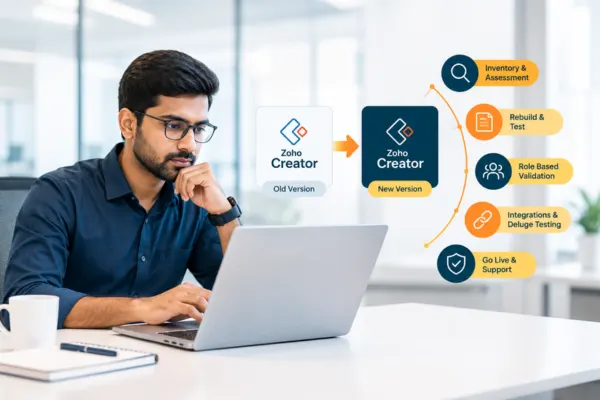
1. Discovery & Application Audit

We inventory the application as it stands: forms and fields, reports and their filters, pages including any custom HTML or CSS, workflows by trigger type, scheduled jobs, connections and connectors, custom functions, published and public forms with their URLs, users, roles, permissions and portal users. Alongside that we list everything outside the app that touches it — external systems calling the Creator API, webhooks pointing at it, other Zoho apps reading from it, and any embedded forms sitting on your website. That external list is where upgrade incidents actually come from.

2. Compatibility Mapping

Each item on the inventory is checked against Creator 6 behaviour and classified: carries over untouched, carries over with a behaviour change to verify, or needs rework. Custom HTML and CSS pages get particular attention because presentation-layer customisation is the least portable part of any Creator app. API-based integrations are checked for the version they call, and Deluge that relies on older integration tasks or response formats is flagged for retesting. You get the classified list as a document before any work starts, so the scope of the upgrade is known rather than discovered.

3. Sandbox Build & Testing

The application is upgraded in a sandbox or non-production environment, never directly in production. Every form is submitted, every report opened, every workflow triggered, every scheduled job run early, and every integration exercised against a test endpoint. Testing is done role by role — administrator, each user role, and portal user — because permission behaviour is where a “working” upgrade most often turns out not to be working for the people who actually use it.

4. Rework & Deluge Revalidation

Whatever the mapping flagged gets fixed here. Custom pages are rebuilt against the current page framework. Deluge is revalidated rather than assumed: integration tasks are checked against their current form, API calls are updated to supported versions, and any script that parsed a response by position rather than by key is corrected. Connections and connectors are re-authorised and tested. External integrations are updated in step, so the day you switch, the systems calling your app are already speaking the right version.

5. Cutover, Training & Go-Live

Cutover is scheduled, usually outside business hours, and follows a written runbook: freeze changes, promote, verify a defined checklist, re-point integrations, unfreeze. Users get a short orientation on what has changed in the interface, which for most people is smaller than they fear. We stay on hand through the first working day and the first month-end, because scheduled and periodic jobs only prove themselves when their moment arrives.

The Creator 5 to 6 Upgrade Checklist

This is the list we work through on every upgrade. It is also usable as a self-assessment before you call anyone.

#CheckWhy it matters
1Full inventory of forms, reports, pages, workflows and schedulesYou cannot test what nobody has listed
2Custom HTML / CSS pages identifiedPresentation-layer customisation is the least portable element
3Every external system that calls the app’s API listed, with the API version it usesThe most common source of post-upgrade incidents
4Webhooks and incoming integrations verifiedSilent failures — nothing errors on your screen
5Deluge reviewed for integration tasks and API-dependent callsBehaviour and response handling need retesting, not assuming
6Connections and connectors re-authorisedOAuth grants and connectors are environment-specific
7Published, public and embedded form URLs capturedThese are pasted into websites, emails and QR codes you do not control
8Scheduled workflows listed with their next run timesA missed monthly job is discovered a month late
9Users, roles, permissions and portal users mappedPermission behaviour is where a “successful” upgrade usually fails
10Reports with saved filters and shared views checkedFilters and sharing do not always survive untouched
11Mobile app usage confirmed, including offline behaviourField users notice differences first
12Sandbox test pass completed role by roleAdministrator testing proves nothing about a field user
13Rollback point recorded and rollback conditions agreed in writingDecide what “abort” means before you need it
14Cutover runbook with a named owner and a scheduled windowUpgrades go wrong when nobody owns the sequence

What Changes: Creator 5 to Creator 6

AreaWhat to expectAction in the upgrade
Console and navigationUnified console; apps, BI and analytics reports and integration flows grouped as one solution, organised as Develop, Deploy and ManageShort user orientation; admin retraining on where things now live
Forms and fieldsCore structure carries overVerified field by field during the sandbox pass
ReportsCarry over; filters, sharing and saved views need verifyingChecked per report and per role
Pages with custom HTML / CSSLeast portable area of the applicationRebuilt against the current page framework where needed
DelugeThe language carries forward; integration tasks and API-dependent calls need reviewRevalidated and retested rather than assumed
API integrationsExternal callers must target a supported API versionInventoried, updated and tested before cutover
Connections and connectorsAuthorisations are environment-specificRe-authorised and tested in the target environment
Workflows and schedulesCarry over; timing and triggers need confirmingTriggered early in the sandbox rather than waited for
Users, roles, portal usersCarry over; permission behaviour needs role-by-role testingTested as each role, not as administrator
Environments and release managementDevelopment, sandbox and production separation availableAdopted as part of the upgrade, so future changes are reviewable

Where Your Creator Data Lands in the Zoho Ecosystem

An upgrade is usually the moment the surrounding pieces get tidied up too, which is why we scope the connected apps and integration flows alongside the application itself rather than after it.

Zoho Creator 6

The upgraded application, with environments, release management and the current builder.

Zoho Analytics

Reporting that goes beyond in-app reports, now reachable from the same console.

Zoho Flow

Integration flows managed alongside the app rather than as a separate concern.
Zoho CRM, Books and Desk

The connected apps whose integrations are re-tested as part of the upgrade rather than after it.

Zoho One

Where most upgrading customers already are, and where the consolidated console makes the most difference.
Creator 5 to 6 Migration Cost & Timeline

What drives the cost:
  • Application size β€” form, report, page and workflow counts
  • Custom HTML and CSS pages β€” usually the single largest rework item
  • Integration count β€” every external caller has to be inventoried, updated and tested
  • Deluge volume β€” particularly scripts using integration tasks or parsing API responses
  • Roles and portal users β€” testing effort scales with the number of distinct permission profiles
  • Number of applications β€” several apps sharing users and data are upgraded in a planned sequence.

Β 

Rough guide by application size:
  • Small (a handful of forms and reports, no custom pages, no external integrations): days to a couple of weeks, mostly testing
  • Mid-sized (a departmental app with custom pages, several integrations and real Deluge): a few weeks including sandbox testing and rework
  • Larger (multiple apps, portal users, external systems calling the API, heavy customisation): phased app by app with a runbook per cutover.

Β 

We quote after the audit. The audit is also the deliverable that tells you whether this is a two-week exercise or a two-month one β€” which is worth knowing before you commit either way.

How We Minimize Downtime and Risk

Nothing is done in production first. The upgrade is built and exercised in a sandbox or non-production environment, and your live Creator 5 application keeps running untouched while testing happens.

Nothing is done in production first

The upgrade is built and exercised in a sandbox or non-production environment. Your live Creator 5 application keeps running untouched while testing happens.

We test as every role, not as the administrator

Administrator access hides permission problems. Each role and portal user profile is tested against the workflows and reports they actually use.

We freeze changes only for the cutover window

App changes and, where relevant, data entry pause for a short scheduled window while the promotion and verification runbook is executed β€” typically outside business hours.

We agree the rollback before we start

A recorded restore point, a named decision-maker, a defined abort window, the criteria that trigger it, and the sequence for re-pointing integrations back. The Creator 5 application is not decommissioned on cutover day.

Post-Migration Support

Go-live is a checkpoint, not the end of the project — scheduled and periodic jobs only prove themselves when their moment arrives.

Verification

The cutover checklist is executed and signed off β€” forms submitting, reports rendering, workflows firing, integrations exchanging data, portal users able to log in.

User orientation

Short sessions on what changed in the interface, plus admin training on environments and release management, which is the part your team will use most going forward.

Hypercare period

A monitored window covering the first working days and, critically, the first month-end β€” scheduled and periodic jobs only prove themselves when their moment arrives.

Ongoing support

Enhancement work using the newer capability once the upgrade is stable, including the features that were the reason to move in the first place.

Ready to Upgrade Your Creator 5 App?

Still on Creator 5? The audit is the sensible first step whether or not you upgrade with us. We inventory your application, classify every element as carries-over, verify or rework, list every external system that calls it, and give you a scope, a timeline and a rollback plan.
Why Choose Us for Zoho Creator Version Migration?

Why Choose Us for Zoho Creator Version Migration?

Most of what is written about this upgrade is either a Zoho help article covering the platform in general or a short partner blog describing it as painless. Neither tells you what will break in your application, because neither has looked at it. As a Certified Zoho Premium Partner, Techvaria works on Creator applications as core practice, which means we can read yours, test it properly and fix what needs fixing rather than reassuring you.

The discipline is unremarkable and it is the whole job: inventory before touching anything, classify every element in writing, rebuild in a sandbox, test role by role, revalidate Deluge and integrations rather than assuming they carry, cut over on a runbook with an agreed rollback, and stay for the first month-end. Upgrades that go wrong almost never fail on the platform. They fail on the integration nobody listed and the permission nobody tested.

Hear From Our Clients

Industries We Upgrade Creator Apps For

Frequently Asked Questions

The application moves to the newer version, but “automatic” is misleading for anything beyond a simple app. Custom pages, external API callers, connectors and permission behaviour all need verification, and Zoho’s own migration guide documents differences area by area for exactly that reason. The audit tells you which category your app is in.

Two things, consistently. Custom HTML and CSS pages, because presentation-layer customisation is the least portable part of any Creator app; and external integrations calling an older API version or an old URL pattern, which fail silently — nothing errors on your screen, data just stops arriving.

Deluge carries forward, but it should be revalidated rather than assumed. Integration tasks, API-based calls and any script that parses a response by position instead of by key are the parts to retest, along with connections and connectors, which need re-authorising in the target environment.

A small app with no custom pages and no external integrations is days to a couple of weeks, most of it testing. A departmental app with custom pages, several integrations and substantial Deluge is a few weeks including sandbox work. Multiple apps are phased.

Yes, and the plan is written before the cutover: a recorded restore point, an agreed abort window, named criteria for triggering it, a decision-maker, and the sequence for re-pointing integrations back. The Creator 5 application stays available through verification rather than being decommissioned on cutover day.

Less than they expect. The console and navigation are reorganised, so a short orientation covers most users. Administrators need more, mainly around environments and release management — which is a genuine change in how the app is maintained, and a beneficial one.

That is exactly why they are on the checklist. Published, public and embedded form URLs are captured before the upgrade and verified afterwards, because they live in websites, emails and printed material that you do not control and cannot easily update.

Existing applications keep running, so there is no emergency. The cost is gradual: new capability, documentation and support attention follow the current version, and the gap between what your app does and what the platform offers grows. The practical trigger is usually the next significant change you want to make to the app.

Resources

Latest Blogs