
The decision nobody schedules
Dubai is absorbing new companies at considerable scale. According to Khaleej Times, reporting Dubai Chamber of Commerce Chairman Sultan Al Mansoori, 37,373 companies joined the Dubai Chamber of Commerce in the first nine months of 2026, with members’ exports and re-exports reaching AED 252 billion over the same period.
Behind each of those registrations is a group, a founder or a parent company working through a familiar sequence: licence, visas, bank account, office. Those steps have owners, deadlines and specialists.
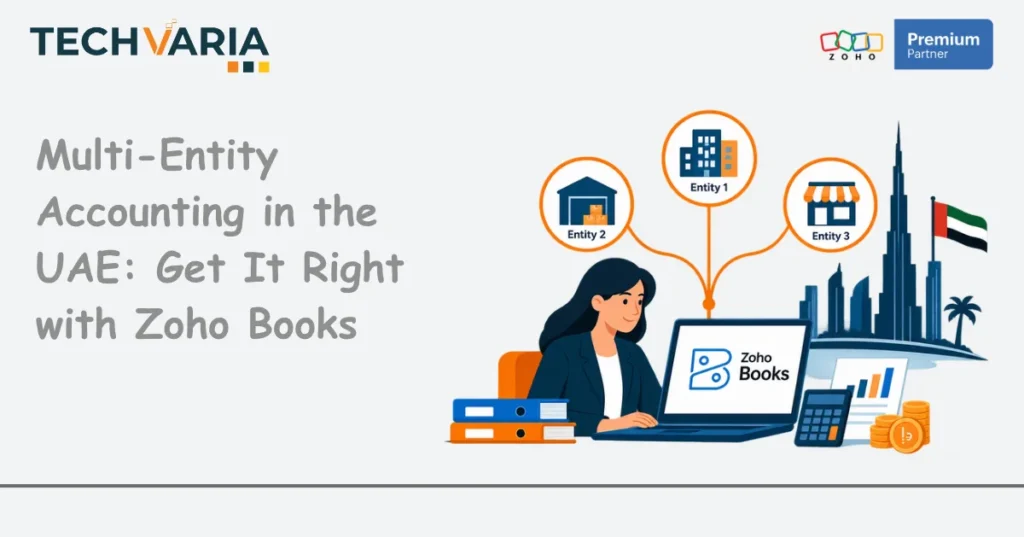
Then the entity needs to invoice someone, and a question arrives that nobody scheduled. Where do these transactions live? In the parent’s existing accounting system, as another branch or department? Or in a separate organisation of its own?
In most groups this gets decided in an afternoon by whoever needs to raise the first invoice. It is treated as administrative. It is not. UAE VAT filing, corporate tax, payroll under the Wage Protection System and, from 2027, e-invoicing all attach to the legal entity, while group management reporting wants everything consolidated in one place. Those two pulls point in opposite directions, and the structure you pick decides which one you serve easily and which one you fight every month.
It is also close to one-way. Once a few hundred transactions have posted, unwinding the choice means a migration with opening balances, tax history and audit trail, which is a project, not an afternoon.
This article is for the person who owns that decision: a group finance director, a CFO, the managing director of a new UAE entity. It covers what the UAE attaches to the entity, how to choose between structures, and what to set up before the first invoice rather than after the first audit.
Techvaria is a Zoho implementation and consulting partner, not a tax adviser, auditor or company formation specialist. Tax positions and licensing questions should go to the relevant qualified adviser.
Why it matters more in the UAE than elsewhere
Groups that have set up entities in several countries sometimes assume the UAE is a light-touch jurisdiction where structure matters less. That was arguably true once. It is less true every year, and three things changed in 2026 alone.
Input VAT recovery now depends on supplier evidence. FTA Decision No. 13 of 2026 introduced supplier and supply due diligence as a condition of recovering input tax from 1 October 2026. The verification records supporting it sit against supplier master data, which lives in whichever organisation holds the purchase ledger. Our guide to the October 2026 input tax recovery changes covers that in detail.
Payroll timing is now fixed. Ministerial Resolution No. 340 of 2026, in force 1 June 2026, makes wages for a month due on the first day of the following month, with enforcement escalating from the second day. A UAE entity with staff runs a UAE payroll cycle, whatever the group’s calendar elsewhere.
E-invoicing arrives at the entity. Phase 1 applies from 1 January 2027 to businesses with annual revenue of AED 50 million or more, using the PINT AE standard through an accredited service provider. Whether your UAE entity meets that threshold is a question about that entity’s revenue, and the invoices it will have to transmit are issued from wherever its sales ledger sits. Our UAE e-invoicing readiness guide covers the preparation.
Add VAT registration and filing, corporate tax registration and record retention, and the pattern is clear. The UAE does not ask the group questions. It asks the entity. If your systems cannot answer at entity level without manual extraction, every one of those obligations becomes a monthly reconciliation exercise.
The cost shows up quietly. Nobody files a complaint about structure. It appears as a finance team that spends the first week of every month separating UAE transactions from everything else, a VAT return assembled in a spreadsheet, and a group consolidation that never quite agrees with the local statutory accounts.
One organisation or two: how to decide
Strip away the software and there are two structures, with a third that is sometimes mistaken for a solution.
Separate organisation per entity. The UAE entity has its own books, its own chart of accounts, its own tax configuration and its own reporting. Group reporting is produced by consolidating across organisations.
Single organisation, entity as a dimension. Everything sits in one set of books, with the UAE entity identified by a branch, department, location or cost centre tag. Group reporting is native; entity reporting is a filter.
The third option, single organisation with a plan to split later, is the one that causes the most damage, because it is not a structure. It is a decision deferred until splitting is expensive.
How to choose:
| If this is true | Lean toward |
|---|---|
| The UAE entity has its own VAT registration and files its own returns | Separate organisation |
| The entity will have UAE employees on WPS payroll | Separate organisation |
| The entity may cross the e-invoicing revenue threshold | Separate organisation |
| Statutory accounts must be produced for the UAE entity | Separate organisation |
| The entity is a cost centre only, with no local invoicing or employment | Single organisation with a dimension |
| The entity is a representative office with no trading activity | Single organisation with a dimension |
| Group consolidation is needed monthly and quickly | Either, but plan the consolidation method deliberately |
| Intercompany transactions between parent and UAE entity will be frequent | Separate organisations, with an intercompany process designed up front |
The short version: if the UAE entity has its own tax registration, its own employees or its own statutory accounts, it almost certainly needs its own books. Those obligations are entity-level, and trying to serve them from a dimension inside a larger ledger means every filing starts with an extraction you have to trust.
The honest counterweight is that separate organisations cost more and make consolidation a deliberate exercise rather than a default report. That is a real trade-off, not a technicality, and for a genuinely small cost centre the single-organisation route is the right answer.
What your UAE entity inherits on day one
Useful to see together, because these attach to the entity rather than the group, and each has a different trigger:
| Obligation | What triggers it |
|---|---|
| VAT registration and filing | Taxable supplies and imports measured against the registration thresholds, assessed for the entity |
| Input tax due diligence | Recovering input VAT, from 1 October 2026 under FTA Decision No. 13 of 2026 |
| Corporate tax registration and filing | Being a taxable person under the corporate tax regime |
| Payroll under WPS | Employing staff under a MoHRE licence, with wages due the first of the following month under MR 340 of 2026 |
| E-invoicing | Annual revenue of AED 50 million or more brings the entity into Phase 1 from 1 January 2027 |
| Record retention | Statutory retention periods, which differ by regime and are longer than most groups assume |
Two notes of caution, both deliberate. Thresholds, effective dates and scope change, and several of these sit with specialist advisers rather than with an implementation partner. Confirm your own position with the Federal Tax Authority, MoHRE or a qualified UAE adviser rather than taking a general article as a compliance checklist. What this article can tell you is which of these are entity-level questions, and all of them are.
Where Zoho fits, and what it does not promise
Zoho Books supports multiple organisations under one account. Per Zoho’s own knowledge base, you create a new organisation from the organisation menu, either starting fresh or duplicating an existing one, and each new organisation begins with a 14-day trial of the Premium plan, after which, in Zoho’s words, “you will have to subscribe to a plan based on your business needs separately.”
That last point is worth reading twice, because it carries a planning consequence: each organisation is its own subscription, so the separate-organisation route has a licensing cost that the dimension route does not.
More significant is what the documentation does not say. The page describing how to manage multiple organisations does not describe transferring data between them. It does not set out a supported path for moving transactions, balances or history from one organisation into another.
That absence is not proof that it cannot be done. Data can usually be moved with export, transformation and import, and that is what a migration project is. But it means you should plan on the practical basis that the structure you choose is the structure you keep, and that changing it later is a project with a budget rather than a setting you toggle.
Mapped to the decision:
| Requirement | Capability | Outcome |
|---|---|---|
| Entity-level VAT filing | A separate Zoho Books organisation with its own tax configuration | The return comes from the books rather than from an extraction |
| Group visibility across entities | Zoho Analytics across organisations | Consolidated reporting without collapsing the statutory separation |
| One login across the group | Zoho One for the user and application layer | People work across entities without duplicate identities |
| Shared pipeline, separate ledgers | Zoho CRM for the commercial relationship, with Books per entity | Sales see one customer; finance sees the right entity |
| UAE payroll on a UAE cycle | Zoho Payroll for the UAE entity | The local wage cycle runs to the local deadline |
Three limitations worth stating
- Consolidation is a reporting exercise, not a button. Reporting across organisations in Zoho Analytics requires the chart of accounts and dimensions to be aligned at setup. Organisations configured independently will not consolidate cleanly, and retrofitting alignment is tedious.
- Intercompany transactions need a designed process. Nothing automatically mirrors a sale in one organisation as a purchase in another. If parent and UAE entity will trade with each other, decide how that is recorded and reconciled before it starts.
- No configuration makes you compliant. It makes the entity’s position reportable and the evidence retrievable. Whether your VAT treatment or corporate tax position is correct is a question for your tax adviser.
Dubai and UAE considerations
Mainland and free zone are not the same question. A free zone entity, a mainland LLC and a branch of a foreign company have different licensing, reporting and in some cases tax positions. Confirm which you have before deciding how to model it, because the entity’s legal form drives what has to be reported separately.
Data residency is a decision available to you. Zoho operates data centres in the UAE, which matters to entities serving government, semi-government or regulated clients who ask where data is held. Our guide to Zoho’s UAE data centres covers how that choice is made and what moving an existing account involves. Deciding this at setup is considerably easier than revisiting it.
Arabic requirements vary by document and counterparty. Decide which templates and documents need Arabic output before go-live rather than during a client onboarding.
The group’s financial year may not suit the entity. Align deliberately rather than by default, and take the tax year question to your adviser.
Regional headquarters structures add a layer. Groups establishing a UAE regional HQ serving several markets are making a more complex version of the same decision, usually with intercompany recharges that need designing from the start.
Best practices
- Decide the structure before the first invoice, not after the first quarter. Ten minutes of thought in week two is worth more than a migration in month nine.
- Let entity-level obligations drive the choice. Tax registration, employees and statutory accounts are the deciding tests. Convenience is not.
- Align the chart of accounts across organisations at setup, even where local statutory requirements differ. This is what makes consolidation possible later.
- Design intercompany before you need it. The first recharge is the moment to have a process, not to invent one.
- Keep the customer in one place and the ledger in the right place. One CRM record for the relationship; the invoice raised from the entity that made the supply.
- Write down who owns what. Which team closes the UAE books, who files the VAT return, who approves payroll. In new entities this is usually assumed rather than agreed.
Common implementation mistakes
- Deferring the structure decision. The most expensive mistake available, because the cost grows with every posted transaction.
- Copying the parent’s configuration wholesale. A chart of accounts built for Indian GST or UK VAT will not serve UAE VAT reporting without rework.
- Treating the UAE entity as a department. It works until the first VAT return, then every filing becomes an extraction exercise.
- Ignoring the licensing cost of separate organisations. Each is its own subscription. Budget for it rather than discovering it.
- Leaving consolidation until year end. If the accounts do not consolidate in month two, they will not consolidate in month twelve either.
- Assuming you can merge or split later. Zoho’s documentation on managing multiple organisations does not describe moving data between them. Plan as though the choice is permanent.
An illustrative scenario
The following example is entirely fictional. It is not a Techvaria client, and the details are invented to illustrate the mechanics described above.
A mid-sized engineering group headquartered outside the UAE sets up a Dubai entity to serve regional clients. The licence comes through in March. The group finance director is managing the setup alongside a full workload, and the Dubai general manager needs to invoice a client in the first week of April.
The quickest route is to add the Dubai entity as a branch in the group’s existing accounting system. It takes an afternoon. The first invoice goes out on time.
By the third quarter the picture has changed. The entity is VAT registered and filing its own returns, which the group accountant assembles each quarter by filtering branch transactions into a spreadsheet and checking them by hand. Four UAE employees have been hired, so payroll runs on a UAE cycle that does not match the group’s. The auditors appointed for the entity’s statutory accounts ask for a trial balance that the branch structure cannot produce directly.
None of this is a crisis. It is about three days of avoidable work every month, and a nagging uncertainty about whether the VAT return and the management accounts actually agree.
The group eventually separates the entity into its own organisation. The work is not conceptually difficult (opening balances, the tax history, reconciling the cut-over) but it takes a cycle to do properly and it happens during a busy period, because that is when the auditors asked.
Nothing here required better software. It required the structure question to be asked in March, when the answer was free.
Where this applies
- Foreign groups establishing a first UAE entity: the core case, and the one where local obligations are least familiar.
- Regional headquarters serving several markets, where intercompany recharges and shared costs make the structure decision more consequential.
- UAE businesses adding a second entity, whether a free zone company alongside a mainland one, or a new trading entity for a different activity.
- Groups consolidating after acquisition, where two existing sets of books have to coexist before any rationalisation.
- Professional services and contracting firms opening a UAE arm, where local employment and client invoicing both start quickly.
Implementation guidance
- Establish what the entity actually is. Legal form, licensing authority, whether it will register for VAT, whether it will employ staff, whether statutory accounts are required. This determines the structure and takes a conversation, not a project.
- Make the structural decision explicitly, using the tests above, and record the reasoning. Successors will ask.
- Design the chart of accounts for alignment, so entity reporting and group consolidation can both be served.
- Configure UAE tax deliberately. VAT treatments, tax codes and reporting mapped to how the entity will actually file, not copied from the parent.
- Set up supplier and customer master data with the new obligations in mind, including the verification fields the October 2026 due diligence requirements expect.
- Plan intercompany before the first recharge: how it is recorded, who reconciles it, how often.
- Define roles and permissions across entities. Who sees the group, who sees only the UAE entity.
- Decide consolidation method and test it in month one, not at year end.
- Run one full cycle before you trust it: a month-end close, a VAT return, a payroll run.
- Review after the first quarter and tighten. If the entity is one of several, the pattern you settle now becomes the template, so our Zoho Books implementation page covers how the configuration work is usually scoped.
Approaches compared
| Approach | Works when | Where it breaks |
|---|---|---|
| Separate organisation per entity | Entity has its own tax registration, employees or statutory accounts | Higher licensing cost; consolidation must be designed |
| Single organisation, entity as a dimension | Cost centre or representative office with no local invoicing or employment | Every entity-level filing becomes an extraction |
| Single organisation now, split later | Nothing: this is a deferral, not a structure | Splitting cost rises with every transaction posted |
| Separate systems entirely per entity | Rare; usually the result of acquisition | No shared customer view, duplicated effort, painful consolidation |


Director @ Techvaria | Solutions Architect | Low-Code & AI Automation for Growth | Proven Expertise in Digital Transformation Across Industries
