
Zoho Creator and Odoo Integration
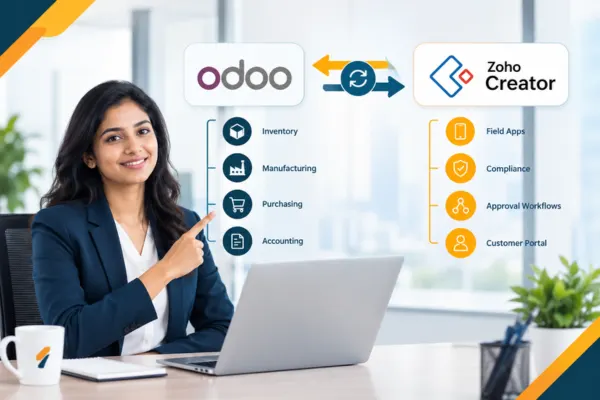
Businesses running Odoo as their ERP frequently need operational applications Odoo does not cover well β field inspections, site data capture, custom approval flows, or processes that would require expensive Odoo module development to support. Building those in Zoho Creator and integrating them with Odoo gives you the right tool for each layer. Techvaria builds that integration properly: authenticated API connections, defined field mapping, a single system of record per field, error handling, and logging so failures surface immediately.
Home / Zoho Creator and Odoo Integration
Why Businesses Run Creator Alongside Odoo
Odoo is strong where its single-database model is the advantage: inventory, manufacturing, purchasing, and accounting operating on one data model with no synchronisation between them. It is less well suited to the peripheral operational applications that sit around that core β a site inspection app for field teams, a contractor compliance tracker with certificate expiry alerts, a custom approval workflow that does not map to any Odoo module, or a customer-facing submission portal. Building these in Odoo means custom module development in Python, which requires a developer with Odoo framework expertise, carries upgrade risk across Odoo version changes, and typically takes considerably longer than the equivalent Creator build.
Building them in Creator and integrating back to Odoo keeps the ERP as the system of record for the data that belongs there β products, partners, stock, invoices β while the operational application handles the process layer. The integration is the part that decides whether this works. Done properly, the two systems stay in agreement without duplicate entry. Done poorly, you get duplicate records, silent sync failures, and two systems disagreeing about the same figure.
Business Challenges We Solve
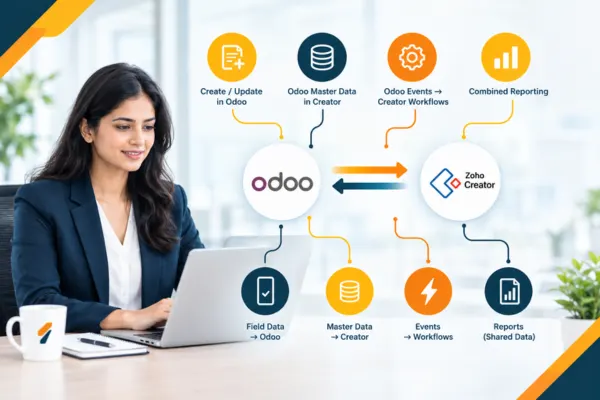
The integration requirements we are asked to build follow a few consistent patterns. Field data captured in Creator needs to create or update records in Odoo β a delivery confirmation creating a stock move, an inspection result updating an equipment record, a site measurement generating a sales order. Odoo master data needs to be available in Creator β the product catalogue, partner list, or price list, so the operational app works against current data rather than a stale copy. Odoo events need to trigger Creator workflows β a confirmed sales order generating an installation job, a purchase receipt initiating a quality inspection. And in some cases, reporting needs to combine data from both, which requires a defined position on where each figure originates.
Whatβs Included
The difficulty in each case is not the API call itself. Odoo exposes a well-documented XML-RPC interface and, in recent versions, REST access, and Creatorβs Deluge invokeurl handles authenticated calls to both. The difficulty is everything around it: deciding which system owns each field so updates do not fight each other, handling the case where a record exists in one system and not the other, preventing an update in system A from triggering a sync that updates system B which triggers a sync back, managing what happens when Odoo is unreachable or the credential has expired, and making sure a failure is visible rather than silent. These are design decisions, and getting them right at the start is the difference between an integration that runs unattended and one that needs weekly manual reconciliation.
Integration Design and System-of-Record Definition
Before any code, we define which system owns each shared field and in which direction each record type flows β the decision that prevents most integration failures before they can occur.
Odoo API Connection and Authentication
Authenticated connection to Odoo via XML-RPC or REST depending on your version and hosting, with credentials held securely and connection health monitored rather than assumed.
Field Mapping and Data Transformation
Explicit mapping between Creator form fields and Odoo model fields, including transformation where formats, units, or reference structures differ between the two systems.
Two-Way Record Synchronisation
Creator to Odoo and Odoo to Creator flows built with matching keys and loop prevention, so an update on one side does not trigger an endless sync cycle back and forth.
Master Data Sync
Product catalogue, partner records, price lists, and other Odoo master data made available in Creator, refreshed on a schedule or on demand, so the operational app works against current data.
Error Handling, Retry, and Logging
Every call validated for response, failures logged to a dedicated record with the payload retained, retry logic where the failure mode warrants it, and alerting so nobody discovers a broken sync weeks later.
Reconciliation Reporting
A view showing records that failed to sync, records present in one system but not the other, and field-level discrepancies β so the integrationβs health is verifiable rather than assumed.
Documentation and Handover
The integration architecture, field mapping, trigger points, and failure handling documented so the connection remains maintainable by your team or another developer.
Zoho Applications We Use for This
Creator carries the integration logic. The applications below are the Zoho products most often involved on the Zoho side of an Odoo connection.
Zoho Creator
The application layer where the operational process runs, and where the Deluge integration logic is written and maintained
Zoho Flow
Used where a straightforward trigger-and-action connection is sufficient and custom Deluge would be unnecessary overhead
Zoho CRM
Where the business also runs Zoho CRM and customer data must stay consistent across CRM, Creator, and Odoo
Zoho Analytics
Combined reporting drawing on both Creator and Odoo data where management reporting spans the two systems

Zoho Books
Relevant only where a business runs Books alongside Odoo for a separate entity, requiring a defined boundary between them

Where This Applies
This applies to businesses that have Odoo in place as the ERP and a process requirement Odoo does not serve well. Manufacturers running production and inventory in Odoo who need shop-floor quality inspection, machine maintenance records, or job card capture on tablets. Distribution businesses using Odoo for purchasing and stock who need route-based delivery with mobile proof of delivery. Construction and contracting firms using Odoo for accounting and procurement who need site progress capture, subcontractor compliance tracking, and safety inspection records. Services businesses using Odoo for invoicing who need a field service or installation workflow with photo capture and customer sign-off.
It applies particularly where the alternative is custom Odoo module development. That path is viable but carries a specific cost profile: framework-level Python development, a developer dependency for every change, and regression risk at each Odoo version upgrade. Where the requirement is a peripheral process rather than a core ERP function, building it in Creator and integrating usually delivers faster and stays easier to change afterwards.
It also applies to businesses partway through this arrangement already β running both systems with a manual or partial connection between them, and finding that the reconciliation effort is consuming the benefit. Formalising the integration properly is usually a contained project with an immediate operational return.
Ready to Connect Creator and Odoo?
Why Choose Techvaria for This Integration
Techvaria is a Zoho Premium Partner and an Odoo Silver Partner, which means both sides of this integration are within our own practice rather than one side being a system we work around. We know Odooβs data model and API behaviour and we know Creatorβs execution characteristics, and the integration design reflects both. We build with error handling, logging, and reconciliation reporting as standard, and we document the connection so it remains maintainable. Where the honest answer is that a requirement belongs in Odoo as a module rather than in Creator, we are equipped to say so and to build it there instead.
Hear From Our Clients
Industries We Serve
Frequently Asked Questions
Through Odooβs API. Odoo exposes an XML-RPC interface supported across versions, and REST access in more recent releases. Creator makes authenticated calls to these from Deluge using invokeurl, and can receive inbound data from Odoo via webhook where your Odoo instance is configured to send it. The connection method depends on your Odoo version and whether it is Odoo Online, Odoo.sh, or self-hosted.
Both, with a caveat. Self-hosted and Odoo.sh instances give full API access and the ability to configure outbound webhooks. Odoo Online restricts custom server-side code, which limits how Odoo can push events outward β in that case the integration is typically polled from the Creator side on a schedule rather than triggered from Odoo. We confirm what your specific instance supports during scoping.
Yes, and most integrations we build are bidirectional. The critical design work is defining which system is authoritative for each field so updates do not conflict, and implementing loop prevention so an update written to Odoo does not trigger a sync that writes back to Creator and repeats. Both are design decisions made before any code is written.
Failures are caught, logged with the full payload retained, and alerted. Where retrying makes sense β a timeout or a temporary unavailability β retry logic runs automatically. Where it does not β a validation rejection or an authentication failure β the record is flagged for attention with the error reason. The principle is that no failure is silent, which is the most common weakness in integrations we are asked to repair.
Sometimes you should, and we will say so if the requirement is genuinely a core ERP function. The case for Creator is peripheral operational applications: faster to build, easier to change afterwards, no framework-level Python dependency, native mobile with offline capture, and no regression risk at Odoo version upgrades. The case for Odoo is anything that needs to sit inside the ERPβs own data model and transactional integrity.
Through matching keys agreed at design time β an external reference stored in both systems that uniquely identifies the same record on either side. Every sync checks for an existing match before creating, and creation only occurs when no match is found. Where the source data has no reliable unique key, establishing one is part of the integration design work.
Two to five weeks for most implementations, depending on how many record types flow, whether the sync is one-way or two-way, and what transformation is required between the two data models. Master data sync alone is at the shorter end. Full bidirectional transactional sync across several record types is at the longer end.
Yes. Integrations need maintenance β APIs change, credentials expire, business rules evolve. Most clients move onto a retained support arrangement covering integration monitoring and enhancement. Where you would rather maintain it internally, the documentation and reconciliation reporting are built to support that.