

Skip to content

Zoho Creator and WhatsApp Integration

Email notifications from business applications get ignored. WhatsApp messages get read, usually within minutes. For businesses whose customers, drivers, technicians, and suppliers live on WhatsApp rather than in an inbox, connecting your Creator application to the WhatsApp Business API changes the response rate on everything from order confirmations to approval requests. Techvaria builds that integration properly β€” with the template approvals, session window rules, and delivery logging that the WhatsApp Business Platform actually requires.

Why WhatsApp Integration Needs More Than an API Call

Why WhatsApp Integration Requires More Than an API Call

Sending a WhatsApp message from Creator is technically a single API call. Building something that works reliably in production requires understanding the rules WhatsApp imposes around that call, and most failed implementations fail on those rather than on the code.

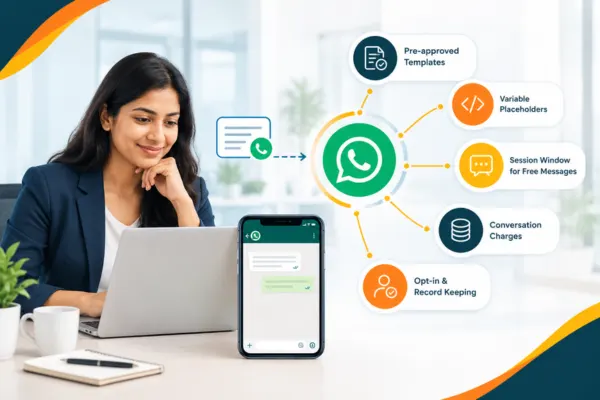
Business-initiated messages outside a 24-hour customer service window must use pre-approved message templates, submitted to Meta and reviewed before they can be sent β€” which means the message content has to be designed and approved before the application goes live, not written on the fly. Templates have variable placeholders with formatting constraints, and a template rejected for policy reasons has to be reworded and resubmitted. Free-form messages are only permitted within a session window opened by the customer’s own message, which shapes how two-way flows must be structured. Business-initiated conversations are charged per conversation with rates that vary by category and country. Opt-in is required, and how you collect and record it matters. None of this is difficult once understood, but it does mean that a WhatsApp integration is a design exercise before it is a development one β€” and the businesses that get value from it are the ones that plan the message flow and the template set at the start.

Business Challenges We Solve

The requirement usually starts with a communication failure that email cannot fix. Customers are not seeing order confirmations or delivery notifications, so they call the office instead β€” turning an automated notification into a staffed phone line. Approvals sit unactioned because the approver is out of the office and does not open email on their phone. Drivers and field technicians need job details and need to confirm completion, but installing and training them on an application is disproportionate to what they actually need to do. Suppliers need purchase order confirmations and delivery reminders that reliably get read. Customers need to check an order or ticket status without calling, and the cost of that call volume is measurable.

What’s Included

Creator integrates with the WhatsApp Business API through authenticated REST calls from Deluge, either directly against the Meta Cloud API or through a Business Solution Provider depending on your setup. Outbound flows are triggered by workflow events in the application β€” an order confirmed, a delivery dispatched, an approval requested, a certificate approaching expiry. Inbound flows use webhooks to capture replies and route them back into the Creator record, so a supplier confirming a purchase order or an approver replying to a request updates the record without anyone transcribing it. Every message sent, delivered, read, and failed is logged against the source record, so the communication history is auditable and delivery failures are visible rather than assumed.

WhatsApp Business API Setup and Verification

Business verification with Meta, phone number registration, and account configuration β€” either directly on the Cloud API or through a Business Solution Provider, whichever fits your volume and existing arrangements.

Message Template Design and Approval

Templates designed for each notification type, written to pass Meta’s policy review, submitted, and tracked through approval β€” including rewording and resubmission where a template is rejected.

Outbound Notification Workflows

Messages triggered from Creator events: order confirmations, dispatch notifications, appointment reminders, approval requests, payment reminders, and expiry alerts, with variables populated from the record.

Two-Way Message Handling

Inbound webhook capture of customer and supplier replies, routed back to the originating record in Creator, with session window logic determining whether a free-form or template response is required.

Interactive Buttons and List Messages

Quick-reply buttons and list options where a structured response is needed β€” an approver confirming or rejecting, a customer selecting a delivery slot, a driver marking a job complete β€” captured directly as a record update.

Media and Document Sending

Invoices, delivery notes, certificates, and images sent as WhatsApp attachments generated from Creator or Zoho Books, so documents reach the recipient in the channel they actually use.

Delivery Logging and Failure Handling

Sent, delivered, read, and failed status recorded against each message and its source record, with failures alerted rather than silent, and retry logic where the failure is transient.

Opt-In Management and Compliance

Opt-in captured and recorded against each contact with timestamp and source, opt-out handled automatically, and message frequency managed to stay within policy and avoid quality rating damage.

Zoho Applications We Use for This

The message goes out over WhatsApp. These are the Zoho applications that generate the events behind it and hold the records the replies return to.

Zoho Creator
Zoho Creator

The application generating the events, holding the Deluge integration logic, and storing the message log against each record
Zoho CRM
Zoho CRM

Customer contact records, opt-in status, and communication history where WhatsApp is part of the customer relationship

zoho books
Zoho Books

Invoice and payment reminder documents sent as WhatsApp attachments with payment status driving the reminder logic

Zoho Inventory
Zoho Inventory

Dispatch and delivery events triggering customer notifications and driver job messages
Zoho Desk
Zoho Desk

Support ticket updates and resolution notifications delivered over WhatsApp alongside the ticket record
Zoho Flow
Zoho Flow

Orchestration for straightforward trigger-to-message flows where custom Deluge is unnecessary

Where This Applies

This applies wherever your audience is more reliably reached on WhatsApp than by email β€” which in India and the UAE covers most customer, supplier, and field workforce communication. Distribution and retail businesses sending order confirmations, dispatch notifications, and delivery windows to customers who would otherwise call to check. Logistics operations pushing job details to drivers and capturing delivery confirmation without requiring an app installation. Service businesses sending appointment reminders, technician-en-route notifications, and completion confirmations. Manufacturers sending purchase order confirmations and delivery reminders to suppliers, and capturing acknowledgement. Real estate and facilities operators sending maintenance updates and contractor job assignments.

It applies with particular value to approval workflows. An approval request delivered as a WhatsApp message with accept and reject buttons is actioned in minutes rather than days, and the response writes straight back to the Creator record with the approver identity and timestamp preserved. For businesses where approval delays are a genuine operational cost β€” purchase orders held, dispatches waiting, credit decisions pending β€” this is often the flow that justifies the whole integration.

It also applies to reducing inbound call volume. A meaningful share of customer service calls in operational businesses are status enquiries. Proactive WhatsApp notification at each status change removes the reason for most of those calls, and where enquiries still come, a two-way flow can answer them without staffing.

Ready to Reach People Where They Actually Are?

A scoping session maps which events should generate messages, what each message needs to say, where two-way responses are required, and what your current WhatsApp Business setup is β€” or what setting one up involves. We design the template set first, because approval lead time is the main scheduling constraint on these projects, and build the Creator integration while templates are under review.
Why Choose Techvaria for WhatsApp Integration

Why Choose Techvaria for WhatsApp Integration

Techvaria is a Zoho Premium Partner building operational applications on Zoho Creator for businesses in India and the UAE, where WhatsApp is the default business communication channel. We build these integrations with the platform’s actual constraints designed in β€” template approval lead time, session window rules, conversation pricing, opt-in recording, and quality rating management β€” rather than discovering them after launch. Every message is logged against its source record, failures are visible, and the message flow is documented so it stays maintainable as your process changes.

Hear From Our Clients

Industries We Serve

Frequently Asked Questions

A WhatsApp Business API account, which requires a verified Meta Business account and a phone number dedicated to the API β€” it cannot be a number already in use on the consumer WhatsApp or WhatsApp Business app. You also need the message templates designed and approved. We can guide you through the setup or work with your existing Business Solution Provider if you already have one.

Any business-initiated message sent outside a 24-hour window opened by the customer must use a template pre-approved by Meta. Templates have fixed wording with variable placeholders for values like name, order number, or date. Approval typically takes anywhere from minutes to a couple of days, and templates can be rejected on policy grounds and need rewording. Because of this, template design is the first task in the project rather than the last.

Yes. Inbound messages arrive via webhook and are routed to the relevant record in Creator. Within the 24-hour session window opened by the customer’s message, you can respond freely without a template. Structured responses β€” quick-reply buttons or list selections β€” are captured directly as field updates on the record, which is more reliable than parsing free text.

Yes. PDFs generated from Creator or Zoho Books can be sent as attachments, along with images and other supported media types. This is commonly used for invoices, delivery notes, work completion certificates, and site photos. The document is generated, uploaded, and sent as part of the workflow rather than attached manually.

Meta charges per conversation rather than per message, with rates varying by conversation category β€” marketing, utility, authentication, service β€” and by destination country. Rates change periodically, so we do not quote them here; your Business Solution Provider or Meta’s current pricing page will have accurate figures. The practical planning point is that utility and service conversations are considerably cheaper than marketing, and structuring your flows into the right category materially affects cost.

It can, which is why opt-in and message frequency are handled deliberately. Meta assigns a quality rating based on user feedback β€” blocks and reports β€” and a poor rating restricts messaging volume. We build opt-in capture with timestamp and source, automatic opt-out handling, and frequency controls so recipients receive relevant messages rather than volume. Utility notifications people have asked for rarely cause problems; unsolicited marketing does.

Yes, and this is one of the more valuable applications. An approval request is sent with approve and reject buttons; the response writes back to the Creator record with the approver’s identity and a timestamp, advancing the Blueprint stage. Where the approval requires context, the message can include the relevant detail and a link into the application for the full record.

Two to four weeks for most implementations, though template approval sits partly outside our control and can extend the calendar. We build the integration and the message flows while templates are under review, so approval is usually not the critical path. Complex two-way flows with multiple interactive paths sit at the longer end.

Resources

Latest Blogs