
Skip to content

Zoho Creator vs Zoho CRM Custom Modules

Businesses already running Zoho CRM face this decision regularly: a new process needs a home, and it could be a custom module in CRM or a separate application in Creator. Both work. Choosing wrongly produces either a CRM cluttered with modules that do not belong there, or a Creator app that duplicates data CRM already owns. This page sets out the criteria that actually decide it β€” data relationships, user licensing, workflow depth, and where each platform’s limits sit.

Criteria for Choosing Creator or CRM

The Criteria That Actually Decide This

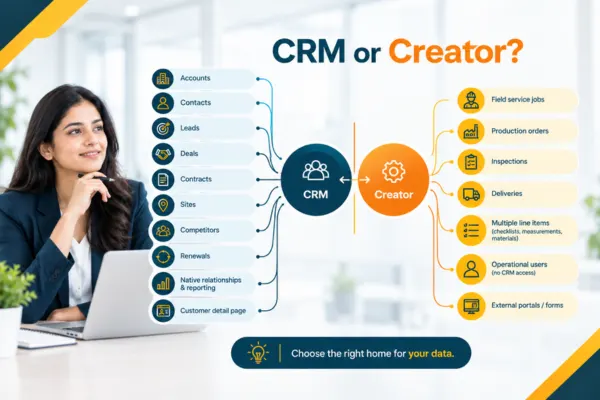
The instinct is to decide on complexity β€” simple in CRM, complex in Creator β€” and that instinct is unreliable. The better test is whether the data belongs to the customer relationship. CRM custom modules are the right home for records that are genuinely about accounts, contacts, leads, or deals and that your sales and account teams need alongside the customer record: a contract, a site associated with an account, a competitor record, a renewal. These benefit from CRM’s native relationships, its views and filters, its reporting, and the fact that they appear on the customer’s detail page where the sales team already works. Creator is the right home for operational processes that happen to involve customers but are not about the relationship: field service jobs, production orders, inspections, deliveries, asset registers.

The practical tells are structural. If the record needs multiple line items β€” a checklist, a set of measurements, a list of consumed materials β€” CRM custom modules have no native subform equivalent and Creator does. If the users are operational staff who need no CRM access, putting the process in CRM means licensing them for CRM, which is materially more expensive than a Creator licence. If external parties need to submit or view data, Creator’s portals and stateless forms handle that directly. Getting this decision right at the start avoids the two expensive corrections: migrating a module out of CRM later, or rebuilding a Creator app because the data should have lived in CRM all along.

What’s Driving This Decision

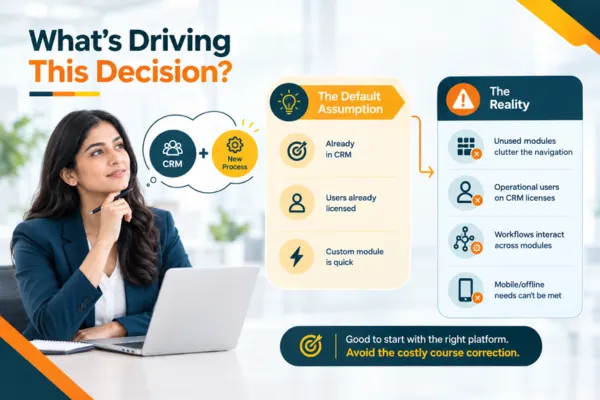
The question typically arises when a business running CRM successfully identifies a new process to systemise. The default assumption is to build it in CRM, because CRM is already there, the users are already licensed, and adding a custom module is quick. That assumption is right often enough to be dangerous β€” it works for the first module and the second, and by the fifth the CRM has become an operational system it was not designed to be. The symptoms are recognisable: modules that no salesperson ever opens cluttering the navigation, operational users licensed for a CRM they use ten percent of, workflow rules interacting across modules in ways nobody fully tracks, and a request for a mobile form with offline capture that CRM cannot satisfy.

What Drives the Creator vs CRM Decision

How the Options Compare

The opposite error is less common but equally costly. Building a Creator application for something that is genuinely customer relationship data means duplicating accounts and contacts into Creator, maintaining a sync between the two, and giving the sales team a second place to look for information about their own customer. Every field synced between two systems is a potential disagreement, and the maintenance cost accumulates. Where the record is about the customer and the audience is the sales team, CRM is the correct home and the sync is an unnecessary cost. The decision is therefore not about which platform is more capable β€” it is about where the data belongs and who needs to work with it.

Data Relationships and Context

CRM custom modules sit natively within the account, contact, lead, and deal relationship graph and appear on the customer record. Creator maintains its own relationships and connects to CRM through integration. Where the record is genuinely about the customer, CRM’s native context is a real advantage that integration cannot replicate.

Multi-Line and Subform Data

Creator supports subforms natively, so a single record can hold a variable list of line items β€” checklist responses, measurements, consumed materials, inspection points. CRM custom modules have no direct equivalent, and workarounds using related lists are clumsier for both entry and reporting.

User Licensing Cost

Operational users who need only the process, not the CRM, are considerably cheaper to license on Creator than on CRM. Where a process involves a large operational headcount β€” warehouse staff, technicians, drivers β€” this difference alone frequently decides the architecture.

External and Portal Access

Creator provides portals for external users with scoped access, and stateless forms allowing external submission without any licence. CRM’s external access options are narrower. Where suppliers, contractors, or customers must submit or view data, Creator is usually the answer.

Mobile and Offline Capture

Creator publishes native mobile applications from the same build, with offline data capture that syncs on reconnection. CRM’s mobile application is designed for sales use rather than structured field data capture, and offline behaviour is more limited.

Workflow and Approval Depth

Both platforms support workflow and approval. Creator’s Blueprint offers stage-controlled process enforcement with granular transition permissions, which suits operational processes with strict sequencing. CRM’s blueprint and workflow are strong within the sales process context they were designed for.

Reporting Audience

CRM reporting is built for the sales and management audience and integrates with CRM dashboards natively. Creator reporting serves the operational audience and can be filtered by role and location. Where both audiences need a view, Zoho Analytics draws from both.

Long-Term Maintainability

A CRM with many unrelated custom modules becomes harder to administer, and workflow interactions across modules become difficult to trace. Separating operational processes into Creator keeps CRM focused on the relationship and keeps each system’s logic contained β€” which matters more the longer both are in use.

Zoho Applications We Use for This

These are the applications involved on either path, and in the hybrid arrangement where both platforms are in play.

Zoho CRM
Zoho CRM

Custom modules, layouts, and workflow where the record belongs to the customer relationship and the audience is commercial

Zoho Creator
Zoho Creator

Standalone operational applications with subforms, portals, mobile offline capture, and Blueprint process control

Zoho Analytics
Zoho Analytics

Reporting that spans CRM and Creator, so management views do not depend on which platform holds which record

zoho books
Zoho Books

Where either path must generate financial records, integration is required regardless of which platform is chosen

Zoho Flow
Zoho Flow

Synchronising records between CRM and Creator where a hybrid architecture is the right answer

Where This Applies

This decision arises in any business running Zoho CRM that is extending into operational process management β€” which is most businesses two or more years into a CRM deployment. Services firms adding project delivery, timesheets, or field service to an existing CRM. Manufacturers and distributors adding production, dispatch, or quality processes alongside their sales pipeline. Real estate and facilities operators adding inspections, maintenance, and contractor management. Equipment suppliers adding installation, servicing, and warranty workflows to a CRM that manages the sale.

It applies particularly at the point where a business is about to add its third or fourth CRM custom module. That is usually the moment to review the architecture as a whole rather than making another incremental decision, because the accumulated effect β€” navigation clutter, licensing cost, workflow interaction complexity β€” is a structural issue that individual module decisions do not surface.

It also applies to businesses already experiencing the consequences: a CRM that operational staff have to be licensed for, a custom module that everyone finds awkward because the data really needed subforms, or a Creator app duplicating customer data that CRM already holds. Correcting these is a defined project and is usually worth doing before more is built on the wrong foundation.

Ready to Get the Architecture Right?

An architecture review examines your current Zoho setup, the processes you are planning to add, and where each one belongs β€” with the licensing implications made explicit. Where existing modules or applications are in the wrong place, we assess whether correcting that is worth the migration effort or whether it is better left alone. The output is a clear plan for what goes where and why.
Why Choose Techvaria for Zoho Architecture

Why Choose Techvaria for Zoho Architecture

Techvaria is a Zoho Premium Partner working across CRM, Creator, Books, People, and Desk, which means we are not defaulting to whichever product we specialise in. We make this decision regularly and we have seen the cost of getting it wrong in both directions β€” CRMs carrying operational weight they were not designed for, and Creator applications maintaining a customer master that duplicates CRM. We assess against data ownership, audience, licensing, and structural fit rather than against complexity alone, and we state the licensing consequence explicitly because it is frequently the deciding factor.

Hear From Our Clients

Industries We Serve

Frequently Asked Questions

Ask who owns the data and who needs to work with it. If the record is about a customer relationship and the sales or account team needs it on the customer’s page, it belongs in CRM. If it is an operational process with its own lifecycle, run by operational staff who do not otherwise need CRM, it belongs in Creator. When the answer is genuinely both, a hybrid β€” CRM as the master for customer data, Creator for the process, with a defined sync β€” is usually correct.

Not natively in the way Creator subforms do. CRM has related lists, which can hold associated records, but entering a variable list of items as part of a single record β€” checklist responses, measurements, consumed materials β€” is clumsier in CRM and harder to report on. If the process requires multi-line data as a routine part of every record, that alone usually points to Creator.

Significantly, and it is often the deciding factor. Users who need only the operational process are cheaper to license on Creator than on CRM. For a business adding a process used by fifty warehouse or field staff, the licensing difference across a few years typically exceeds the entire cost of building the application. Zoho’s current rates for both should be confirmed at the time, as they change periodically.

Creator handles this better. Portals give external users scoped logins with access to their own records, and stateless forms allow submission without any licence at all β€” useful for supplier document uploads or customer request forms. CRM’s external access options are narrower and generally less suited to structured external data capture.

This is common and the answer is a hybrid architecture. CRM remains the master for accounts and contacts; the Creator application references them through an integration rather than duplicating them. Operational data stays in Creator, and the summary the sales team needs β€” job status, service history β€” can be surfaced back into CRM. The critical design decision is defining a single system of record for every shared field.

Not automatically. Migration has real cost β€” data movement, workflow rebuilding, user retraining β€” and if the current arrangement works and the licensing is not a burden, leaving it is often correct. Migration is worth considering where the licensing cost is material, where the CRM has become difficult to administer, or where a limitation such as the absence of subforms is actively constraining the process. We assess this case by case rather than recommending it as a rule.

No, and often the reverse for operational staff. A Creator application presents only the process the user needs, on a purpose-built interface, with a mobile app that works offline. CRM presents a sales-oriented interface with modules and features an operational user has no use for. For non-sales staff, a focused Creator app is typically easier to adopt.

Yes, through Zoho Analytics, which draws data from CRM and Creator into combined dashboards. This means the architecture decision does not have to be driven by reporting β€” management can see a unified view regardless of which platform holds which record, so the decision can be made on the criteria that actually matter.

Resources

Latest Blogs