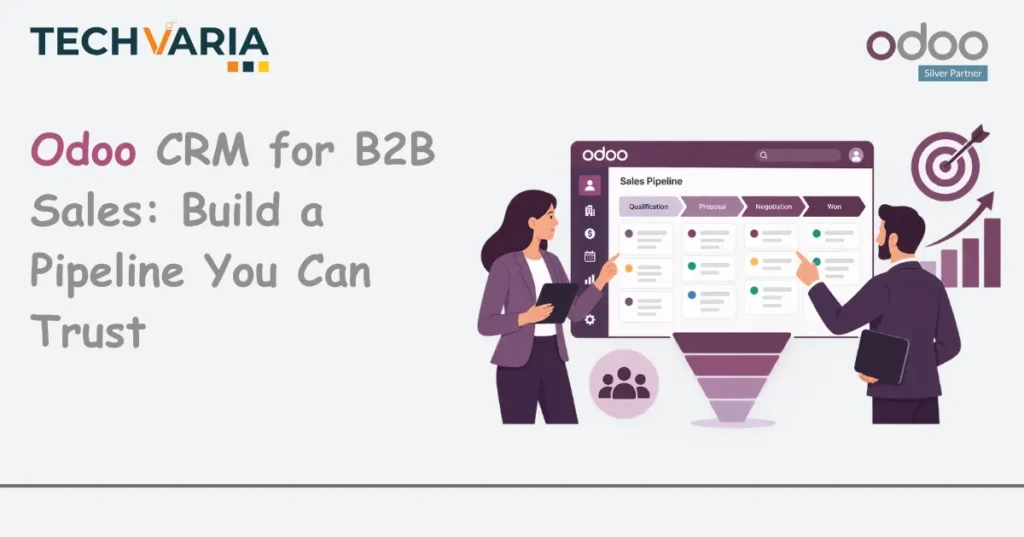
Most B2B sales pipelines are works of fiction, and everybody involved knows it.
The deals sitting in “negotiation” have not been touched in seven weeks. The close dates have been pushed forward three times each. The forecast says ₹4.2 crore, the sales director privately expects ₹2.6 crore, and the CFO plans on ₹2 crore because that is what experience suggests. Nobody is lying. The system simply has no mechanism for distinguishing a deal that is progressing from a deal that is being kept alive out of politeness.
This is not solved by buying a CRM. Plenty of companies have one and still cannot forecast. It is solved by designing a pipeline where stage changes require evidence, where inactivity is visible, and where the quotation the customer received is the same object the forecast is built on.
Odoo CRM has one structural advantage in this that most CRMs cannot match: it sits inside the ERP. The opportunity becomes a quotation with real products at real prices checked against real stock, and that quotation becomes a sales order, a delivery and an invoice without leaving the system. Sales stops being a separate world with its own version of the truth.
This guide covers how to design an Odoo CRM implementation that produces an honest pipeline — stages, scoring, quotations, activity discipline, forecasting and the handoff to delivery. It is written for sales directors, founders, operations heads and finance leaders in B2B businesses.
The Problem: Pipelines That Describe Hope
The failure modes are remarkably consistent across industries.
- Stages describe internal activity, not buyer commitment. “Proposal sent” tells you what your team did. It says nothing about whether the customer has a budget, a timeline or an intention to buy.
- Nothing ever leaves the pipeline. Deals that died eighteen months ago sit in “negotiation” because closing them as lost feels like admitting failure. The pipeline inflates, coverage ratios look healthy, and the forecast is meaningless.
- Probability is decorative. Stage probabilities were set once, by someone, and have never been checked against actual outcomes. A stage nominally at 75% might convert at 30% in reality.
- Quotations live in Word and Excel. Which means pricing is inconsistent, discounts are ungoverned, version control is a filename convention, and the number in the CRM does not match the number the customer received.
- No activity discipline. There is no next step on most opportunities. Deals go quiet and nobody notices until a quarterly review.
- Sales and delivery are disconnected. A deal closes and the delivery team learns about it from an email. What was promised verbally is not recorded anywhere, and the commercial assumptions behind the price are lost.
- Reporting is backward-looking. You can see what closed. You cannot see what is likely to close, why deals are lost, or where in the cycle they stall.
Why Pipeline Accuracy Is an Operations Issue
Sales forecasting is usually framed as a sales management concern. In a business that makes or ships anything, it is an operations and finance concern, and the consequences run wider than most sales conversations acknowledge.
Procurement and production plan against the forecast. An inflated pipeline causes stock to be bought and capacity to be reserved for orders that never arrive. That is working capital tied up in the wrong place. An understated pipeline causes the opposite — lead times stretch, customers wait, and the business loses work it had already won.
Cash planning depends on it. Finance needs to know what is likely to invoice and when. A forecast that is routinely 40% optimistic is not a forecast; it is a mood.
Hiring and capacity decisions follow it. Services and manufacturing businesses commit to headcount months ahead based on expected demand.
Win-loss data is the cheapest market research available. Every lost deal contains information about pricing, competitors, product gaps and process weaknesses. Companies that record loss reasons systematically build a picture that no consultant could assemble. Companies that do not lose that information permanently, every single week.
The practical point: pipeline accuracy is worth more than pipeline size. A sales director who says “₹2.6 crore, and here is the evidence” is more valuable to the business than one who reports ₹4.2 crore that nobody believes.
What Odoo CRM Covers
Odoo CRM handles the standard B2B sales surface: lead capture and qualification, opportunity pipeline management in kanban, list and forecast views, customer and contact records, activity scheduling and logging, email integration, quotation generation through the Sales module, sales team structure and targets, and reporting on pipeline, conversion and performance. It is one of the modules our Odoo services team is most often asked to configure alongside an existing ERP.
Its differentiators are worth being specific about:
- Native quote-to-cash. The opportunity produces a real quotation with real products, live pricing from pricelists, and — where relevant — stock availability. That quotation converts to a sales order, then delivery, then invoice, in the same system.
- One customer record. The account in CRM is the account in accounting, inventory, projects and helpdesk. No integration, no duplicate master data.
- Included, not a separate licence. CRM is part of the Odoo application library rather than a separate product with its own subscription.
- Configurable by business users. Stages, fields, automation and reports change without a developer.
Where it is less strong, stated plainly: it does not match Salesforce’s depth for very large, complex sales organisations with elaborate territory hierarchies and heavy governance, and its marketing automation is lighter than dedicated platforms. For the mid-market B2B businesses that make up most of the Indian and GCC market, those gaps rarely bind.
Designing a Pipeline That Reflects Reality
Stages Defined by Buyer Behaviour
This is the highest-leverage decision in the entire implementation, and it takes a two-hour workshop rather than a technical exercise.
The rule: a stage should be defined by something the customer has done, not by something you have done.
Compare a typical weak pipeline with a stronger one:
| Weak (activity-based) | Stronger (evidence-based) |
|---|---|
| New Lead | New — contact made, fit unconfirmed |
| Contacted | Qualified — need, budget range and timeline confirmed |
| Proposal Sent | Solution Agreed — customer has confirmed the proposed approach fits |
| Negotiation | Commercially Engaged — customer is discussing price, terms or contract |
| Closed Won / Lost | Verbal Commitment — decision maker has indicated intent, pending paperwork |
| Closed Won / Closed Lost |
The second version is harder to move deals through, which is exactly the point. Every advancement requires something the customer did.
Keep it to five to seven stages. More than seven and reps stop distinguishing between them meaningfully.
Write a one-line exit criterion for each stage and put it in the stage description, which Odoo displays. “To leave Qualified, the customer must have confirmed a budget range and a decision timeline.” Ambiguity is what lets pipelines inflate.
Probability and Expected Revenue
Odoo assigns a probability to each stage and calculates expected revenue across the pipeline.
Two disciplines make this useful rather than decorative:
- Set initial probabilities from your own history, not from instinct. Take two years of closed deals, work out what proportion of deals reaching each stage eventually won, and use those figures.
- Recalibrate every six months. Conversion rates shift as products, markets and teams change.
Odoo also offers predictive lead scoring, which uses historical win data to estimate probability from record attributes. It is genuinely useful once you have sufficient closed history — typically several hundred deals — and close to useless before that. Start with stage-based probability and enable prediction later. The Odoo CRM documentation sets out how the scoring model is configured.
Required Fields at Each Stage
Do not make everything mandatory at creation. Make specific things mandatory at specific transitions. A workable pattern:
- To enter Qualified: decision maker identified, need documented, budget range, expected decision date
- To enter Solution Agreed: quotation created in Odoo, not attached as an external file
- To enter Commercially Engaged: competitor identified (or noted as none), key terms captured
- To Close Won: sales order created
- To Close Lost: loss reason mandatory, from a controlled list
That last one is non-negotiable and frequently omitted. A pipeline without loss reasons discards its most useful output.
Lead Capture, Scoring and Assignment
Odoo can operate with or without a separate lead stage before opportunities. Enable leads if you have meaningful inbound volume requiring qualification before a salesperson invests time; skip it if most business is referral or outbound, where the extra stage adds friction without value.
Capture channels that feed the pipeline directly:
- Website forms and the contact page, creating leads automatically
- A catch-all email alias that converts inbound mail into leads
- Live chat on the website
- Import for lists and events
- API for third-party sources
Assignment rules route leads by territory, product interest, deal size, language or round robin across a sales team. The key discipline is speed: inbound lead response time is one of the strongest predictors of conversion in B2B, and an unassigned lead sitting overnight is usually a lost one.
Lead scoring combines explicit fit criteria — industry, company size, region, stated need — with engagement signals. Configure a simple version first. Elaborate scoring models built before you have conversion data are guesswork with arithmetic attached.
Quotations: Where Odoo Pulls Ahead
For B2B businesses selling physical products, configured solutions or mixed product-and-service bundles, this is the strongest argument for running sales inside the ERP.
A quotation built in Odoo carries:
- Real products from the same catalogue purchasing and inventory use
- Live pricing from pricelists, including customer-specific and volume-based rates
- Margin visibility on the quotation line, so the rep can see what a discount actually costs
- Stock availability and lead time for what is being quoted
- Optional and alternative lines, letting the customer choose between configurations
- Quotation templates for standard offerings, so a complete quote takes minutes, with a quote calculator where pricing needs to be derived rather than looked up
- Electronic signature and online acceptance, which materially shortens the gap between agreement and order
- Automatic conversion to sales order, delivery and invoice on acceptance
The governance layer matters too. Discount approval rules can require authorisation above a threshold, which is how you stop margin erosion that nobody notices because each individual discount seemed reasonable.
Track quotation-to-order conversion and average discount by salesperson. These two numbers together tell you more about sales effectiveness than activity counts ever will — and they are available with no extra data entry, because the quotation is already in the system.
Activity Management and Sales Discipline
Odoo’s activity system is the mechanism that prevents pipelines going quiet.
Every opportunity should have a next scheduled activity — a call, meeting, email or task with a date. Odoo surfaces overdue activities prominently and can flag opportunities with none.
Three practices turn this from a feature into discipline:
- Make “no next activity” visible in a saved filter reviewed at the weekly sales meeting. An opportunity with no next step is either dead or neglected, and both need a decision.
- Use opportunity ageing by stage. A deal that has been in one stage for three times your average cycle length for that stage is not progressing, whatever the rep says.
- Log outcomes, not just activities. “Called” is noise. “Called — procurement confirmed budget approved, technical sign-off pending with plant head” is intelligence that survives the rep leaving.
Forecasting and Sales Reporting
Odoo provides several forecasting views, and mature teams use more than one.
- Expected revenue by stage — probability-weighted pipeline
- Forecast view — deals grouped by expected close month
- Pipeline coverage — pipeline value against target, where healthy B2B businesses typically want three to four times coverage depending on win rate
- Win/loss analysis by reason, competitor, product, salesperson and segment
- Sales cycle length by segment, which is what makes close dates realistic
- Activity and conversion reporting by rep and team
The reports worth building during implementation rather than later:
| Report | Question It Answers |
|---|---|
| Pipeline by stage with ageing | Where are deals stalling? |
| Deals with no activity scheduled | What is being neglected? |
| Win rate by stage entered | Are our probabilities honest? |
| Loss reasons, last 12 months | Why do we actually lose? |
| Average discount by rep and product | Where is margin going? |
| Quote-to-order conversion | Is our proposing effective? |
| Cycle length by segment | Are our close dates credible? |
Connecting Sales to Delivery
The moment a deal closes is where most CRMs stop and most problems start. In Odoo it is a continuation rather than a handoff.
- The accepted quotation becomes the sales order — no re-entry
- Stock is reserved and the delivery order is generated
- For made-to-order items, the sales order can trigger manufacturing or procurement
- For service and project work, the order can create the project and tasks
- Invoicing follows the order, on delivery or on milestones
- The customer record carries the full history — opportunities, orders, deliveries, invoices, support tickets
The practical consequence is that the commercial context survives the sale. The delivery team can see what was quoted, at what price, with what lead time commitment. Finance can see what is due to invoice. Nobody reconstructs anything from email.
This is also where the case for Odoo CRM is strongest relative to a standalone CRM: for a business that manufactures, stocks or ships, the CRM that lives inside the ERP removes an entire integration and an entire category of error.
Benefits You Can Measure
- Forecast accuracy. Measure forecast versus actual monthly. Evidence-based stages typically close the gap substantially within two quarters.
- Quotation turnaround time. Templates and live pricing cut this from days to hours in most B2B businesses.
- Quote-to-order conversion. Rises with faster turnaround, online acceptance and consistent pricing.
- Average discount. Falls once margin is visible at the line and approval rules exist.
- Pipeline hygiene. Measured as the share of opportunities with a scheduled next activity.
- Sales cycle length. Becomes measurable, then manageable.
- Lead response time. Assignment rules cut this from hours to minutes.
- Loss reason coverage. From zero to complete, producing an actual improvement agenda.
- Order entry errors. Effectively eliminated, since the quotation becomes the order.
Odoo CRM vs Zoho CRM vs Salesforce
| Dimension | Odoo CRM | Zoho CRM | Salesforce Sales Cloud |
|---|---|---|---|
| Best fit | Businesses running Odoo ERP, especially product-based | Sales-led organisations, strong across SMB to mid-market | Large, complex sales organisations |
| Core pipeline management | Strong | Strong | Excellent |
| Native quote-to-cash with stock | Strongest — same system as inventory and manufacturing | Good, via Zoho Books and Inventory | Requires CPQ and integration |
| Process enforcement | Stages, automation, approval rules | Blueprint — very capable | Flow — powerful, steeper curve |
| Marketing automation | Lighter | Stronger native suite | Strong, additional licensing |
| Customer support integration | Native Helpdesk | Native Zoho Desk | Service Cloud, separate licence |
| AI capability | Predictive lead scoring | Zia | Einstein |
| Customisation | High; Studio plus Python | High; low-code plus Deluge | Very high; Apex |
| Licence cost | Included in Odoo | Low to moderate | Highest |
| Where it strains | Very large sales orgs, heavy marketing automation | Deep manufacturing/inventory linkage | Cost and admin dependency |
The decision is usually simpler than it looks. If your business manufactures, stocks or distributes physical goods and already runs Odoo, Odoo CRM is the natural answer — the quote-to-cash integration is worth more than any individual CRM feature you would gain elsewhere. If you are a sales-and-marketing-led services business with lighter operational requirements, Zoho CRM is frequently the better fit, and Techvaria implements both. If you run a large, complex global sales organisation, Salesforce remains formidable and priced accordingly. Gartner Peer Insights carries user reviews across the whole sales force automation market if you want a wider comparison.
Best Practices for Implementation
- Design stages in a workshop with the people who sell. Two hours with the sales team produces a better pipeline than two weeks of consultant design.
- Set probabilities from your own closed history. Not from a template.
- Build quotation templates for your top offerings before go-live. This is the feature reps feel immediately, and immediate benefit drives adoption.
- Make loss reasons mandatory from day one. Retrofitting this is culturally much harder.
- Migrate selectively. Open opportunities and active accounts, plus a bounded window of closed history. Do not import a decade of dead leads.
- Configure discount approval thresholds early. Introducing controls after reps have established habits creates friction that introducing them at launch does not.
- Train on the pipeline logic, not the buttons. Reps need to understand what each stage means. The interface takes twenty minutes.
- Run the weekly sales meeting off the system from week one. This is the single most effective adoption mechanism there is. If the meeting runs off a spreadsheet, the CRM is optional.
- Review stage definitions after 90 days. Real usage will show which stages are ambiguous. A structured Odoo implementation builds that review in rather than leaving it to chance.
Common Mistakes That Kill CRM Adoption
- Too many required fields at creation. Reps enter minimum viable garbage to clear the form. Require fields at stage transitions instead.
- Activity-based stages. The root cause of unreliable forecasting.
- Never closing lost deals. An inflated pipeline is worse than a small one because it drives bad operational decisions.
- Quotations outside the system. You lose pricing governance, margin visibility, conversion data and the automatic order handoff.
- Probabilities that nobody validated. Expected revenue becomes a confidently wrong number.
- Optional loss reasons. Throwing away the most valuable by-product of selling.
- Managing the CRM separately from the sales meeting. Guarantees it becomes an administrative chore.
- Importing everything. Ten years of leads that were never qualified make every report noisier.
- Ignoring mobile. Field sales teams update records in the car park between meetings or they do not update them at all.
- No owner after go-live. Stages drift, fields accumulate, reports stop matching how the business sells.
Real Business Example: An Industrial Equipment Supplier
Consider a supplier of industrial pumps and process equipment — 38 staff, 11 in sales across three regions, selling configured equipment with lead times of six to sixteen weeks, plus spares and service.
Before
Odoo ran inventory, purchasing, accounting and light manufacturing. Sales ran on a shared spreadsheet and individual reps’ notebooks. Quotations were produced in Excel from a template each rep had modified over time, which meant three different discount structures were in circulation. The forecast was assembled monthly by the sales director asking each rep for a number. Procurement had stopped trusting the forecast entirely after twice buying long-lead components for orders that never materialised. Nobody recorded why deals were lost. When a rep left in the previous year, his accounts effectively had to be rebuilt from email.
What Was Implemented
Over roughly eight weeks the company implemented Odoo CRM alongside its existing modules. The pipeline was redesigned in a workshop with all eleven reps: six stages, each with a written exit criterion based on customer evidence rather than internal activity. Probabilities were calculated from two years of closed deals rather than assumed — which revealed that the stage everyone had treated as “nearly closed” historically converted at around 55%, not the 85% the team had believed. Quotation templates were built for the four main equipment families, with live pricelist pricing, margin visible at line level, stock and lead time indication, and optional lines so customers could compare configurations. A discount approval rule was set above a defined threshold. Loss reasons were made mandatory from a controlled list of eight. The weekly sales meeting was moved onto the pipeline view from the first week.
Adoption
Mixed for a month. Two senior reps resisted the evidence-based stage criteria, which genuinely made their pipelines look worse. What resolved it was the quotation templates: a quote that had taken forty minutes in Excel took eight minutes in Odoo, arrived looking consistent, and could be accepted online. Once reps felt that, the stage discipline stopped being the main topic.
After Two Quarters
Reported pipeline value fell by roughly a third at first, as dead deals were closed out — and forecast accuracy improved to within about 12% of actual, from a previous gap that had regularly exceeded 40%. Procurement began planning against the forecast again, which shortened lead times on two equipment families because long-lead items could be ordered with confidence. Average discount fell measurably once margin was visible on the quotation line and approvals were required above the threshold. The loss reason data produced the finding management valued most: a specific competitor was winning a disproportionate share of one product family on lead time rather than price — a problem procurement could address and price cutting never would have.
The sales director’s summary was that the pipeline got smaller and the business got bigger.
Industry Use Cases
- Manufacturing and industrial equipment. Configured products, long lead times and technical sales cycles. The quote-to-manufacturing link is the decisive advantage. See manufacturing solutions.
- Trading and distribution. High quotation volume, volume-based pricing, stock availability at the point of quoting, and dealer networks. See trading and distribution solutions.
- Construction and projects. Long cycles, tender processes and multi-stakeholder decisions, where opportunity ageing and stakeholder mapping matter most.
- IT services and SaaS. Multi-stakeholder sales, renewals and expansion alongside new business. See IT services ERP.
- Automobile and EV. Dealer and fleet sales, enquiry management and service-linked upsell. See automobile and EV solutions.
- Logistics services. Rate quoting, contract wins and account-based selling to shippers. See logistics solutions.
- Healthcare equipment and supplies. Regulated procurement processes, tender participation and long institutional sales cycles. See healthcare solutions.
Implementation Tips From the Field
- Run the stage workshop before anything is configured. It is the design, and it takes two hours.
- Calculate real historical conversion by stage. The number almost always surprises people, and that surprise is the start of honest forecasting.
- Build the top four quotation templates before go-live. Adoption follows immediate benefit.
- Clean the customer master first. Duplicate accounts across sales and accounting will otherwise fragment every report.
- Set a pipeline hygiene KPI. Percentage of open opportunities with a scheduled next activity. Review it weekly.
- Test the mobile experience with a field rep. If updating an opportunity from a phone is awkward, field data will be stale.
- Close out the graveyard at go-live. Bulk-close deals with no activity for twice your average cycle, with loss reasons. It is a one-day exercise that makes every subsequent report credible.
- Review at 90 days. Techvaria’s Odoo consulting services team runs this pass routinely, tightening stage definitions against how the business actually sells.

Mustufa Rahi is an Odoo Certified Functional Consultant and ERP expert at Techvaria with 15+ years of experience in implementation, automation, and business process optimization, helping organizations scale efficiently.