There is a conversation that happens in almost every B2B company, usually quarterly, usually tense.
Marketing reports that it generated 340 leads. Sales reports that the leads were unqualified. Marketing points out that sales did not follow up on most of them. Sales points out that the ones they did follow up on were students, competitors, and one person who had downloaded a whitepaper about something the company does not sell. Nobody is lying, and nothing changes.
The underlying problem is that “lead” is being used to mean two entirely different things. Marketing means “someone who gave us their email address.” Sales means “someone who might buy.” Without a system that distinguishes them — and without an agreed definition of when one becomes the other — the argument is unresolvable.
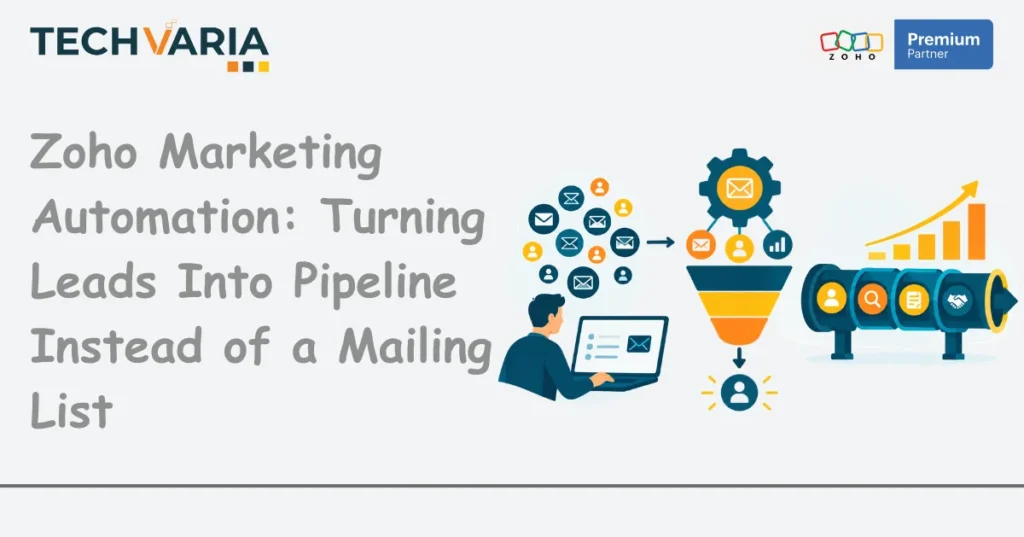
Zoho Marketing Automation exists to close that gap. It tracks what prospects actually do, scores them on both fit and behaviour, nurtures them until they are genuinely ready, and hands them to sales at a defined threshold with the full engagement history attached.
This guide covers how the platform works, how it differs from Zoho Campaigns (a distinction that causes real confusion), how to build a scoring model that is not arbitrary, and how to design the handoff so sales trusts what arrives. It is written for marketing leaders, sales directors and founders in B2B businesses.
The Problem: Marketing Generates Volume, Sales Wants Pipeline
The failure pattern is consistent across B2B companies with a marketing function.
- Every form fill is treated as a lead. A whitepaper download and a pricing enquiry arrive in the same bucket with the same status, and sales has no way to tell them apart before picking up the phone.
- Nurture is a newsletter. Everyone gets the same email regardless of what they looked at, how long ago they engaged, or whether they are a plausible customer at all.
- Behaviour is invisible. A prospect visits the pricing page four times in two days. Nobody knows. That is the single strongest buying signal most B2B companies have, and it goes unrecorded.
- Handoff has no definition. Leads pass to sales when marketing thinks they should, which is usually when the monthly number needs to look good.
- Sales stops trusting the source. After enough unqualified leads, sales quietly deprioritises anything marketing sends, which means genuinely good leads get the same treatment as the noise.
- Nurture stops at the first “no”. A prospect who is not ready this quarter is marked closed and never contacted again, despite being exactly the person to talk to in nine months.
- Attribution is guesswork. Nobody can say which campaigns produced revenue, so budget is allocated on impressions and opinion.
Why the Handoff Is the Whole Game
Three arguments matter when justifying this investment.
Sales capacity is the scarcest resource in a B2B business. A salesperson’s week is finite. Every hour spent on a prospect who was never going to buy is an hour not spent on one who might. The value of a scoring model is not that it finds more leads; it is that it stops sales spending time on the wrong ones. That is a productivity gain on your most expensive function.
Most of your market is not ready now. In considered B2B purchases, only a small fraction of potential buyers are actively in-market at any given moment. The rest will be, eventually. A company that only engages the actively-buying fraction competes hardest at the moment of maximum competition. A company that nurtures the rest builds relationships before the competition arrives. This is the entire economic argument for nurture, and it is why “they didn’t convert” is a bad reason to stop.
Trust between marketing and sales is an asset. Once sales stops believing marketing leads, the system degrades regardless of lead quality, because good leads get the same neglect as bad ones. An agreed, measurable handoff definition — with a threshold both sides signed off — is what prevents that. Where the wider goal is a coherent customer experience across marketing, sales and service, this sits inside a broader CX transformation.
There is also a straightforward efficiency point. Attribution data lets you stop spending on channels that generate volume without revenue. Most companies that measure properly find at least one significant line of spend producing very little.
Zoho Marketing Automation vs Zoho Campaigns
This confuses people regularly and deserves a clear answer, because choosing wrong means either overpaying for unused capability or hitting a wall six months in. Our Zoho consulting services team is asked to settle this distinction more often than any other.
Zoho Campaigns is an email marketing platform. It sends campaigns to lists, handles templates, subscriber management, basic autoresponders and email analytics. If your requirement is “send a good-looking newsletter to our contacts and see who opened it,” Campaigns does that well and is the simpler, cheaper answer. If that is where you are, our guide to the features of Zoho Campaigns that drive business growth covers what it does well.
Zoho Marketing Automation is a lead management platform that includes email as one channel. It adds website visitor tracking, behavioural triggers, multi-step branching journeys, fit and behaviour lead scoring, landing pages and forms, multi-channel touchpoints, and a structured qualification handoff into Zoho CRM.
| Requirement | Zoho Campaigns | Zoho Marketing Automation |
|---|---|---|
| Send newsletters and broadcasts | Yes | Yes |
| List segmentation | Yes | Yes, plus behavioural |
| Website visitor tracking | No | Yes |
| Behaviour-triggered journeys | Basic autoresponders | Yes, with branching |
| Lead scoring | No | Yes, fit and behaviour |
| Landing pages and forms | Limited | Yes |
| MQL threshold and CRM handoff | Manual | Automated |
| Attribution reporting | Email-level | Journey and revenue-level |
The decision rule: if you send to a list, use Campaigns. If you need to know what individual prospects are doing and act on it differently per person, you need Marketing Automation. Companies with an existing Zoho Campaigns setup often move when they realise they cannot answer “who on our list is showing buying signals right now?”
What the Platform Actually Does
Zoho Marketing Automation covers:
- Visitor tracking — identifying and recording website behaviour, linking anonymous sessions to known contacts once they identify themselves
- Forms and landing pages — capture points that feed directly into the lead database with source attribution
- Lead scoring — configurable models across demographic fit and behavioural engagement
- Journeys — multi-step, branching automation responding to behaviour, time and attribute changes
- Segmentation — dynamic lists based on attributes and behaviour
- Multi-channel touchpoints — email, SMS and social, with notifications into internal channels
- CRM synchronisation — native, bidirectional with Zoho CRM
- Analytics — campaign, journey and attribution reporting
The structural advantage, as with the rest of the ecosystem, is that the marketing lead and the CRM lead are the same record. Sales sees the full engagement history — pages viewed, emails opened, content downloaded, score progression — on the record they already work in. No integration, no separate login, no “let me check with marketing.”
Building a Lead Scoring Model That Works
Fit Scoring and Behaviour Scoring
The most common scoring mistake is collapsing everything into one number. A single score cannot distinguish between a perfect-fit prospect doing nothing and a poor-fit prospect doing everything, and those two require opposite responses.
Score on two axes.
Fit (are they the right kind of buyer?) — based on attributes, positive and negative:
| Attribute | Example Weighting |
|---|---|
| Target industry | +15 |
| Company size in range | +15 |
| Decision-making job title | +20 |
| Influencer job title | +10 |
| Target geography | +10 |
| Student / academic email | −25 |
| Competitor domain | −50 |
| Personal email domain (B2B context) | −10 |
Behaviour (are they showing intent?) — based on actions:
| Action | Example Weighting |
|---|---|
| Pricing page visit | +20 |
| Repeat pricing page visit within 7 days | +25 |
| Case study or comparison page view | +12 |
| Demo or contact form submission | +40 |
| Webinar attendance | +20 |
| Whitepaper download | +8 |
| Email open | +1 |
| Email link click | +5 |
| Blog post view | +2 |
| Careers page visit | −10 |
Two points about these numbers. First, they are a starting framework, not a formula — calibrate them against your own conversion data. Second, note the relative weights: a single pricing page visit is worth twenty blog views, because it means something entirely different. Scoring models that weight all engagement equally produce high scores for people who read a lot and buy nothing.
Include negative scoring. Most companies only score up, which means a competitor researching you thoroughly ends up looking like your hottest lead. The careers page example above is a small thing that saves real sales time.
Setting the Threshold
The marketing qualified lead threshold is the point at which a lead passes to sales. Get it wrong in either direction and the system fails.
Set it too low and sales drowns in unqualified leads, stops trusting the source, and the whole model collapses.
Set it too high and genuinely interested prospects sit in nurture while a competitor calls them.
Two rules make this workable:
- Require both dimensions. A lead should need a minimum fit score and a minimum behaviour score. Fit alone means they could buy but show no sign of wanting to. Behaviour alone often means a student or a competitor.
- Set the threshold with sales in the room, and revisit it quarterly. This is a joint definition or it is not a definition at all.
Run the model in “observe” mode for three or four weeks before activating automated handoff. Watch which leads it would have passed, ask sales whether they would have wanted them, and calibrate. This one step prevents most of the damage that poorly tuned scoring does to sales trust.
Score Decay
Engagement six months ago is not engagement today. Without decay, scores only ever rise, and your “hottest” leads eventually become whoever has been on the list longest.
Configure behaviour scores to decay over time — a percentage reduction per month of inactivity is a common approach. Fit scores should not decay, since a company’s industry and size do not change because they stopped reading emails.
Designing Journeys That Are Not Just Drip Emails
A journey is a multi-step automated sequence that branches on what the prospect does. The difference between a journey and a drip campaign is that a drip sends step two regardless; a journey asks what happened after step one.
Journeys worth building first, in roughly this order:
- New lead welcome and orientation. Triggered on first capture. Establishes who you are and what you do, and — importantly — segments by what they came for. Branch on the content they downloaded or the page they converted on.
- Content-specific nurture. Someone who downloaded an ERP implementation guide gets a different sequence from someone who read about CRM migration. This is the most basic form of relevance and it is skipped surprisingly often.
- Re-engagement. Triggered by inactivity — no engagement for 60 or 90 days. A short sequence with a genuine choice at the end, including the option to leave. Keeping unengaged contacts on your list damages deliverability and flatters your numbers.
- High-intent alert. Not an email to the prospect — a notification to sales. Repeat pricing page visits, a demo form, or multiple people from the same domain visiting in a week are all worth a human response within the hour.
- Post-demo nurture. For prospects who engaged but did not buy. This is the most neglected and often the highest-return journey in B2B, because these people have already qualified themselves and simply were not ready.
- Customer onboarding and expansion. Existing customers are a different audience with different needs, and marketing automation should not stop at the sale.
Design principles that matter:
- Branch on behaviour, not just time. Time-based sequences are drip campaigns with extra steps.
- Include an exit condition. A prospect who requests a demo should leave the nurture journey immediately — nothing looks worse than receiving “have you considered our solution?” the day after a sales call.
- Keep sequences short. Four to six well-targeted messages beat a twelve-step sequence nobody finishes.
- Set frequency caps. A prospect enrolled in three journeys should not receive three emails on Tuesday.
The Marketing-to-Sales Handoff
This is where the value is realised or lost, and it is more process than configuration.
What a good handoff includes:
- An agreed definition, documented and signed off by both marketing and sales leadership
- Automatic transfer at threshold — creating or updating the Zoho CRM lead with owner assignment
- Full context attached — every page viewed, email engaged with, content downloaded, and the score history
- A response commitment — sales acknowledges within a defined window, because speed of first response is one of the strongest predictors of B2B conversion
- A defined rejection path — sales can return a lead with a reason, which feeds back into scoring calibration
- A closed loop — outcomes flow back so marketing can see which sources and journeys produce revenue, not just MQLs
That fifth point is the one most implementations omit, and it is what makes the model improve over time. A lead rejected as “wrong company size” is scoring feedback. A lead rejected as “not ready, revisit in six months” should return to nurture rather than being lost — which is only possible if the path exists.
Attribution and Reporting
| Metric | What It Answers |
|---|---|
| Leads by source | Where does volume come from? |
| MQLs by source | Where does quality come from? |
| MQL-to-opportunity rate | Is our threshold set correctly? |
| Opportunity-to-win rate by source | Which channels produce revenue? |
| Cost per MQL and per opportunity | Where should budget go? |
| Journey conversion rates | Which nurture actually works? |
| Time from first touch to MQL | How long is our real cycle? |
| Sales response time to MQL | Is the handoff commitment being met? |
| Rejection rate and reasons | Is scoring calibrated? |
The first two rows together are usually the most valuable analysis a B2B marketing team can run, because volume and quality rankings frequently differ. The channel producing the most leads is very often not the channel producing the most revenue.
Benefits You Can Measure
- MQL-to-opportunity conversion. The clearest measure of whether qualification is working.
- Sales time on qualified prospects. Rises as unqualified volume is filtered out.
- Lead response time. Falls sharply with high-intent alerts routed to sales in real time.
- Nurture-sourced pipeline. Opportunities from leads that were not ready at first contact — usually invisible before automation.
- Cost per opportunity. Falls as budget shifts toward channels that convert.
- Database engagement health. Improves as re-engagement journeys clean inactive contacts.
- Marketing-sales alignment. Measurable through rejection rates and response-time compliance.
- Revenue attribution coverage. From guesswork to a reported figure.
Zoho Marketing Automation vs HubSpot vs Mailchimp
| Dimension | Mailchimp / Zoho Campaigns | Zoho Marketing Automation | HubSpot Marketing Hub |
|---|---|---|---|
| Best fit | List-based email marketing | B2B lead management, especially Zoho users | Content-led inbound marketing organisations |
| Visitor tracking | Limited | Yes | Yes, extensive |
| Lead scoring | Basic or none | Fit and behaviour | Advanced, including predictive on higher tiers |
| Branching journeys | Basic automation | Yes | Yes, sophisticated |
| Landing pages and forms | Yes | Yes | Yes, with strong CMS |
| Native CRM link | Integration required | Native with Zoho CRM | Native with HubSpot CRM |
| Content / SEO tooling | Limited | Limited | A major strength |
| Cost profile | Low | Low to moderate; in Zoho One | Rises steeply with contact count and tier |
| Setup complexity | Low | Moderate | Moderate to high |
| Where it strains | Anything behaviour-based | Deep content marketing tooling | Cost at scale |
The honest read: HubSpot is excellent, particularly for organisations whose strategy is content-led inbound marketing, and its CMS and SEO tooling are genuinely stronger. Its cost rises steeply with database size, which is the usual reason mid-market companies look elsewhere. Zoho Marketing Automation delivers the core lead management capability — tracking, scoring, journeys, handoff — at a materially lower cost, and for organisations already running Zoho CRM or a Zoho One implementation, the native CRM connection removes an integration that would otherwise need building and maintaining.
Best Practices
- Define MQL jointly, before configuring anything. Marketing and sales leadership in one room, output written down. This is the foundation; everything else is implementation detail.
- Build fit scoring from your best existing customers. Look at who actually buys and works out well, then score for that profile rather than for an aspirational one.
- Include negative scoring. Competitors, students, job seekers and out-of-market geographies.
- Run in observe mode before activating handoff. Three to four weeks of calibration protects sales trust permanently.
- Build three journeys well rather than nine badly. Welcome, high-intent alert and re-engagement cover most of the value.
- Always include exit conditions. Nothing undermines credibility like automated nurture continuing through a live sales conversation.
- Set a response commitment with sales. And report compliance against it.
- Create the rejection feedback path. It is what makes the model improve rather than ossify.
- Protect deliverability. Authenticate your sending domain, honour unsubscribes promptly, and remove persistently unengaged contacts. A large list with poor engagement delivers worse than a smaller engaged one.
Common Mistakes in Marketing Automation
- Single-dimension scoring. Cannot distinguish a perfect-fit prospect doing nothing from a poor-fit one doing everything.
- No negative scoring. Competitors and job seekers rise to the top of your lead list.
- No score decay. Longevity on the list becomes indistinguishable from intent.
- Threshold set unilaterally by marketing. Guarantees the sales-trust problem the system was meant to solve.
- Journeys without exit conditions. Prospects receive nurture emails during live deals.
- Automating a process nobody agreed. Automation makes an undefined process fast and consistent, not correct.
- Treating nurture as a newsletter. Undifferentiated content to everyone is broadcast, not nurture.
- Abandoning leads that said no. The post-demo nurture journey is often the highest-return sequence a B2B company can run.
- No closed loop from sales outcomes. Scoring never improves because nothing tells it what worked.
- Ignoring deliverability. Everything else is irrelevant if the emails land in spam.
Real Business Example: A B2B Software Company
Consider a company selling industry-specific software to mid-market manufacturers — 55 staff, six salespeople, average deal size in the mid five figures, sales cycles running three to seven months.
Before
Marketing ran Zoho Campaigns, sending a monthly newsletter to roughly 9,000 contacts and occasional product announcements. Website form submissions created CRM leads directly with no qualification. Sales received around 90 leads a month, of which they estimated fewer than one in eight was worth a call — a figure the sales director had stopped mentioning because it caused friction. Sales had informally stopped working inbound leads within 48 hours, which meant the genuinely good ones went cold too. Nobody could say which marketing activity produced revenue. Prospects who took a demo and did not buy were marked closed-lost and never contacted again.
What Was Implemented
The project started with a two-hour workshop that produced no software configuration at all — just an agreed MQL definition signed off by both the marketing head and the sales director. The definition required a fit score above a set floor and a behaviour score above another, with named disqualifiers.
Zoho Marketing Automation was then configured alongside the existing Zoho CRM. Fit scoring was built from an analysis of the company’s 40 best existing customers by retention and margin — which revealed that its most successful customers clustered in a narrower size band than the marketing material targeted. Behaviour scoring weighted pricing and comparison pages heavily and blog content lightly. Negative scoring covered competitor domains, academic addresses and the careers page. Score decay was set at a monthly reduction on behavioural points.
Four journeys were built: a segmented welcome sequence branching on conversion content, a post-demo nurture sequence for prospects who did not buy, a 90-day re-engagement sequence, and a high-intent alert routing an immediate notification to the assigned salesperson on repeat pricing page visits.
The model ran in observe mode for four weeks. Sales reviewed the leads it would have passed and rejected about a fifth of them, which led to two weighting changes and one additional disqualifier before go-live.
After Two Quarters
Volume passed to sales fell from roughly 90 leads a month to around 28 MQLs — a reduction the sales director described as the point at which the team started taking inbound seriously again. MQL-to-opportunity conversion was several times the previous lead-to-opportunity rate. Average time to first sales contact on high-intent alerts fell to under two hours, from a previous average measured in days.
The post-demo nurture journey produced the outcome nobody had forecast: within six months it had generated a meaningful number of reopened opportunities from prospects who had gone quiet months earlier, at effectively zero acquisition cost. Attribution reporting showed that one paid channel, which had absorbed a substantial share of budget, had produced high lead volume and almost no opportunities — that spend was reallocated to webinars, which had the best MQL-to-opportunity rate of any source.
The marketing head’s own summary was that the number they had been reporting for three years had been measuring the wrong thing.
Industry Use Cases
- B2B software and SaaS. Trial and demo nurture, product-interest segmentation, and high-intent alerting on pricing behaviour. See IT services ERP.
- Manufacturing and industrial. Long, technical sales cycles with multiple stakeholders, where nurturing the influencer while the decision maker is elsewhere in the organisation matters. See manufacturing solutions.
- Professional and financial services. Relationship-led selling where content-driven credibility building over long horizons is the primary mechanism.
- Healthcare and medical devices. Regulated messaging, institutional buying cycles and long procurement processes. See healthcare solutions.
- Trading and distribution. Dealer and reseller recruitment, catalogue interest tracking and reactivation of dormant accounts. See trading and distribution solutions.
- Education and training. Enquiry-to-enrolment journeys with defined intake cycles, where timing-based nurture is unusually effective.
- Real estate and capital goods. High-value, low-frequency purchases where the nurture horizon is measured in quarters rather than weeks.
Implementation Tips From the Field
- Hold the MQL workshop before touching the software. Two hours with marketing and sales leadership is the most valuable part of the project.
- Analyse your best customers, not your biggest. Fit scoring built from retention and margin produces better targeting than scoring built from deal size.
- Instrument the website properly first. Visitor tracking with no meaningful page structure produces data you cannot score on.
- Start with three journeys. Welcome, high-intent alert, re-engagement. Add more once these are working.
- Give sales a rejection button with reasons. And review the reasons monthly.
- Set up deliverability properly at the start — domain authentication, list hygiene, unsubscribe handling. Retrofitting reputation is slow.
- Report MQL-to-opportunity by source from month one. It is the number that redirects budget.
- Review scoring quarterly with sales. Markets shift, products change, and a model left untouched for a year becomes inaccurate without anyone noticing.
- Audit the configuration after 90 days. Techvaria’s Zoho implementation audit covers marketing automation setups, where scoring drift is common.

Director @ Techvaria | Solutions Architect | Low-Code & AI Automation for Growth | Proven Expertise in Digital Transformation Across Industries