
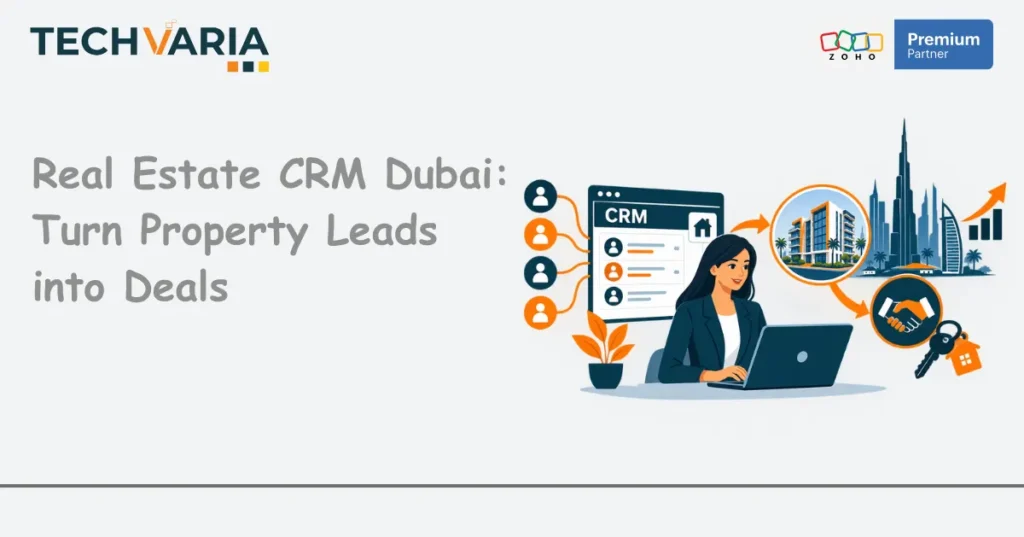
In Dubai real estate, lead volume is rarely the problem. Brokerages spend thousands of dirhams every month on Property Finder and Bayut, run Meta and Google ads, and field a steady stream of enquiries across portals, WhatsApp, email, and phone. The problem is what happens after the enquiry arrives.
Most high-value enquiries go cold before an agent ever responds. By the time a lead is noticed — buried under WhatsApp groups, portal notifications, and an inbox nobody is watching after hours — the buyer has already spoken to a faster agency. In a market this competitive, the brokerage that replies first usually wins the viewing, and the brokerage that wins the viewing usually wins the deal.
This article is written for Dubai and UAE brokerage owners, managing directors, and sales and operations heads who are tired of paying for leads they can’t convert. It explains exactly where leads leak, why the Dubai market punishes slow response so severely, and how a properly configured Zoho CRM — with honest attention to what it can and cannot do natively — closes those gaps.
The Real Estate Business Problem: Leads You Paid For, Going Cold
Picture a typical mid-sized Dubai brokerage. Enquiries arrive through at least five channels: Property Finder, Bayut, the agency website, Instagram or Meta ads, and direct WhatsApp messages. Each channel lands somewhere different. Portal leads sit in portal dashboards and email. WhatsApp enquiries sit on individual agents’ phones. Website forms go to a shared inbox. Nobody has a single, real-time view of everything coming in.
The practical consequences are predictable:
- A lead submitted at 9 p.m. on Bayut isn’t seen until the next morning.
- Two agents unknowingly chase the same enquiry while a third enquiry is missed entirely.
- An Arabic-language enquiry waits because the agent who received it replies only in English.
- A hot buyer who asked about a specific off-plan unit gets a generic reply three hours later.
- Management has no reliable way to see which portal, which campaign, or which agent actually produced closed deals.
This is not a sales-talent problem. It is a lead-management and operations problem — and it is fixable.
Why This Problem Matters So Much in Dubai and the UAE
Dubai’s market gives buyers enormous choice and very little patience. The same portal listing generates enquiries to multiple agencies simultaneously, so the buyer is often in conversation with three or four brokers at once. Response speed is not a nicety; it is the single biggest controllable factor in whether an enquiry becomes a viewing.
- Fierce, simultaneous competition. A buyer enquiring on Property Finder or Bayut rarely contacts just one agent. Whoever responds first and most relevantly shapes the conversation.
- High deal values. A single recovered sale can be worth more than an entire year of portal subscription spend. The cost of a missed lead is not the lead fee — it’s the commission on the deal that didn’t happen.
- Round-the-clock enquiries. International buyers across time zones send enquiries at all hours. A team that only responds during office hours is, by definition, losing the after-hours pipeline.
- Bilingual expectations. A significant share of high-value enquiries arrive in Arabic. If your first response can’t meet the buyer in their language, you’ve lost ground before the conversation starts.
- Fragmented data destroys reporting. When enquiries live in five systems, management cannot measure cost-per-acquisition by source, agent conversion rates, or campaign ROI with any confidence. Budget decisions become guesswork.
In Dubai real estate, lead velocity — not lead volume — is the metric that separates agencies that grow from agencies that churn through portal spend.
Where Leads Actually Leak: A Stage-by-Stage Breakdown
Stage 1 — Capture
Enquiries arrive in multiple places and are never consolidated. Anything not manually copied into a system effectively doesn’t exist. Leads are lost here simply because no one saw them in time.
Stage 2 — Response
Even captured leads sit unanswered because there’s no instant acknowledgement and no clear owner. The buyer, meanwhile, is already talking to a faster competitor.
Stage 3 — Assignment
Without rules, leads are assigned by whoever happens to be looking — or not at all. Hot buyers get the same slow treatment as casual browsers. Duplicate chasing wastes agent time.
Stage 4 — Follow-up
Most deals require several touches. Without structured, reminded follow-up sequences, agents forget, and genuinely interested buyers quietly go cold.
Stage 5 — Reporting
Because the earlier stages are manual and fragmented, management can’t attribute closed deals to sources. Portal budgets are renewed or cut on gut feel rather than evidence.
How Zoho CRM Addresses the Dubai Lead-Velocity Problem
The value of Zoho CRM here is not that it is “a CRM.” It is that, configured correctly, it collapses those five leak points into one controlled, measurable workflow. Here is the relationship between problem, capability, and outcome.
Centralised lead capture → one pipeline, nothing missed
Problem: enquiries scattered across portals, WhatsApp, website, and ads.
Zoho capability: Zoho CRM can serve as the single destination for leads from every channel. Website forms flow in through Zoho’s web forms natively. Portal and messaging leads flow in through Zoho Flow, webhooks, email parsing, or a connected integration. Each lead carries its source and listing reference so nothing is anonymous.
Outcome: every enquiry lands in one pipeline, tagged by source, visible to management in real time.
Instant acknowledgement → responding inside the window that matters
Problem: buyers go cold within minutes; humans can’t watch every channel 24/7.
Zoho capability: Zoho CRM workflow rules can trigger an immediate automated first response — email, or WhatsApp via Zoho’s WhatsApp integration — the moment a lead is created, acknowledging the enquiry while an agent is assigned. This can run around the clock.
Outcome: the buyer hears back in seconds, every hour of the day, holding their attention until a human takes over.
Automated assignment → the right agent, instantly
Problem: leads assigned ad hoc, or not at all; duplicates chased.
Zoho capability: Zoho CRM assignment rules route each lead to the right agent based on criteria you define — area, language, property type, price band, or round-robin for fairness. Duplicate detection reduces two-agents-one-lead waste.
Outcome: hot leads reach a capable, available agent immediately; the team stops tripping over each other.
Structured follow-up → no interested buyer forgotten
Problem: multi-touch follow-up depends on memory.
Zoho capability: Zoho CRM cadences, workflows, and tasks create automatic follow-up sequences and reminders. If a lead hasn’t been contacted within a set time, the system escalates to a manager.
Outcome: every lead is worked systematically, and genuine buyers aren’t lost to forgetfulness.
Reporting and attribution → budget decisions based on evidence
Problem: no reliable source-to-deal attribution.
Zoho capability: Zoho CRM dashboards and Zoho Analytics report on lead source, agent response time, conversion rate by source, and campaign ROI.
Outcome: management can see which portal and which agent actually produce closed deals, and allocate budget accordingly.
A Realistic Look at Portal Integration (What’s Native, What Isn’t)
This is where many vendors overpromise, so it’s worth being precise.
Zoho CRM does not have a native, one-click integration with Property Finder or Bayut. Those portals do not offer an open, self-serve public API the way a payment provider does; their lead and listing APIs are made available to agencies and approved integration partners. Any claim that Zoho “connects natively” to UAE property portals should be treated with caution.
What is genuinely achievable:
- Zoho web forms → Zoho CRM: fully native. Your own website enquiries flow straight in.
- WhatsApp → Zoho CRM: supported through Zoho’s WhatsApp Business integration, enabling automated first responses and logged conversations.
- Portal leads (Property Finder / Bayut) → Zoho CRM: achievable via Zoho Flow, webhook or email-parsing workflows, or a third-party/custom middleware layer that ingests portal lead notifications and creates CRM records. This typically requires configuration and, depending on the portal’s current lead-delivery method, API credentials or an approved connector, as our Bayut, dubizzle and Property Finder case study describes.
- Zoho Flow acts as the integration backbone connecting these moving parts.
The honest summary: the outcome Dubai brokerages want — portal enquiries landing in one CRM pipeline within seconds — is very achievable, but through configured integration, not a native switch. This is precisely the kind of scoping a specialist implementation partner handles, and it’s why the integration approach should be defined up front rather than assumed.
Dubai/UAE Real Estate Considerations
- Bilingual (Arabic + English) communication. Automated first responses, templates, and agent assignment should account for language so an Arabic-language enquiry gets an Arabic-capable agent and an appropriate first reply.
- Multi-emirate and multi-branch operations. Brokerages operating across Dubai, Abu Dhabi, and Sharjah need branch-aware pipelines, role-based visibility, and consolidated reporting across locations.
- RERA and Dubai Land Department context. Dubai’s real estate sector is regulated by the Dubai Land Department and its regulatory arm, RERA, including listing-permit systems. A CRM can help you store and organise permit references, broker (BRN) details, and documentation against listings and deals — but configuring a CRM does not, by itself, make a brokerage compliant. Regulatory compliance remains the brokerage’s responsibility; the CRM is a tool that supports good record-keeping, not a substitute for following DLD/RERA requirements. Always verify current obligations directly with the DLD and RERA.
- Lead-source economics. With significant monthly spend on portals, source-level attribution isn’t a reporting nicety in the UAE — it directly governs whether that spend is justified.
Best Practices for Real Estate Lead Management in Zoho
- Define your pipeline stages around the real buyer journey — Enquiry → Qualified → Viewing Scheduled → Viewing Done → Negotiation → Closed — not a generic sales template.
- Make instant first-response non-negotiable. Configure automated acknowledgement on every lead, 24/7, before any human step.
- Codify assignment rules. Decide explicitly how leads route (area, language, price band, round-robin) rather than leaving it to chance.
- Build follow-up cadences with escalation. If a lead isn’t contacted within your target window, escalate automatically.
- Capture source and listing reference on every lead. Attribution is impossible without it.
- Qualify before you route to senior closers. Use a short qualification step (budget, location, timeline, intent) so your best agents spend time on real buyers.
- Review response-time and conversion dashboards weekly. Make lead velocity a managed metric, not an afterthought.
Common Implementation Mistakes (and How to Avoid Them)
- Assuming native portal integration exists. Teams buy a CRM expecting one-click Property Finder/Bayut sync and stall at go-live. Prevention: scope the integration approach (Flow, webhook, or middleware) before implementation begins.
- Migrating messy data. Importing duplicate and inconsistent contact records pollutes the CRM from day one. Prevention: de-duplicate and standardise data before migration.
- Configuring the CRM as a glorified contact list. Without automation, a CRM just stores names. Prevention: implement capture, response, assignment, and follow-up automation from the start, or commission a Zoho implementation audit if an existing CRM is already underused.
- Skipping agent adoption. Agents revert to WhatsApp and spreadsheets if the CRM feels like extra work. Prevention: train for their actual workflow, and make the CRM the easiest path, not an added chore.
- No source attribution. Without it, portal spend decisions stay guesswork. Prevention: enforce source capture on every lead.
- Over-customising upfront. Building elaborate custom modules before the basics are adopted creates fragility. Prevention: start with a clean standard configuration, then extend.
Illustrative Scenario: A Dubai Brokerage (Fictional)
The following is a fictional, illustrative example — not a real Techvaria client, and the figures are hypothetical for illustration only.
Marina Crest Properties (fictional) is a 25-agent residential brokerage in Dubai Marina. They spend heavily across Property Finder and Bayut, run Meta ads, and field constant WhatsApp enquiries. Their “system” is a shared spreadsheet plus individual agents’ phones.
Original workflow: Portal leads arrive by email and portal dashboard. Agents check when they can. After-hours enquiries wait until morning. There are no assignment rules, so leads are claimed informally. Follow-up depends on each agent’s memory. Management can’t say which portal produces closed deals.
Proposed Zoho configuration:
- All channels feed one Zoho CRM pipeline — website via native forms, WhatsApp via Zoho’s WhatsApp integration, and Property Finder/Bayut leads via a Zoho Flow / webhook-based capture layer.
- An automated bilingual first response fires the instant any lead is created, 24/7.
- Assignment rules route leads by area, language, and round-robin; duplicates are flagged.
- Follow-up cadences with manager escalation ensure no qualified lead is dropped.
- A Zoho Analytics dashboard shows response time, source attribution, and agent conversion.
Potential operational improvements (illustrative, not guaranteed): faster first response across every channel, fewer missed after-hours leads, no duplicate chasing, and — for the first time — clear visibility into which portal and which agent generate closed deals. The point of the example is the shape of the improvement, not a promised number.
Real Estate Use Cases
- Residential brokerage: high-volume portal and WhatsApp lead capture, instant response, area/language-based assignment.
- Off-plan sales: project- and unit-level interest tracking, developer-pipeline management, longer multi-touch nurture cadences. See Zoho for construction and real estate in the UAE.
- Commercial property: multi-stakeholder deals with longer cycles and structured follow-up.
- Leasing and renewals: renewal reminders and tenant communication workflows so leases don’t lapse unnoticed.
- Property management: centralised owner and tenant records, enquiry and request tracking.
Zoho Implementation Guidance
A dependable real-estate CRM rollout in the UAE typically follows this path:
- Business and process mapping — document how enquiries arrive, who handles them, and where deals currently leak.
- Audit existing data — review current spreadsheets or CRM for duplicates and gaps.
- Data preparation and migration — clean, de-duplicate, and standardise contacts and listings before import.
- Lead-source and capture configuration — connect website forms, WhatsApp, and portal capture (via Flow/webhook/middleware).
- Pipeline, assignment, and follow-up setup — stages, routing rules, cadences, and escalation.
- Integration requirements — confirm the portal-capture method and any middleware before go-live.
- Roles and permissions — branch-aware, role-based visibility for multi-office brokerages.
- Testing — validate capture, response, assignment, and reporting with real sample leads.
- Training — role-specific, built around agents’ actual daily workflow.
- Reporting and governance — dashboards for response time, source attribution, and conversion.
- Post-implementation optimisation — refine rules and cadences based on live performance.
Spreadsheet vs. Standard CRM vs. Configured CRM
| Capability | Spreadsheet + phones | Standard CRM (out of box) | Configured Zoho CRM |
|---|---|---|---|
| Multi-channel lead capture | Manual, incomplete | Partial (web forms) | All channels incl. portal/WhatsApp |
| Instant 24/7 first response | None | Rarely configured | Automated, bilingual, 24/7 |
| Lead assignment | Informal | Basic | Rule-based by area/language/round-robin |
| Follow-up | Memory-based | Manual tasks | Automated cadences with escalation |
| Source attribution | None | Limited | Full source-to-deal reporting |
| Management visibility | Minimal | Some dashboards | Response time, conversion, ROI by source |
| Arabic/English handling | Ad hoc | Not addressed | Built into routing and templates |


Director @ Techvaria | Solutions Architect | Low-Code & AI Automation for Growth | Proven Expertise in Digital Transformation Across Industries
