
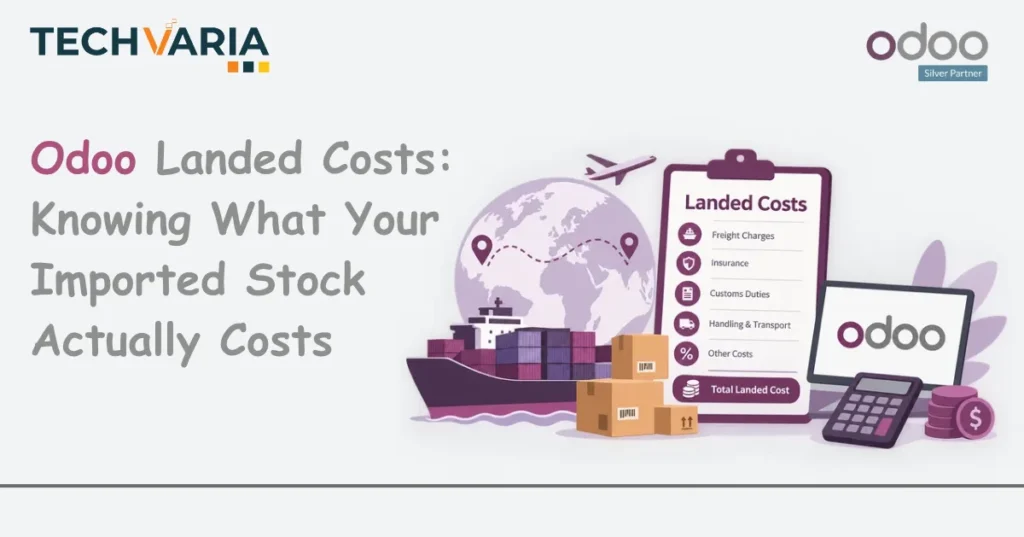
Ask an importer what a product costs and you will usually get the supplier’s invoice price. Ask what it costs landed in the warehouse, ready to sell, and the answer becomes a pause, then an estimate, then usually a percentage that somebody decided some years ago.
That percentage is the problem. Most importing and distribution businesses apply a blanket uplift — add 12%, add 15% — to cover freight, duty, insurance and clearing. It is simple, it is consistent, and it is wrong on almost every individual product, because a light, high-value item and a heavy, low-value one in the same container do not carry the same share of the freight bill.
The consequence is not a small accounting inaccuracy. It is that the products you believe are your best margin earners may not be, and the ones you have been discounting to move may have been losing money all along.
Odoo’s landed cost functionality exists to fix this: it takes the additional costs of getting goods to your warehouse and allocates them onto the actual stock, by a method you choose, so that inventory valuation and gross margin reflect reality.
This guide covers what belongs in landed cost, how the mechanism works in Odoo, how to choose an allocation method, the timing problem that catches most businesses, and the mistakes that produce confident but wrong numbers. It is written for finance managers, import managers, operations directors and business owners in importing and distribution.
The Problem: You Are Pricing Against a Cost You Do Not Know
The symptoms are recognisable across importers, distributors and trading businesses.
- Costs arrive separately from goods. The supplier invoice comes with the shipment. The freight invoice comes from the forwarder two weeks later. The customs duty is paid at clearance. The clearing agent bills at month-end. By the time all of it is in, the stock may already be sold.
- A blanket percentage is applied. Usually set years ago, rarely reviewed, and systematically wrong at the individual product level. It over-costs some items and under-costs others, and both errors distort pricing decisions.
- Additional costs are expensed rather than capitalised. Freight and duty get posted to overhead accounts instead of onto stock value. Inventory is understated on the balance sheet, and cost of goods sold is misstated in the period.
- Gross margin by product is fiction. You can report it. You cannot rely on it, because the cost side is an estimate applied uniformly.
- Pricing decisions compound the error. Discounting is authorised on products whose real margin is thinner than believed. Items with genuinely strong margins are under-promoted because they do not look special.
- Shipment profitability is never measured. Whether a particular container or consignment made money, after all costs, is not a question the system can answer.
- Reconciliation at year-end is painful. Auditors ask how additional costs were allocated. The honest answer — a percentage someone chose — is not a satisfying one.
Why Landed Cost Accuracy Decides Margin
Three arguments make this a commercial issue rather than a bookkeeping refinement.
Import costs are a large share of unit cost, and they vary enormously by product. For many imported goods, freight, duty, insurance and clearing together represent a substantial proportion of the landed value. Crucially, that proportion is not uniform: duty rates differ by HS classification, and freight allocates by volume or weight rather than by value. A blanket percentage guarantees that light, high-value goods subsidise heavy, low-value ones inside your own margin reporting.
Pricing built on wrong costs is wrong pricing. Distribution runs on thin margins and high volume, so a few percentage points of cost error translates directly into pricing decisions that destroy value. The business is not making bad decisions; it is making reasonable decisions from bad inputs.
Inventory valuation is a reported balance. Stock is typically one of the largest assets on a distributor’s balance sheet, and additional costs incurred to bring inventory to its present location and condition generally belong in its carrying value under standard accounting treatment such as IAS 2 Inventories. Expensing them instead understates inventory and misstates cost of sales in the period. Confirm the precise treatment for your jurisdiction and circumstances with your auditor — this is an accounting policy matter, not a software setting.
There is also a supplier-negotiation argument. A business that knows its true landed cost per product can evaluate an alternative supplier, a different incoterm or a consolidated shipment on evidence. A business working from a blanket percentage cannot.
What Actually Belongs in Landed Cost
Getting the scope right early prevents both under-costing and disputes with your auditor.
Typically included
- Freight and shipping — ocean, air or road, including any origin charges you bear
- Insurance on the consignment
- Customs duty and import levies
- Customs clearing and brokerage fees
- Port and terminal handling charges
- Inland transport from port to your warehouse
- Inspection, testing or certification required to import
- Demurrage and detention, where incurred (though these are worth tracking separately, since they are avoidable costs and knowing their size changes behaviour)
Typically excluded
- Recoverable taxes — where import VAT or GST is recoverable as input credit, it is not a cost of the goods. This is the single most common error in landed cost setups
- Warehousing costs after receipt — storage is generally a period cost, not part of acquisition
- Selling and distribution costs — outbound freight to customers
- General administrative overhead
- Abnormal costs — losses, penalties or waste outside the normal course
Write your inclusion list down, agree it with your auditor, and configure only those cost types. An undocumented inclusion policy becomes a year-end argument, and the argument is always more expensive than the hour it takes to agree the policy in advance.
How Odoo Landed Costs Work
The mechanism is straightforward once the sequence is clear.
- Goods are received. A purchase order is confirmed and a receipt processed, bringing stock in at the supplier’s price.
- A landed cost record is created. In Odoo’s Inventory operations, you create a landed cost document and select which receipt or receipts it applies to. One landed cost can cover several receipts — useful for consolidated shipments.
- Cost lines are added. Each additional cost — freight, duty, clearing — is entered as a line using a designated service product configured as a landed cost type, with its own default allocation method.
- An allocation method is applied. Odoo distributes each cost line across the products in the receipt, by the method you select per line.
- The landed cost is validated. On validation, Odoo adjusts the stock valuation of the affected products and posts the corresponding accounting entries. Unit costs update, and subsequent margin reporting reflects the true cost.
The prerequisites that people miss
- Products must use a costing method that supports valuation adjustment — this is covered below and it is the single most common configuration failure
- Inventory valuation should be configured as automated for the accounting entries to post correctly
- Landed cost products must be flagged as such in the product configuration
- The accounts used for the adjustment need agreeing with your accountant
Choosing an Allocation Method
This is the decision that determines whether your numbers are meaningfully better than a blanket percentage. Odoo supports several bases, and the right one differs by cost type.
- By value (equal proportion to cost). Each product absorbs cost in proportion to its purchase value. Appropriate for insurance, which genuinely scales with value, and for ad valorem duty.
- By weight. Cost distributed by the gross weight of each product line. Appropriate for air freight and for road transport priced by weight.
- By volume. Cost distributed by cubic measure. Appropriate for ocean freight, where you are effectively buying container space.
- By quantity. Cost split evenly per unit. Appropriate for per-item handling, inspection or labelling charges.
- Equal split across lines. Divided equally across the product lines regardless of size or value. Appropriate for fixed documentation or brokerage fees where the charge does not vary with the consignment contents.
The critical point: use a different method per cost line. The most common mistake is applying one method to every cost on the shipment. A single consignment might correctly use volume for ocean freight, value for insurance, separate duty lines per rate group for customs, and equal split for documentation fees. Odoo allows this, and using it properly is where the accuracy comes from.
Duty is the one that most often needs care. Duty rates vary by HS code, so a single “by value” allocation across mixed products with different duty rates will be wrong. Where a consignment contains products at materially different duty rates, enter duty as separate lines per rate group rather than as one pooled cost.
The Costing Method Decision Underneath It
Landed costs only work correctly if the product’s costing method supports revaluation, and this catches a surprising number of implementations.
| Costing method | How cost is determined | Landed cost behaviour |
|---|---|---|
| Standard price | A fixed cost you set manually | Landed cost adjustment does not flow into unit cost as expected; generally unsuitable where landed costs matter |
| Average cost (AVCO) | Weighted average of purchases | Works well — landed costs adjust the average, most common choice for importers |
| First In First Out (FIFO) | Cost tracked by layer | Works well — landed costs adjust the relevant layer; better traceability, more complex |
Practical guidance: most importers and distributors are best served by average cost, which handles landed cost adjustment cleanly and is simpler to explain to auditors and to your own team. FIFO suits businesses that need layer-level traceability, typically where product costs move sharply or where lot-level costing matters. Standard price is generally the wrong choice if landed costs are significant to you.
Changing costing method on live products with existing stock is not a trivial configuration switch — it affects valuation and requires careful handling. Decide this at implementation, and if you need to change it later, treat it as a controlled exercise with your accountant rather than a settings change.
Timing: The Problem Nobody Plans For
This is the operational reality that determines whether your landed cost process works in practice or only in theory.
Costs arrive after the goods, and often after the sale. The container clears on the 3rd. The freight invoice arrives on the 18th. The clearing agent bills on the 30th. Meanwhile you have been selling from that stock since the 5th.
Three workable approaches:
- Wait for actuals. Apply landed costs only when all invoices are in. Most accurate, but stock is valued at supplier price in the interim, and any sales made before the adjustment carry an understated cost of sales.
- Estimate, then true up. Apply an estimated landed cost at receipt based on the shipment’s documentation and historical rates, then post an adjustment when actual invoices arrive. More operationally demanding, and considerably more useful — your valuation is approximately right from day one rather than precisely wrong.
- Accrue at shipment level. Record an accrual for expected costs and reconcile at period end. Suits businesses with predictable, consistent shipping arrangements.
Whichever you choose, define it as a policy and apply it consistently. The problem is not which approach you use — it is businesses that use all three depending on who processed the shipment, which makes period-on-period comparison meaningless.
Set a cut-off rule. Landed costs relating to a period must be applied before the period closes, with an accrual for anything still outstanding. Without a cut-off, costs drift across periods and your monthly gross margin becomes noisy for reasons that have nothing to do with trading.
Benefits You Can Measure
- Gross margin accuracy by product. The headline outcome — margin reporting you can price against.
- Inventory valuation correctness. Stock carried at its real cost, which matters on the balance sheet and at audit.
- Shipment profitability. Newly answerable: did this consignment make money after all costs?
- Pricing decision quality. Discount authority granted on evidence rather than on an assumed uplift.
- Supplier and incoterm comparison. The ability to evaluate a cheaper supplier with higher freight, or a change from FOB to CIF, on real numbers.
- Product mix decisions. Identifying lines whose true margin does not justify the working capital they consume.
- Reduced year-end adjustment. Continuous, documented allocation rather than a retrospective correction.
- Visibility of avoidable costs. Demurrage and detention become measurable, and measurable costs tend to shrink.
Allocation Methods Compared
| Method | Best used for | Why | Watch out for |
|---|---|---|---|
| By value | Insurance, ad valorem duty | These genuinely scale with consignment value | Over-costs high-value light goods if used for freight |
| By weight | Air freight, weight-based road transport | Carriers price by weight | Requires accurate product weights in the master data |
| By volume | Ocean freight, container shipping | You are buying space, not mass | Requires accurate product dimensions |
| By quantity | Per-unit handling, inspection, labelling | Charge is per item | Misallocates if unit sizes vary widely |
| Equal split | Fixed documentation, brokerage fees | Charge does not vary with contents | Unfair on consignments with one small line |
| Blanket percentage (no allocation) | Nothing, once you have alternatives | Simple | Systematically wrong at product level — the practice this article exists to replace |
Best Practices
- Agree the inclusion policy with your auditor first. What goes into landed cost, what stays as period cost, and how recoverable taxes are treated. Document it.
- Get product weights and dimensions into the master data. Volume and weight allocation are only as good as this data, and it is usually the longest preparation task.
- Use a different allocation method per cost line. This is where accuracy comes from. One method for everything is barely better than a percentage.
- Separate duty by rate group. Products at materially different duty rates should not share a single pooled duty allocation.
- Choose average cost unless you have a specific reason not to. It handles landed cost adjustment cleanly and is straightforward to explain.
- Decide your timing policy and enforce a cut-off. Estimate-and-true-up is usually the best balance, but consistency matters more than the choice.
- Track demurrage and detention separately. They belong in landed cost but they are avoidable, and separating them makes the avoidable portion visible.
- Reconcile landed cost accounts monthly. The clearing account between accrued and actual costs should not carry an unexplained balance.
- Review your assumed uplift against actuals after a quarter. Most businesses discover their blanket percentage was materially wrong in at least one product category.
Common Mistakes in Landed Cost Setups
- Using standard costing with significant landed costs. The configuration most likely to produce confusing results.
- Including recoverable input tax. Overstates inventory and misstates margin. If you can reclaim it, it is not a cost of the goods.
- One allocation method for every cost line. Barely an improvement on the percentage you were using.
- Missing product weights and volumes. Allocation silently falls back to less appropriate bases or produces distorted results.
- Applying costs after stock has been consumed. The adjustment has nowhere sensible to go, and the margin on those sales stays wrong.
- No period cut-off. Costs drift across months and monthly margin becomes noisy.
- Pooling duty across mixed HS codes. Products with low duty subsidise those with high duty inside your own reporting.
- Not reconciling the clearing account. The account quietly accumulates differences nobody investigates.
- Treating it as a finance-only project. Purchasing and logistics own the source data — weights, dimensions, incoterms and invoices — and must be involved.
An Illustrative Scenario: An Electrical Goods Importer
A composite illustration built from patterns common to importers, not an account of a specific named client.
Consider a distributor importing electrical goods and accessories from two Asian suppliers into India, selling to retailers and electrical contractors. Roughly 1,400 SKUs, twelve to fifteen containers a year, plus occasional air freight for urgent lines.
The Starting Position
Odoo ran purchasing, inventory, sales and accounting. Landed costs were handled by applying a standard 14% uplift to supplier price when setting the product cost, a figure derived several years earlier from an annual average. Freight, duty and clearing invoices were posted to expense accounts as they arrived.
The finance manager had suspected the number was wrong for some time. The trigger was a specific dispute: the sales team had been aggressively discounting a range of light fittings that appeared to carry healthy margin, while a range of heavier consumer units was being deprioritised as “low margin.”
What the Analysis Showed
Once the business modelled a recent container properly — ocean freight allocated by volume, insurance by value, duty separated by HS code group, clearing charges split between per-consignment and per-unit components — the picture inverted for several product lines.
The light fittings were bulky relative to their value and were absorbing a disproportionate share of container space. Their true landed cost was materially above the 14% assumption. The consumer units were dense and comparatively high value, and were carrying less freight cost per rupee of value than assumed.
The blanket percentage had not been wrong on average. It had been wrong on almost every individual product, in opposite directions.
What Was Implemented
The costing method was moved from standard to average cost, handled as a controlled exercise with the company’s accountant rather than as a settings change. Product weights and volumes were captured — the longest task, taking about five weeks across 1,400 SKUs, and prioritised by sales volume so the fast-moving lines were accurate first.
Landed cost products were configured with sensible default allocation methods: ocean freight by volume, air freight by weight, insurance by value, duty entered per rate group, documentation fees as equal split, per-unit handling by quantity. Demurrage was set up as a separate cost line so it could be reported on.
A timing policy was agreed: an estimated landed cost applied at receipt using the shipment documentation, trued up when actual invoices arrived, with a hard cut-off before period close and an accrual for anything outstanding.
After Two Quarters
Product-level gross margin became something the commercial team used rather than distrusted. Discounting authority on the light fittings range was tightened, and two lines were repriced. The consumer units were promoted more actively once their real margin was visible.
The finding management valued most was not about pricing. Separating demurrage as its own cost line revealed it was running at a level nobody had quantified, concentrated on shipments from one supplier with recurring documentation delays — which became a supplier conversation that a blanket percentage would have hidden indefinitely.
Industry Use Cases
- Trading and distribution. The core use case — imported stock, mixed consignments, thin margins and pricing decisions that depend on accurate cost. See trading and distribution solutions.
- Manufacturing with imported raw materials. Landed cost on inputs feeds directly into product costing and therefore into manufacturing margin. See manufacturing solutions.
- Retail and e-commerce. Imported goods where pricing is competitive and margin error is quickly punished by the market. See e-commerce solutions.
- Automotive parts and accessories. Large SKU counts with widely varying weight-to-value ratios — the situation where blanket percentages do most damage. See automobile and EV solutions.
- Healthcare and medical supplies. Imported devices and consumables, often with specific duty treatments and certification costs. See healthcare solutions.
- Logistics and freight forwarding businesses using Odoo for their own trading arms, where cost allocation discipline is professionally expected. See logistics solutions.
Implementation Tips
- Start with product weights and dimensions. It is the critical path. Prioritise by sales volume so your fast movers are accurate first.
- Model one recent container manually before configuring. Compare the result against your blanket percentage. That comparison is usually what secures internal buy-in.
- Configure default allocation methods on the landed cost products. It removes a per-transaction decision and improves consistency.
- Set up separate cost products for avoidable charges such as demurrage, so they are visible rather than buried.
- Agree the accounting treatment and the accounts with your accountant before the first validation, not after.
- Test with a mixed consignment. Products with very different weight-to-value ratios in one receipt is the scenario that exposes configuration errors.
- Reconcile the landed cost clearing account monthly from the first month.
- Review your legacy uplift percentage against actuals after a quarter and document the finding — it is usually the clearest evidence of the project’s value.
- Plan a post-go-live review. Techvaria’s Odoo support and maintenance team covers the stabilisation period when allocation edge cases surface.

Mustufa Rahi is an Odoo Certified Functional Consultant and ERP expert at Techvaria with 15+ years of experience in implementation, automation, and business process optimization, helping organizations scale efficiently.

