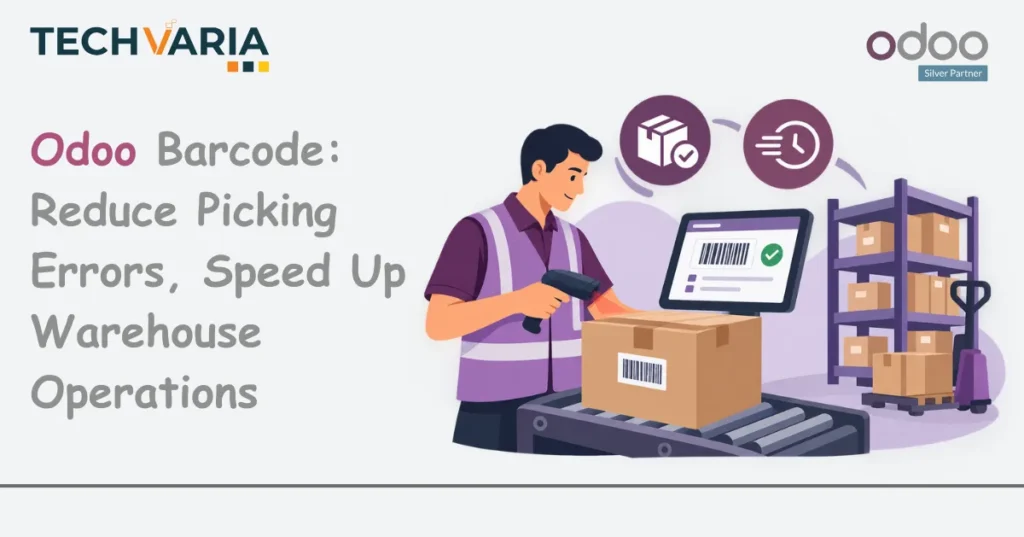
Warehouse errors have a particular quality: they are cheap to make and expensive to fix.
A picker takes the wrong variant from an adjacent bin. It takes two seconds. Downstream it becomes a wrong delivery, a customer complaint, a return collection, a credit note, a replacement dispatch and — if the customer is significant — a conversation about reliability. The two seconds cost considerably more than two seconds.
Most growing warehouses run on paper pick lists and experienced staff. It works, because the experienced staff know the stock. It stops working when volume rises, when the team changes, or when the catalogue grows past the point where anyone can hold it in their head.
Odoo Barcode replaces that arrangement with scan-driven operations: every receipt, putaway, transfer, pick and count confirmed by scanning rather than by reading and remembering. This guide covers how it works, the location and product setup decisions that determine whether it succeeds, picking strategies, hardware, and the rollout approach that gets warehouse teams using it rather than working around it.
It is written for warehouse managers, operations directors and business owners in distribution, manufacturing and retail.
The Problem: Warehouses Run on Paper and Memory
- Pick lists are printed and marked by hand. Confirmation happens at a desk afterwards, from handwriting, sometimes hours later.
- Similar products get confused. Adjacent bins, similar packaging, variant differences that matter to the customer and are invisible at arm’s length in poor light.
- Nobody knows where anything is, except the people who do. Stock location lives in the memory of two or three long-serving staff, which is a genuine business continuity risk and makes new starters slow for months.
- Receiving is a bottleneck and a blind spot. Goods arrive, sit on the dock, and enter the system in a batch later. Between arrival and entry, stock exists physically but not in the system — which is exactly when sales promise it.
- Counting stops the business. Full counts require shutting down, and they produce a variance that arrives too late to trace.
- Errors are discovered by customers. Which is the most expensive possible detection point.
Why Picking Accuracy Is a Margin Issue
The cost of a mispick is almost entirely downstream. The pick itself costs nothing to correct in the aisle. Once dispatched, it costs outbound freight, return freight, re-picking, re-dispatch, an administrative credit, and warehouse capacity consumed twice. In thin-margin distribution, a handful of mispicks can consume the margin on a large number of correct orders.
Throughput limits revenue during peaks. If your warehouse can process a certain number of order lines per hour, that ceiling determines what you can accept during your busiest weeks. Scanning typically raises the ceiling without adding headcount — and peak capacity is when additional capacity is worth the most.
Stock accuracy depends on transaction discipline. Every unrecorded movement degrades the data. Scanning at the point of movement is what makes stock accuracy achievable rather than aspirational, which in turn makes reorder points, availability promises and cycle counting meaningful.
Staffing flexibility improves. A scan-guided warehouse can be worked by someone who does not know the stock. That changes your ability to absorb peaks with temporary staff and reduces dependence on long-serving individuals.
What Odoo Barcode Actually Does
Odoo Barcode is a mobile-oriented interface over Odoo Inventory operations, designed for handheld use in a warehouse.
The operations it covers:
- Receipts — scan the incoming product and location, confirm quantities against the purchase order
- Internal transfers — move stock between locations with both ends scanned
- Putaway — direct stock to the correct location on receipt, guided by rules
- Delivery picking — scan-confirmed picking against the delivery order
- Batch and wave picking — several orders picked in one pass
- Inventory adjustments and cycle counts — count by scanning rather than by transcription
- Lot and serial capture — recorded at the point of movement rather than reconstructed
The principle throughout is the same: the system tells the operator what to do next, and the scan confirms it was done. That inversion — from operator-led to system-led — is where the accuracy comes from.
Location Naming: The Decision Everything Depends On
If you get one thing right in a barcode project, make it this.
Every physical position that holds stock needs a unique, barcoded location identifier. The naming convention determines whether the system can guide operators efficiently, and it is very difficult to change once labels are printed and staff have learned it.
A workable convention encodes the physical hierarchy in a readable sequence — zone, aisle, rack, level, position — so a location code tells a human roughly where to walk and tells the system exactly where the stock is.
Principles that hold up:
- Encode a walking path. If the sequence follows the route through the warehouse, the system can sort pick lists to minimise travel. If it does not, pickers zig-zag regardless of how good the software is.
- Keep it fixed length and consistent. Variable formats break sorting and confuse scanning.
- Leave room to expand. Warehouses add racking. Numbering that runs out forces awkward exceptions.
- Label at eye level and legibly. Labels that require kneeling or a torch get skipped, and a skipped scan is an unrecorded movement.
- Barcode staging and dock areas too. Goods sitting on the dock are in the building but often not in the system, and that gap causes a specific class of problem — stock that sales can see but the warehouse cannot find.
Walk the pick route before finalising the convention, with the person who picks most often. Fifteen minutes of that conversation prevents a labelling exercise you have to repeat.
Barcoding Products Properly
- Use manufacturer barcodes where they exist and are reliable. Most retail-packaged goods carry a standard barcode that is already unique and printed.
- Assign internal barcodes where they do not. Loose components, own-brand goods, repackaged items. Generate and print internal codes rather than leaving items unscannable, because an unscannable item is an item the operator has to handle by exception — and exceptions are where discipline decays.
- Handle variants carefully. Size, colour and specification variants must have distinct barcodes. A single code across variants recreates the exact error that scanning exists to prevent.
- Consider packaging levels. Units, inner cartons and pallets may each need a code, particularly if you pick in more than one unit of measure. Odoo supports packaging definitions; use them rather than relying on operators to do mental arithmetic.
- Clean the product master first. Duplicates, inconsistent units of measure, and items with no barcode are the real project. In most implementations this takes longer than the configuration.
Putaway and Removal Strategies
These are what make a barcode system intelligent rather than merely confirmatory.
Putaway strategies direct incoming stock to appropriate locations automatically — by product category, by storage requirement, by fast-moving zone. Without them, stock goes wherever there is space, and picking travel grows indefinitely.
Removal strategies determine which stock is picked when several locations or lots hold the same item:
| Strategy | Picks | Best for |
|---|---|---|
| FIFO | Oldest received first | General stock rotation |
| LIFO | Most recent first | Specific accounting or practical cases |
| FEFO | Earliest expiry first | Food, pharmaceuticals, cosmetics, chemicals |
| Closest location | Nearest available stock | High-velocity picking where rotation is less critical |
FEFO is the one that matters most for regulated and perishable goods, because it converts expiry management from a manual check into a system behaviour. Businesses handling shelf-life goods should treat this as a requirement rather than a refinement.
Picking Methods and When to Use Each
- Single order picking. One order, one pass. Simple, and appropriate for large orders or where order integrity matters. Inefficient for many small orders.
- Batch picking. Several orders picked together, sorted afterwards. Reduces travel substantially where orders are small and overlapping.
- Wave picking. Orders grouped by a criterion — dispatch time, carrier, zone — and released as a wave. Suits businesses with carrier cut-off times.
- Zone picking. Pickers stay in a zone; orders move between zones. Suits large warehouses where travel dominates.
- Cluster picking. Multiple orders picked simultaneously into separate containers on one trolley. Effective for small-line e-commerce orders.
Most distributors starting with barcode scanning get the largest immediate gain from batch picking on small orders, because travel time usually dominates pick time. Measure your average lines per order before choosing — if it is low and your orders overlap, batching is where the throughput is.
Hardware: What You Actually Need
| Component | Options | Notes |
|---|---|---|
| Handheld device | Rugged industrial scanner, or a phone/tablet with a Bluetooth scanner | Rugged devices survive warehouse conditions; phones are cheaper and more familiar |
| Scanner type | 1D laser, 2D imager | 2D reads damaged and QR codes; generally worth the small premium |
| Connectivity | Warehouse wi-fi | The most commonly underestimated requirement — survey coverage before rollout |
| Label printer | Thermal, for locations and internal barcodes | Location labels need durability |
| Mounting | Trolley or forklift mounts | Operators need both hands |
Wi-fi coverage is the failure point nobody budgets for. Racking absorbs signal, and a warehouse that has adequate coverage in the office and the dock frequently has dead zones in the aisles. Survey it properly before rollout — a scan-driven process that drops connection mid-pick is worse than paper, because operators lose confidence and revert.
Benefits You Can Measure
- Picking error rate. The headline metric — measure it before and after.
- Order lines picked per hour. Throughput, and therefore peak capacity.
- Receiving-to-available time. How quickly incoming stock becomes sellable.
- Stock accuracy. Improves as movements are captured at the point they happen.
- Time to productivity for new staff. From weeks to days, since the system guides rather than the individual knowing.
- Returns and credit notes from picking errors. Falls directly.
- Count duration. Cycle counting replaces shutdown counting.
- Dependence on key individuals. Reduced — a genuine continuity improvement.
Picking Method Comparison
| Method | Travel efficiency | Sorting effort | Best for | Watch out for |
|---|---|---|---|---|
| Single order | Low | None | Large orders, order integrity | Inefficient at volume |
| Batch | High | Moderate — sort after picking | Many small overlapping orders | Sorting errors if unscanned |
| Wave | High | Moderate | Carrier cut-offs, scheduled dispatch | Requires disciplined scheduling |
| Zone | Very high | High — orders consolidated | Large warehouses | Consolidation becomes the bottleneck |
| Cluster | High | Low | Small e-commerce orders | Trolley capacity limits |
Best Practices
- Design the location convention before printing anything. Walk the route with a picker.
- Clean the product master and assign barcodes to everything. No exceptions — one unscannable item teaches operators that workarounds are acceptable.
- Survey wi-fi coverage in the aisles. Not in the office.
- Pilot one zone or one process for three weeks. Receiving is often the best starting point because it is contained.
- Configure putaway and removal strategies from the start. Scanning without them is confirmation, not guidance.
- Train hands-on, on the floor, with the actual device. Classroom training for a physical task does not transfer.
- Measure the baseline before go-live. Error rate and lines per hour. Without them you cannot demonstrate the gain.
- Start cycle counting once scanning is established. It becomes almost free.
- Listen to the pickers in week one. They will identify the awkward step within days, and fixing it early is what secures adoption.
Common Mistakes
- Poor location naming. Difficult to change later, and it caps every efficiency gain.
- Leaving some items unbarcoded. Establishes that exceptions are normal.
- Same barcode across variants. Recreates the error scanning was meant to prevent.
- Ignoring wi-fi dead zones. Operators lose confidence and revert to paper.
- No putaway strategy. Stock scatters and travel time grows.
- Skipping the pilot. Rolling out across the whole warehouse at once multiplies problems.
- Classroom-only training. The task is physical; the training must be too.
- No baseline measurement. You cannot prove the improvement or diagnose regression.
- Treating it as an IT rollout. It is a warehouse process change with a technology component.
An Illustrative Scenario: A Spare Parts Distributor
A composite illustration built from common patterns, not an account of a specific named client.
Consider an automotive spare parts distributor with a 40,000 square foot warehouse, roughly 18,000 SKUs with heavy variant overlap, and around 400 order lines picked daily across trade counter and dispatch.
Before
Picking ran on printed lists. Three long-serving pickers knew the stock; two newer staff were noticeably slower and made most of the errors. Similar part numbers in adjacent bins were a recurring problem, particularly across fitment variants that looked identical. Mispicks were discovered by customers, and the returns handling consumed a meaningful part of one person’s week. Stock counts were annual and produced a variance the finance manager had stopped trying to explain.
What Was Implemented
The product master came first and took six weeks — deduplicating part numbers, standardising units of measure, and assigning internal barcodes to the substantial minority of items that had none. Variants were given distinct codes, which was the single change that addressed the most common error.
Locations were renamed to a fixed-length convention encoding zone, aisle, rack and level, sequenced to follow the natural pick route. Labels were printed at eye level. Staging and dock areas were barcoded, which closed the gap where received goods existed physically but not in the system.
A wi-fi survey found two dead zones in the deep racking, and two access points were added before rollout rather than after complaints.
Putaway strategies directed fast-moving lines to an accessible zone. Removal was set to FIFO. Batch picking was introduced for small dispatch orders, which were the majority.
Rollout was piloted on receiving for three weeks, then picking in one zone for a further three, before the full warehouse.
After One Quarter
Picking errors fell sharply, with the largest single contribution coming from distinct variant barcodes rather than from scanning itself. Lines per hour rose on dispatch picking, mostly attributable to batch picking reducing travel. New staff reached acceptable productivity in days rather than weeks, because the device told them where to go.
The outcome the operations manager valued most was less expected: with receiving scanned at the dock, the gap between goods arriving and becoming sellable closed from most of a day to minutes — which removed a recurring argument between sales and the warehouse about stock that was “in the building somewhere.”
Industry Use Cases
- Trading and distribution. Large catalogues, variant-heavy, high line volume. The core use case. See trading and distribution solutions.
- Automotive parts. Extreme variant similarity and fitment complexity — distinct variant barcoding is the decisive change. See automobile and EV solutions.
- Manufacturing. Raw material issue, WIP movement and finished goods putaway, with lot traceability captured at the point of movement. See manufacturing solutions.
- Pharmaceutical and healthcare distribution. FEFO removal and batch capture are compliance requirements. See healthcare solutions.
- E-commerce fulfilment. High order volume with few lines each — cluster and batch picking carry the value. See e-commerce solutions.
- Third-party logistics. Multi-client stock in shared space, where location discipline is contractual. See logistics solutions.
Implementation Tips
- Walk the pick route with a picker before naming locations.
- Budget six weeks for product data, not one. It is the critical path.
- Survey wi-fi in the aisles, loaded. Empty racking gives a false reading.
- Buy one of each device and test it before ordering for the team.
- Pilot receiving first. Contained, low risk, and it proves the concept to sceptics.
- Give variants distinct barcodes even where the manufacturer does not.
- Measure error rate and lines per hour before you start.
- Fix the first operator complaint within days. It signals that the system serves them.
- Plan a post-go-live review. Techvaria’s Odoo support and maintenance team covers the stabilisation period when edge cases surface.

Mustufa Rahi is an Odoo Certified Functional Consultant and ERP expert at Techvaria with 15+ years of experience in implementation, automation, and business process optimization, helping organizations scale efficiently.