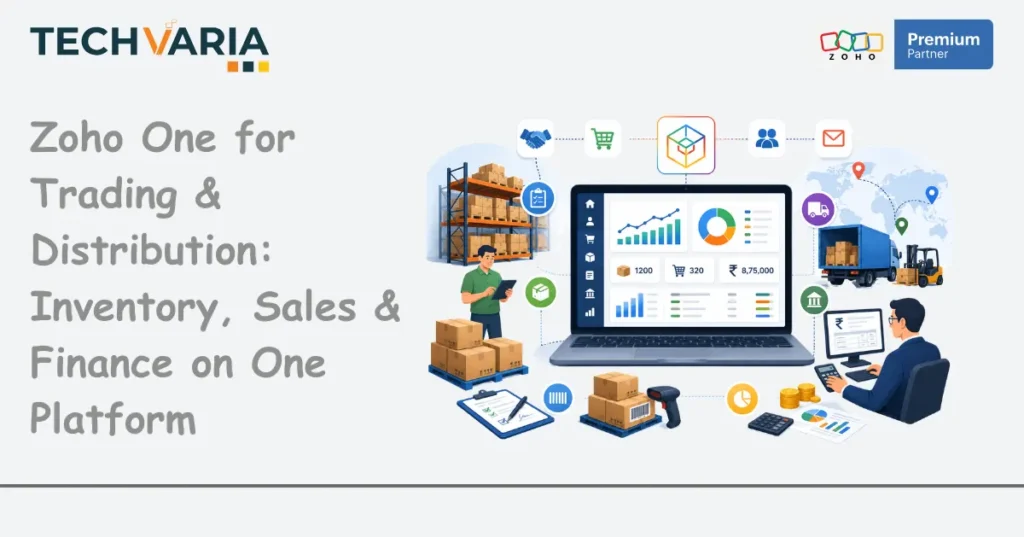
Trading and Distribution’s Data Problem
A trading and distribution business is, at its core, an information business. The trader who knows exactly what stock they have, what it cost, what their customers will pay for it, and when they need more — wins. The one operating on approximations loses margin on every transaction and scrambles to maintain customer relationships that their data can’t support.
Yet the majority of mid-sized trading and distribution companies operate with precisely those approximations. Customer pricing maintained in individual sales rep spreadsheets that diverge from each other over time. Inventory counts in a legacy system that doesn’t update when goods are returned. Purchase orders sent via email with no systematic tracking of delivery or invoice matching. Accounting done at month-end from manually compiled data, two weeks after the fact.
Zoho One addresses this by providing trading and distribution businesses with a connected operational platform: CRM for customer and commercial management, Inventory for stock and order management, Books for purchasing and financial management, and Analytics for the business intelligence that drives better decisions.
This guide examines how Zoho One applies specifically to trading and distribution — the workflows that matter, the integrations that deliver value, and the implementation approach that produces real operational improvement.
The Core Business Challenges in Trading & Distribution
- Pricing inconsistency — different customers quoted different prices by different sales reps, with no central pricing control
- Inventory inaccuracy — stock figures that don’t match physical reality, leading to overselling and emergency procurement
- Receivables aging — credit customers not followed up systematically, cash collection slower than it should be
- No customer profitability visibility — high-volume customers who are actually low-margin are not identified
- Procurement reactive, not proactive — stock runs out before purchase orders are raised
- Vendor invoice mismatches — supplier invoices paid without verifying against purchase orders or receipts
- Fragmented customer data — sales history, credit status, and relationship notes not accessible in one place
📊 Trading companies that implement integrated CRM and inventory management report an average 22% improvement in gross margin within 12 months of go-live, primarily through pricing discipline enforcement and reduced emergency procurement costs, according to a 2023 Deloitte SME Operations Report.
How Zoho One Covers the Trading & Distribution Business Model
Zoho One’s architecture maps naturally to the trading and distribution business:
- Zoho CRM: Customer relationship management, sales pipeline, credit management, and account intelligence
- Zoho Inventory: Stock management, purchase orders, sales orders, multi-warehouse operations, and order fulfilment
- Zoho Books: Vendor invoice management, customer invoicing, GST/VAT compliance, and financial reporting
- Zoho Analytics: Business intelligence — margin analysis, customer profitability, inventory turnover, and sales performance
- Zoho Campaigns: Customer communication — price change notifications, product launch announcements, and reorder reminders
All of these applications share the same customer, product, and transaction data — eliminating the reconciliation work that consumes finance team time when different systems hold different versions of the same information.
Zoho CRM for Trading & Distribution: Commercial Management
Customer Account Management
In distribution, the account is the relationship — not the individual contact. A single customer account may have multiple buyers, a dedicated logistics coordinator, and a finance contact for invoicing — all of whom interact with your business in different ways.
Zoho CRM manages this account complexity:
- Account records with multiple linked contacts — each with their role, communication preferences, and interaction history
- Complete account view: all open deals, all historical orders, credit limit status, payment behaviour, and support tickets
- Activity timeline: every call, email, meeting, and note logged against the account — visible to any team member
- Account segmentation by annual purchase value, product category, geographic territory, or industry
Customer Pricing Management
Pricing consistency is one of the biggest commercial discipline challenges in distribution sales. Zoho CRM, connected to Zoho Inventory’s pricelist system, enforces pricing:
- Customer pricelists assigned in CRM, applied automatically when a quotation is created in Zoho Inventory
- Volume-based pricing tiers — different unit prices at different quantity thresholds
- Discount authority limits — a sales rep can offer up to X% discount; anything above requires manager approval in CRM
- Time-bound promotional pricing — managed centrally and applied automatically without sales rep discretion
Sales Pipeline and New Business Development
For trading companies actively acquiring new accounts or growing existing ones, Zoho CRM manages the commercial pipeline:
- New account prospects with product interest, estimated annual volume, and decision-maker contacts tracked in a structured pipeline
- Quotation follow-up tasks automatically created — ensuring no quotation goes unanswered
- Win/loss analysis — understanding why you win and why you lose, by product, territory, and competitor
- Sales rep performance: pipeline by rep, quotations raised by rep, conversion rate by rep — giving sales management clear visibility
Credit and Receivables Management
Credit control is a cash flow imperative for distributors. Zoho CRM provides:
- Credit limit per customer — visible to sales reps when creating quotations
- Credit hold alerts — when a customer exceeds their credit limit, new orders can be flagged or blocked automatically
- Receivables aging in CRM — outstanding invoices by age band per customer, visible to account managers
- Collections follow-up workflow — automatic tasks created for account managers when invoices reach 30, 60, and 90 days overdue
Zoho Inventory for Trading & Distribution: Stock and Order Operations
Multi-Warehouse Inventory Management
Regional distributors and national trading companies typically operate from multiple warehouses or storage locations. Zoho Inventory manages this with:
- Unlimited warehouse and storage location configuration
- Inter-warehouse transfer workflows — documented, tracked, and reflected in location-specific stock counts
- Warehouse-specific reorder rules — each location has independent minimum stock thresholds
- Consolidated stock visibility — total stock across all locations, location-specific stock, and in-transit stock all visible in one report
Purchase Order and Goods Receipt Management
Purchasing in Zoho Inventory follows a structured workflow:
- Reorder rule triggers or manual purchase requisition identifies the need.
- Purchase Order raised to the selected vendor in Zoho Inventory — with product, quantity, and agreed price.
- PO sent to vendor via email directly from Zoho Inventory.
- Goods received against the PO — stock updated immediately on receipt confirmation.
- Goods receipt record linked to the PO — available for three-way matching against vendor invoice in Zoho Books.
Sales Order Fulfilment
The outbound order process in Zoho Inventory:
- Sales Order confirmed — stock reserved against the order.
- Picking list generated for warehouse staff.
- Goods packed and dispatched — delivery order confirmed.
- Invoice generated from confirmed delivery — no separate invoicing step required.
- Delivery tracking number (if carrier-integrated) attached to the delivery record.
💡 Tip: For high-volume distributors processing more than 50 outbound orders per day, configure Zoho Inventory’s batch picking feature — grouping multiple orders by pick location to reduce warehouse travel time and increase throughput.
Lot and Expiry Tracking for Distribution
For distributors handling products with batch management requirements — food and beverage, pharmaceuticals, cosmetics, agrochemicals — Zoho Inventory’s lot tracking provides:
- Lot number assigned on goods receipt from vendor
- FIFO dispensing — oldest lots fulfilled first to minimise expiry wastage
- Expiry date alerts — advance warning when stock is approaching expiry
- Customer delivery traceability — which customer received which lot, for recall management
Zoho Books for Trading & Distribution: Financial Management
Vendor Invoice Management and Three-Way Matching
Zoho Books handles vendor invoice management with the three-way matching control that prevents over-payment:
- Vendor invoice entered in Zoho Books and linked to the originating purchase order
- Quantities and prices automatically compared between invoice, PO, and goods receipt from Zoho Inventory
- Discrepancies flagged for review — payment held until resolution
- Clean matches approved for payment — payment run processed from Zoho Books
Customer Invoicing and GST Compliance
Zoho Books generates customer invoices from confirmed delivery records in Zoho Inventory:
- Invoice data pulled automatically — customer, products, quantities, and agreed prices
- GST calculated automatically based on customer GSTIN, supply state, and product HSN code
- Invoice emailed to customer directly from Zoho Books
- E-invoicing IRN generated for B2B invoices above the e-invoicing threshold
- GSTR-1 and GSTR-3B data prepared from confirmed invoice data
Margin Analysis and Product Profitability
Gross margin visibility is the financial intelligence that drives good trading decisions:
- COGS tracked using weighted average or FIFO cost valuation — accurate cost per unit sold
- Sales report with margin: revenue, cost, and gross margin percentage per product and product category
- Customer profitability: revenue, COGS, and margin contribution per account — identifying which customers are worth pursuing and which deserve renegotiation
- Vendor pricing analysis: landed cost per unit from each vendor — supporting supplier negotiations with data
Zoho One vs. Disconnected Tools for Trading & Distribution
| Business Function | Zoho One | Disconnected Tools (Typical) |
|---|---|---|
| Customer Management | CRM with account hierarchy and interaction history | Spreadsheet or basic contact tool |
| Pricing Control | Centralised pricelists, rep discount limits | Individual rep spreadsheets, inconsistent |
| Inventory Management | Multi-warehouse, real-time, reorder rules | Legacy WMS or spreadsheet, periodic updates |
| Purchase Management | PO workflow, three-way matching | Email-based, no systematic matching |
| Customer Invoicing | Automated from delivery, GST-compliant | Manual entry or delayed batch processing |
| Margin Reporting | Real-time by product and customer | Month-end manual exercise |
| Receivables Management | Aging report, credit limits, automated follow-up | Spreadsheet, manual monitoring |
| Data Consistency | Single platform, no reconciliation | Multiple systems, constant reconciliation |
Real Business Example: Pharma Distributor
A pharmaceutical distributor supplying hospitals, clinics, and retail pharmacies across two states was managing: customer relationships in Excel, inventory in a legacy distributor management system (DMS), purchasing via email with paper GRNs, and accounting in Tally. The business processed approximately 120 outbound orders per day.
Key pain points: customer pricing inconsistency between sales reps, inventory discrepancies between the DMS and physical counts, and a 15-day billing lag (invoices raised 15 days after delivery due to manual data consolidation from the DMS to Tally).
After implementing Zoho One — CRM, Inventory (with lot and expiry tracking), and Books — with a 14-week implementation:
- Customer pricing centralised — all customer pricelists in Zoho Inventory, automatically applied on every order; pricing disputes between customers and reps eliminated
- Inventory accuracy improved to 97.8% — lot tracking and FIFO dispensing eliminated the manual reconciliation exercise
- Billing lag reduced from 15 days to same-day — automated invoice generation from delivery confirmation in Zoho Inventory
- GSTR-1 preparation reduced from 4 days to 6 hours — Zoho Books’ GST reports replaced manual invoice classification
- Expiry wastage reduced by 31% in the first year — Zoho Inventory’s expiry alerts allowed proactive stock rotation and returns to vendors before expiry
Implementation Roadmap for Trading & Distribution on Zoho One
Phase 1 (Weeks 1–4): Foundation
- Product master setup: HSN codes, GST rates, lot tracking configuration, unit of measure
- Customer and vendor master migration: GSTIN, credit limits, payment terms, pricelists
- Warehouse configuration: locations, zones, and reorder rules
- Opening inventory count verification and migration to Zoho Inventory
Phase 2 (Weeks 5–9): Operations
- Zoho CRM configuration: pipeline stages, customer segments, credit management workflows
- Purchase order workflow: vendor management, approval rules, goods receipt process
- Sales order workflow: quotation, order confirmation, picking, dispatch, invoice
- Zoho Books: chart of accounts, tax configuration, bank feeds
Phase 3 (Weeks 10–12): Intelligence and Communication
- Zoho Analytics: margin report, inventory turnover, customer profitability, sales performance dashboard
- Zoho Campaigns: price change notifications, new product announcements, reorder reminder automations
- User training by role: sales reps, warehouse staff, accounts team, management
Phase 4 (Weeks 13–14): Go-Live and Stabilisation
- Parallel run: one week of parallel operation alongside existing systems
- Full go-live and daily support for first two weeks post-cutover
- Post go-live review and optimisation based on operational experience
Conclusion
Trading and distribution businesses operate in an environment where margins are tight, customers have choices, and operational efficiency directly determines profitability. The businesses that thrive are those that manage their commercial relationships, their inventory, and their finances with genuine discipline — not approximations.
Zoho One gives trading and distribution companies the integrated platform to do exactly that. Customer pricing that is controlled and consistent. Inventory that is accurate in real time. Purchasing that responds to demand rather than stockouts. Financial reporting that is current and actionable. All connected. All on one platform.
The implementation must reflect the operational realities of your specific distribution model — the product categories you handle, the customer segments you serve, and the compliance requirements of your market. That contextual understanding, combined with Zoho expertise, is what makes implementation successful.

Director @ Techvaria | Solutions Architect | Low-Code & AI Automation for Growth | Proven Expertise in Digital Transformation Across Industries