
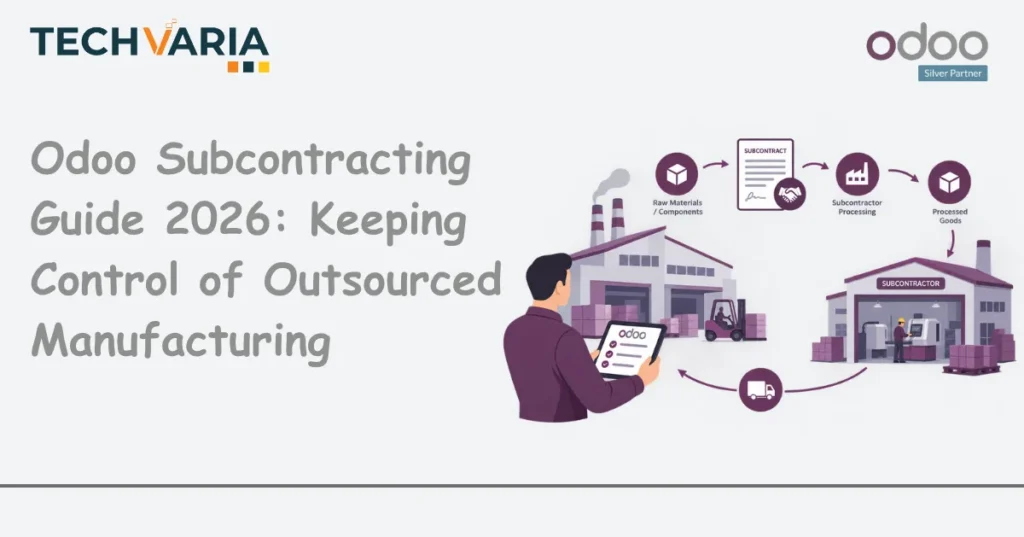
Almost every manufacturer outsources something. Plating, heat treatment, machining, painting, assembly, packing. It is usually a sound decision: the specialist has the equipment, the volume and the expertise, and building that capability in-house would rarely pay back.
The difficulty is not the outsourcing. It is that the moment material leaves your gate, most systems lose sight of it. The stock is still yours. It is still on your balance sheet. But it is not in your warehouse, it is not in your work-in-progress, and in a great many ERPs it is simply missing until finished goods come back.
What follows from that gap is predictable: nobody knows how much material is sitting with vendors, reconciliation happens quarterly and painfully, yield losses are absorbed without being measured, and the true cost of an outsourced operation is a number the finance team estimates rather than reports.
Odoo’s subcontracting functionality exists to close this. Material issued to a vendor remains visible as your stock at their location, finished goods are received against a defined consumption, and the conversion charge becomes part of the product cost rather than a general expense.
This guide covers the three subcontracting models, how to configure the bill of materials, how to cost outsourced work properly, and how to handle yield loss. It is written for production heads, supply chain managers, finance managers and manufacturing business owners.
The Problem: Stock You Own But Cannot See
- Material leaves on a challan and disappears from the system. It is issued out, often to a generic account, and reappears only when finished goods arrive.
- Nobody knows the outstanding balance with each vendor. How much steel is at the plater? How many housings at the assembler? The answer requires a phone call, and the vendor’s answer and yours frequently differ.
- Reconciliation is periodic and adversarial. Quarterly or annually, someone reconciles what was sent against what came back, discovers a gap, and negotiates it with the vendor months after the work was done.
- Yield loss is absorbed silently. You send 1,000 units of material; you get 960 good pieces back. The 40 are written off as process loss without anyone asking whether 4% is the right number, whether it is getting worse, or whether it differs between vendors.
- Conversion cost sits in overheads. The subcontractor’s invoice is posted to a processing expense account rather than onto the product, so product costing understates what the item actually costs to make.
- Lead time is invisible. How long material sits with each vendor is not measured, so planning uses an assumption rather than a fact.
- Compliance documentation is manual. Where jurisdictions require formal documentation for goods sent for job work, it is prepared and tracked outside the system, which is a control weakness as well as an administrative burden.
Why Subcontracting Visibility Affects Margin and Risk
Material at vendors is working capital you are not managing. For manufacturers with significant outsourced content, the value sitting at subcontractors at any moment can be substantial. It is your asset, it carries your risk, and if you cannot quantify it you cannot manage it, nor can you evidence it at audit.
Unmeasured yield loss is unpriced cost. A percentage point of yield difference between two vendors doing the same operation is a real commercial difference, and it will not appear anywhere unless material issued and received is tracked against a defined consumption. Manufacturers who start measuring this routinely find the variance between vendors is wider than they assumed.
Product costing is wrong without conversion cost. If the plating charge sits in overheads rather than on the plated component, every downstream costing decision (pricing, make-versus-buy, product mix) is made on an understated figure.
Documentation and duty treatment carry obligations. Many jurisdictions have specific requirements for goods sent out for processing, including documentation and time limits. Confirm the requirements applicable to your operations with a qualified adviser; the system’s role is to make the underlying tracking reliable enough to support them.
The Three Subcontracting Models
Odoo supports different ways of handling outsourced operations, and choosing the right one determines how much control you get and how much administration you carry.
Model 1: You Supply All Materials (Resupply Subcontractor)
You issue the components; the vendor performs the operation and returns the finished item. You retain ownership throughout, and the vendor charges a conversion fee only.
Best for: operations where the material is the significant cost and you want full control over its quality and source, such as machining, plating, heat treatment and assembly of your components.
Model 2: The Vendor Supplies Some or All Materials
The vendor sources some components themselves and charges for material plus conversion. You may still supply the critical or high-value items.
Best for: operations where the vendor’s purchasing is better than yours for consumables, or where the material is commodity and not worth your handling.
Model 3: Buy the Finished Component Outright
Not subcontracting at all: a straightforward purchase of a finished item. Included here because businesses sometimes treat a simple purchase as subcontracting and create unnecessary complexity.
Best for: where you neither supply material nor need visibility of the process.
Tip: Be deliberate about which model applies to each vendor and operation, and configure accordingly. Businesses that apply one model to all outsourced work either carry unnecessary administration on simple purchases, or lose visibility on operations where they are actually supplying the material.
How Odoo Handles Subcontracting
The mechanism, in sequence:
- The product is flagged as subcontracted with a bill of materials of the subcontracting type, naming the subcontractor and the components consumed.
- A purchase order is raised to the subcontractor for the finished item, at the conversion price.
- Components are issued to the subcontracting location. Odoo holds material sent to subcontractors in a dedicated subcontracting location, and a separate location can be set for each subcontractor, so material sent out remains visible as your stock, held at their site. This is the mechanism that closes the visibility gap.
- The subcontractor performs the work. During this period, the material sits in their location in your system: quantifiable, reportable and auditable.
- Finished goods are received against the purchase order. Odoo consumes the components from the subcontracting location according to the bill of materials, and brings the finished item into your warehouse.
- The vendor bill is matched to the purchase order, and the conversion cost flows into the product’s cost.
The essential point: material never leaves your books, it changes location. That single structural difference is what makes balance reporting, yield measurement and reconciliation possible.
Setting Up the Bill of Materials Correctly
The subcontracting BOM is the control document, and errors here propagate into every subsequent transaction.
- Define exact consumption, including expected loss. If the operation consumes 1.05 kg of material per finished unit because of an inherent trim loss, model 1.05, not 1.00. A BOM that ignores normal loss will show a variance on every single job, which means genuine problems get lost in routine noise.
- Name the subcontractor on the BOM. Where different vendors perform the same operation with different consumption or different supplied components, create separate BOMs per vendor. This is also what lets you compare vendors on yield.
- Include only what you supply. Components the vendor sources should not appear as issued material, or your consumption reporting will be wrong.
- Model packaging and consumables deliberately. If you supply cartons or chemicals, include them. If the vendor provides them within the conversion charge, exclude them.
- Keep BOM versions under control. A changed component or revised consumption should be a new version with an effective date, not an edit to the existing record; otherwise historical variance analysis becomes meaningless.
Costing Outsourced Work Properly
The whole point of this exercise, in commercial terms.
The true cost of a subcontracted component is:
- Material issued, at its own cost, which for imported material should already include landed cost
- Plus the conversion charge from the vendor
- Plus freight both ways, where you bear it
- Plus the cost of normal yield loss
- Plus any rework or inspection cost you incur on return
Configure this so the cost lands on the product, not in general overheads. The purchase order to the subcontractor carries the conversion charge; receipt consumes the components at their cost; the resulting product cost is the sum. Freight and inspection should be attributed rather than pooled. Treating them as general expense is the most common reason outsourced components look cheaper than they are.
Make-versus-buy becomes answerable. Once the true outsourced cost is visible, you can compare it against the in-house cost of the same operation (machine time, labour, consumables, overhead absorption) on a like-for-like basis. Most manufacturers have not run this comparison with accurate numbers on both sides, and the answer occasionally surprises them in both directions.
Yield, Scrap and the Conversations Nobody Wants
This is where the data becomes commercially useful.
- Measure actual versus expected consumption per job. The BOM says what should have been consumed; the receipt says what was produced. The difference is yield variance, and it is a number most manufacturers have never had per vendor.
- Distinguish normal loss from excess loss. Normal loss belongs in the BOM and in the cost. Excess loss is a problem: either a process issue at the vendor, a material quality issue at your end, or a measurement issue in between.
- Track it by vendor and by period. Two vendors performing the same operation at different yields is a commercial fact worth acting on. A single vendor whose yield is drifting is an early warning.
- Agree the treatment of scrap contractually. Who owns the scrap, who bears the loss above an agreed threshold, and how it is valued. These are negotiable terms, and manufacturers who can evidence yield with data negotiate them from a stronger position than those who cannot.
Tip: Run the yield comparison across vendors before your next rate negotiation. A vendor charging slightly less per piece but running two points worse on yield may be the more expensive option, and that calculation is only possible once issue and receipt are tracked against a defined BOM.
Benefits You Can Measure
- Material value at subcontractors. Newly quantifiable: a working capital figure you can manage rather than estimate.
- Yield by vendor and operation. The basis for rate negotiation and vendor selection.
- True product cost. Conversion, freight and loss on the product rather than in overheads.
- Reconciliation effort. From a quarterly investigation to a continuous position.
- Subcontractor lead time. Measured rather than assumed, which improves production planning.
- Make-versus-buy clarity. Answerable with accurate numbers on both sides.
- Audit readiness. Material at third-party locations evidenced rather than reconstructed.
- Vendor performance comparison. On cost, yield and turnaround together rather than on price alone.
Model Comparison
| Dimension | You supply materials | Vendor supplies materials | Buy finished outright |
|---|---|---|---|
| Material ownership during work | Yours, at vendor location | Mixed or vendor’s | Vendor’s |
| Visibility required | High | Moderate | Low |
| Administrative effort | Highest | Moderate | Lowest |
| Cost control | Strongest: you control material source and price | Partial | Price only |
| Quality control over inputs | Full | Limited | None |
| Working capital tied up | Highest | Moderate | Lowest |
| Yield measurement possible | Yes, precisely | Partially | No |
| Best for | Critical or high-value material, quality-sensitive operations | Commodity inputs the vendor buys better | Standard components with no process concern |
Best Practices
- Choose the model per vendor and operation, not once for the whole business.
- Model normal loss in the BOM. Otherwise every job shows a variance and real problems hide in the noise.
- Create a location per subcontractor. This is what makes balances and reconciliation possible.
- Separate BOMs where vendors differ in consumption or supplied components; it is also how you compare them.
- Attribute freight and inspection to the component, not to overheads.
- Reconcile vendor balances monthly, not quarterly. Minutes each month versus days each quarter.
- Review yield by vendor before rate negotiations.
- Version-control the BOM with effective dates.
- Involve purchasing and production together. Purchasing owns the vendor relationship; production owns the consumption reality. Neither can configure this alone.
Common Mistakes
- Issuing material to a generic expense account. The stock leaves your books and the whole exercise fails at the first step.
- BOM consumption set at theoretical yield. Every job shows a variance and nobody investigates any of them.
- One BOM across multiple vendors with different consumption. Yield comparison becomes impossible.
- Conversion cost in overheads. Product costing understates outsourced components.
- Annual reconciliation. Differences become negotiations rather than corrections.
- Not tracking subcontractor lead time. Planning runs on assumption.
- Ignoring documentation obligations. Where jurisdictions require formal tracking of goods sent for processing, an informal process is a compliance exposure.
- Treating simple purchases as subcontracting. Unnecessary administration with no visibility benefit.
- Configuring without production input. The BOM has to reflect what actually happens, not what the drawing says.
An Illustrative Scenario: A Metal Components Manufacturer
A composite illustration built from common patterns, not an account of a specific named client.
Consider a manufacturer of precision metal components supplying automotive and industrial customers. Machining is done in-house; heat treatment, plating and some secondary machining are outsourced to five regional vendors.
Before
Material was issued to vendors on a challan and posted against a “material at job work” account with no location-level detail. The production planner maintained a workbook tracking what had gone where. Reconciliation happened quarterly and routinely produced differences that took days to investigate and were usually settled by negotiation rather than by evidence.
Yield loss was accepted at a rate agreed years earlier with each vendor. Conversion charges were posted to a processing expense account, so the plated components’ product cost showed material and in-house machining only.
What Was Implemented
Each subcontractor was set up as a location, so issued material remained visible as company stock at their site. Subcontracting BOMs were created per vendor per operation, with consumption modelled including normal loss agreed jointly between production and purchasing, a discussion that itself revealed two operations where the assumed loss had not been reviewed in years.
Purchase orders to subcontractors were raised for the finished operation, and conversion charges configured to flow onto the component cost. Inbound and outbound freight was attributed rather than pooled. Monthly balance reconciliation replaced the quarterly exercise.
After Two Quarters
The value of material sitting with vendors became a reported figure for the first time, and it was higher than management had assumed, which prompted a review of batch sizes sent out.
Yield data produced the finding with the most commercial consequence. Two vendors performing the same plating operation showed a material difference in yield. The vendor with the lower per-piece charge was, on a fully costed basis including material loss, the more expensive of the two. That comparison had been impossible before and changed the allocation of work at the next review.
Reconciliation stopped being adversarial, because both sides were working from a continuously maintained position rather than from a quarterly reconstruction.
Industry Use Cases
- Precision engineering and metal components. Heat treatment, plating, grinding and finishing outsourced to specialists. The core use case. See manufacturing solutions.
- Automotive component supply. Multi-stage processing across several vendors with customer-mandated traceability. See automobile and EV solutions.
- Textiles and apparel. Dyeing, printing, embroidery and stitching outsourced, often with significant material issued and meaningful yield variance.
- Electronics assembly. PCB assembly and testing outsourced with high-value components supplied, where material value at vendors is substantial.
- Pharmaceutical and chemical processing. Contract manufacturing with strict batch traceability and documentation requirements. See healthcare solutions.
- Packaging and printing. Converting operations outsourced with supplied substrate, where yield is a genuine commercial variable.
Implementation Tips
- List every outsourced operation and vendor first, and classify each by model. This is the design document.
- Agree normal loss per operation with production, in writing. The discussion is often more valuable than the configuration.
- Create locations before the first issue, so no material moves outside the structure.
- Start with your highest-value outsourced operation. It proves the benefit fastest.
- Reconcile the first month manually alongside the system to validate the setup.
- Attribute freight from the first transaction. Retrofitting it is tedious.
- Build the yield-by-vendor report before you need it for a negotiation.
- Check documentation requirements with your compliance adviser for goods sent for processing.
- Plan a review after two months. Techvaria’s Odoo support and maintenance team covers the period when consumption edge cases surface.

Mustufa Rahi is an Odoo Certified Functional Consultant and ERP expert at Techvaria with 15+ years of experience in implementation, automation, and business process optimization, helping organizations scale efficiently.

