

Custom Inventory Software for Manufacturers
Manufacturing inventory is not one stock figure β it is raw material, work in progress, finished goods, rejects, rework, and consumables, each behaving differently and each needing to be accurate for the others to mean anything. Generic inventory products track items in and items out. They have nowhere to record what was consumed against which production order, what is sitting on the shop floor half-finished, or which batch of raw material went into which finished lot. Techvaria builds inventory systems that hold the manufacturing reality, on the Zoho platform.
Home / Custom Inventory Software for Manufacturers
Why Manufacturing Inventory Needs a Different Model?
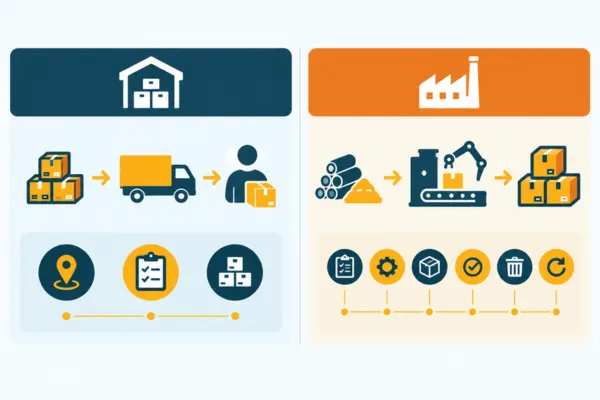
The difference between distribution inventory and manufacturing inventory is transformation. In distribution, what comes in is what goes out — the item identity is stable and the system needs to track quantity and location. In manufacturing, materials are consumed and converted, so the system must record what was issued to production, what was actually used versus what the bill of materials specified, what remains as work in progress at any point, what was produced, what was rejected, and what went to rework. Each of these is a distinct inventory state, and a product that only understands “in stock” and “out of stock” cannot represent them.
The consequences are practical: material availability checks that do not account for quantities already committed to open production orders; a raw material stock figure that includes material physically issued to the floor; costing that cannot separate material variance from yield loss; and no traceability from a finished batch back to the raw material lots that went into it — which matters enormously in food, pharmaceutical, chemical, and automotive supply chains where a recall or a customer audit requires exactly that. Building on Zoho Inventory with Zoho Creator handling the production and consumption layer produces a system that represents these states properly without the weight of a full manufacturing ERP.
Business Challenges We Solve
Manufacturers describe a consistent set of failures. Purchase decisions made on a stock figure that turns out to include material already committed to production, so the shortage is discovered when the job starts. Material issued to the shop floor on a paper slip, entered into the system days later or not at all, leaving the raw material figure permanently overstated. No work-in-progress visibility, so nobody can say what is on the floor or what it is worth without walking it. Actual consumption not compared against the bill of materials, so yield loss and material variance are invisible until the annual stock take reveals a gap nobody can explain. No batch or lot linkage, so a quality issue in a finished product cannot be traced to its raw material source, and a customer audit cannot be satisfied. Rejects and rework handled informally, distorting both stock and production figures.
How We Solve This
The solution structures the inventory around production. Zoho Inventory holds the item master, purchasing, goods receipt, warehouse locations, and finished goods dispatch. Zoho Creator handles what Inventory does not: production orders with bills of materials, material issue against those orders with actual quantities captured on the shop floor, work-in-progress state by production stage, batch and lot assignment with full genealogy from raw material through to finished output, rejection and rework routing, and consumption variance reporting against the BOM. Material issue is captured at the point it happens β on a tablet or phone at the store window, scanning the item and the production order β because that is the only way the raw material figure stays accurate.
Raw Material Stock with Commitment Visibility
Stock reported as physical quantity, quantity committed to open production orders, and quantity genuinely available β so purchasing decisions are made on the figure that actually matters.
Bill of Materials and Production Orders
Multi-level bills of materials against finished and semi-finished items, with production orders generating the material requirement and checking availability before release.
Shop Floor Material Issue Capture
Material issued against a production order and recorded at the store window on a mobile device, with scanning of item and order β so the raw material figure updates at the moment of issue rather than days later.
Work in Progress by Production Stage
WIP tracked by stage with quantity and value at each point, so the floor position is visible in the system and can be valued at period end without a physical walk.
Batch and Lot Traceability
Batch numbers assigned at goods receipt and carried through issue, production, and dispatch, with full genealogy in both directions β which raw material lots went into a finished batch, and which customers received output from a given raw lot.
Consumption Variance Against BOM
Actual material consumed compared against the BOM standard for each production order, with variance reported by item, product, and period, so yield loss and material waste become visible.
Rejection and Rework Handling
Rejects captured at the production stage with reason codes, routed to scrap or rework, with the corresponding inventory and cost effects applied rather than reconciled later.
Finished Goods and Dispatch
Finished output received into stock against the production order with batch identity intact, then allocated and dispatched with the batch record carried through to the delivery document.
Zoho Applications We Use for This
Zoho Inventory carries the item master and the warehouse; Creator carries the production and consumption layer that sits on top of it, with the rest of the stack handling accounting, demand and reporting.
Zoho Inventory
Item master, purchasing, goods receipt, warehouse locations, finished goods stock, and dispatch.

Zoho Creator
Production orders, bills of materials, material issue capture, WIP tracking, batch genealogy, rejection routing, and variance reporting.

Zoho Books
Inventory valuation, purchase and sales accounting, and production cost posting to the financial records.

Zoho CRM
Customer orders driving the production schedule, with order status visible back to the sales team.
Zoho Analytics
Consumption variance analysis, yield reporting by product, stock ageing, and production cost trends.

Zoho Flow
Automated handoffs between Inventory, Creator, and Books, and connections to external systems such as weighing equipment or quality instruments where APIs exist.

Where This Applies?
This applies to small and mid-sized manufacturers where a full manufacturing ERP is disproportionate but generic inventory software is insufficient. Food and beverage processors with batch traceability and shelf-life requirements, where a recall must be traceable in both directions. Chemical and coatings manufacturers with formulation-based BOMs, batch records, and regulatory documentation. Engineering and fabrication businesses producing to order, where each job has its own material requirement and the BOM varies by order. Plastics and packaging manufacturers with scrap and regrind that must return to stock correctly. Pharmaceutical and nutraceutical operations with lot control and documentation obligations. Automotive component manufacturers with customer traceability requirements and PPAP documentation.
It applies particularly to manufacturers currently running production on spreadsheets alongside an accounting package. This is the most common starting position, and it is workable at small scale β until either volume, an audit requirement, or a customer demanding traceability makes it untenable.
It also applies to manufacturers who already have an ERP that covers accounts and purchasing adequately but has no usable production module, or one so cumbersome that the shop floor bypasses it. Building the production and consumption layer in Creator and integrating it back to the existing system is usually faster and considerably cheaper than replacing the ERP.
Ready to Get Your Inventory Right?
Why Choose Techvaria for Manufacturing Inventory?
Techvaria is a Zoho Premium Partner and Odoo Silver Partner building operational systems for manufacturers in India and the UAE. That dual practice matters here: where a requirement genuinely needs full MRP depth — multi-level routings, capacity planning, work centre scheduling — we will say so and can build it on Odoo instead.
Where the requirement is inventory accuracy, consumption control, and traceability without full MRP, Zoho Inventory plus Creator delivers it faster and at lower ongoing cost. We scope honestly against that distinction rather than fitting every manufacturer to one answer.
Hear From Our Clients
Industries We Serve
Frequently Asked Questions
Because standard inventory products model items moving in and out, not items being transformed. They have no concept of material committed to a production order, work in progress by stage, consumption against a bill of materials, or batch genealogy through production. When these are missing, they move to spreadsheets — and the stock figure in the system stops being reliable. A custom layer built over Zoho Inventory holds the states that manufacturing actually requires.
Not entirely, and we are clear about the boundary. This approach covers inventory accuracy, BOM-driven consumption, WIP visibility, batch traceability, and variance reporting. It does not provide full MRP with capacity planning, finite scheduling, and work centre loading. For manufacturers who need those, Odoo’s MRP module is the more appropriate answer, and we build on that instead. Most small and mid-sized manufacturers need the former rather than the latter.
Batch numbers are assigned at goods receipt for raw materials and at production output for finished goods. Every material issue records which batch was consumed against which production order, building a genealogy. From a finished batch you can identify every raw material lot that went into it; from a raw material lot you can identify every finished batch and every customer that received output from it. Both directions matter — one for investigating a quality issue, the other for scoping a recall.
Yes, and this is usually the change that makes the biggest difference. A mobile application at the store window lets the storekeeper scan the item and the production order and record the quantity issued at the moment of issue. This is what keeps the raw material figure accurate. Paper slips entered later are the single most common cause of unreliable manufacturing stock data.
Actual consumption recorded against each production order is compared against the BOM standard for the quantity produced. Variance is reported per item, per product, and per period, so material waste and yield loss become visible as they occur rather than at the annual stock take. This reporting frequently pays for the project on its own, because most manufacturers discover variance they were not aware of.
Yes. Where the BOM varies by order — fabrication, engineering to order, custom assembly — the production order carries its own material requirement rather than referencing a fixed standard BOM. Consumption is then tracked against that order-specific requirement. This is a common pattern and is designed for rather than worked around.
Rejections are captured at the production stage with a reason code and routed to scrap or rework. Scrap is removed from WIP with the cost effect applied; rework returns to the appropriate stage and its additional material and time are tracked against the original order. Where scrap has recoverable value — regrind in plastics, metal offcuts — it can be received back into stock as a distinct item.
Eight to fourteen weeks for most manufacturing inventory implementations. The main variables are the complexity of the BOM structure, whether multi-level semi-finished stages are involved, the extent of batch traceability required, and how much item master cleanup is needed before migration. Item master quality is frequently the largest preparatory task and is worth assessing early.