
Skip to content

Custom Warehouse Management Software in India

Warehouse software fails in a specific way: it works perfectly in the demo and slows the floor down in production. The reason is usually that the product’s picking logic, location structure, or scanning flow does not match how the warehouse is actually laid out and operated, so staff route around it. Custom warehouse software built to your zones, your picking method, and your stock rules avoids that β€” and on the Zoho platform it can be built and running in weeks rather than as a year-long WMS deployment.

Why Packaged WMS Products Underperform in Mid-Sized Warehouses?

Why Packaged WMS Products Underperform in Mid-Sized Warehouses?

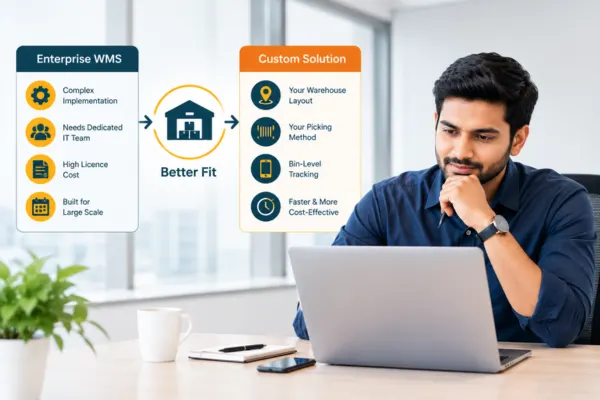
Enterprise WMS products are built for warehouses with dedicated systems teams, fixed processes, and the scale to justify a long implementation. Applied to a mid-sized Indian warehouse, they bring two problems. The first is fit: the product assumes a location structure, a picking strategy, and a putaway logic, and where yours differs the product wins β€” which means changing how the warehouse works to suit software rather than the reverse. That is sometimes correct, when the product encodes better practice, and frequently not, when the warehouse’s layout is determined by a building that cannot be changed and a product mix the product did not anticipate. The second is weight: implementation timelines and licence models scaled for large distribution centres are disproportionate for a warehouse of ten to fifty staff.

The alternative most such businesses actually run is worse β€” stock tracked in the accounting system at a total quantity level, physical location known only to the people who work there, picking from a printed list, and a stock take that produces a variance nobody can explain. Custom warehouse software built on Zoho Creator over Zoho Inventory sits between these: it holds bin-level location, barcode-driven movement, and your actual picking method, without the cost and duration of an enterprise WMS deployment.

Business Challenges We Solve

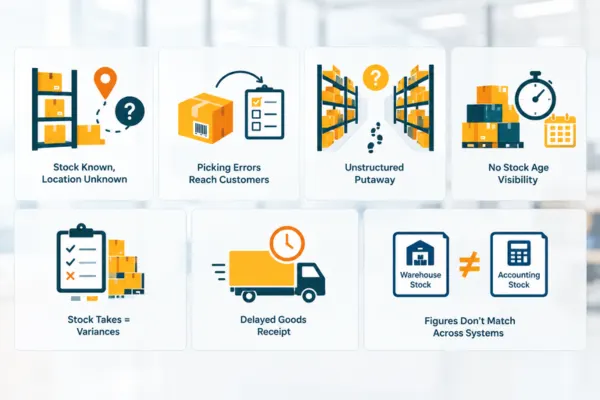
Warehouse operators describe the same failures. Stock quantity is known but location is not, so picking depends on staff memory and a new employee takes months to become productive. Picking errors reach customers because there is no verification step between the pick list and the packed carton. Putaway is unstructured, so fast-moving items end up wherever there was space and every pick becomes a long walk. Nobody knows the age of stock in a location, so older material sits while newer material ships. Stock takes require shutting the warehouse and still produce variances that cannot be traced to a cause. Goods receipt is recorded hours or days after the physical arrival, so the system is permanently behind. And the accounting system’s stock figure and the warehouse’s stock figure disagree, with no way to reconcile them except a manual count.

Warehouse Challenges, Solved

How We Solve This?

The solution addresses each at the point of physical activity. Locations are structured β€” zone, rack, level, bin and every item has a home. Barcode or QR labels on items and locations mean every movement is scanned rather than typed, which is both faster and far more accurate. Goods receipt is captured at the dock on a mobile device with a putaway instruction generated immediately. Picking follows a route through the warehouse ordered by location rather than by the sequence items appear on the order, with a scan verification at each pick. Cycle counting replaces the annual shutdown, counting a subset of locations continuously so variance is found within days of occurring rather than at year end. Zoho Inventory holds the item master and the stock position; Zoho Creator holds the location structure, the mobile scanning flows, and the picking and putaway logic that the standard module does not.

Bin-Level Location Structure

Warehouse mapped as zones, racks, levels, and bins, with every item assigned a home location and stock reported by location rather than as a single warehouse total β€” so the system knows where things physically are.

Barcode and QR Scanning Throughout

Item and location labels generated from the system, with every receipt, putaway, pick, move, and count captured by scan on a mobile device. This is what makes the data accurate, because typed entry at the point of activity does not happen reliably.

Directed Putaway

Goods receipt generates a putaway instruction based on your rules β€” item home location, fast-mover zoning, available capacity, or batch grouping β€” so stock lands where it belongs rather than wherever there is a gap.

Route-Ordered Picking with Verification

Pick lists sequenced by warehouse route rather than order line, with a scan at each pick confirming the correct item and location. Multi-order batch picking and wave picking are supported where volume justifies them.

Batch, Lot, and Expiry Control

Batch and expiry captured at receipt and enforced at picking, with FEFO allocation where shelf life matters β€” so older stock ships first without depending on anyone remembering to check.

Cycle Counting Instead of Shutdown Stock Takes

Continuous counting of a rotating subset of locations, with variance investigated while the cause is still traceable, replacing the annual full count that closes the warehouse and produces unexplainable gaps.

Dispatch, Packing, and Delivery Documentation

Packing verification against the order, carton and weight capture, delivery documentation generated from the actual packed contents, and dispatch confirmation updating stock and invoicing.

Accounting and Tally Reconciliation

Stock movements posting to Zoho Books, or to Tally where that remains the accounting system, with reconciliation reporting so the warehouse figure and the accounting figure are provably in agreement.

Zoho Applications We Use for This

Zoho Inventory holds the item master and the stock position, Creator holds the location structure and the floor-level flows, and the remaining products cover accounting, order intake, reporting and the outside connections.

Zoho Inventory
Zoho Inventory

Item master, purchasing, goods receipt, warehouse-level stock, and dispatch.

Zoho Creator
Zoho Creator

Bin-level location structure, mobile scanning flows, directed putaway, route-ordered picking, cycle counting, and packing verification.

Zoho Books
Zoho Books

Inventory valuation, GST-compliant purchase and sales accounting, and stock movement posting.

Zoho CRM
Zoho CRM

Customer orders flowing into the pick and dispatch queue, with fulfilment status visible to the sales team.

Zoho Analytics
Zoho Analytics

Pick accuracy, stock ageing by location, cycle count variance trends, and warehouse throughput reporting.

Zoho Flow
Zoho Flow

Connections to ecommerce platforms, courier and logistics providers, and Tally where it remains the accounting system.
Where This Applies?

This applies to Indian businesses running warehouses of roughly five hundred to fifty thousand square feet, where stock accuracy and picking speed matter commercially but an enterprise WMS is disproportionate. Distribution and wholesale businesses serving retail or trade customers with high SKU counts and daily order volume. Ecommerce fulfilment operations where pick accuracy directly determines return rates and customer ratings. Manufacturers with raw material and finished goods stores where issue accuracy affects production. Pharmaceutical and FMCG distributors with batch and expiry obligations. Auto parts and hardware distributors with very large SKU counts where finding an item without a location system is the main constraint on throughput. Third-party logistics operators handling stock for multiple clients with segregated inventory and separate reporting.

It applies particularly to businesses running multiple warehouse locations, because that is where the absence of a system becomes most costly β€” stock in one location is invisible to the other, transfers happen informally, and the consolidated position is a manual exercise.

It also applies to businesses that have outgrown their current arrangement rather than never having had one. A warehouse that operated well at two hundred orders a week frequently breaks at eight hundred, not because anything changed structurally, but because the informal knowledge that made it work does not scale and cannot be handed to new staff.

Ready to Get Your Warehouse Under Control?

A discovery session covers the physical layout, how goods actually move through it, your picking method, batch and expiry requirements, and how the warehouse figure needs to reconcile with accounting. We scope the location structure, the labelling approach, the mobile flows, and the integration, and give you a realistic timeline. Most warehouse builds reach production in eight to fourteen weeks including labelling and the initial location mapping.
Why Choose Techvaria for Warehouse Software

Why Choose Techvaria for Warehouse Software?

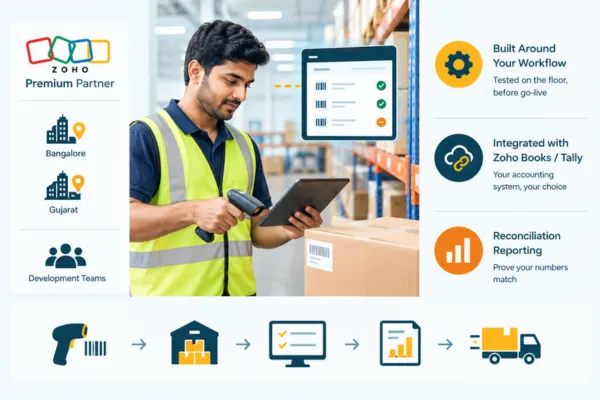
Techvaria is a Zoho Premium Partner with development teams in Bangalore and Gujarat, building operational applications for Indian distribution, manufacturing, and logistics businesses. Warehouse software succeeds or fails on whether the floor actually uses it, so we design the scanning flows around how the work is done rather than around what is easiest to build, and we test them on the floor before go-live.

We integrate with Zoho Books or with Tally where that remains the accounting system, and we build reconciliation reporting so the two figures can be proven to agree rather than assumed to.

Hear From Our Clients

Industries We Serve

Frequently Asked Questions

Not necessarily. Standard Android phones or tablets with the camera work well for most warehouse volumes and are considerably cheaper to deploy and replace. Dedicated rugged scanners are worth it in high-volume picking operations or harsh environments where scan speed and durability justify the cost. We assess this against your throughput during scoping rather than defaulting to either.

Yes, and this is the core of the system. Locations are structured as zones, racks, levels, and bins to whatever depth your layout requires. Stock is reported by location, items have home locations, and every movement records where from and where to. This is precisely what standard inventory modules do not provide and what makes the difference to picking speed and stock accuracy.

Yes. The mobile application supports offline capture and syncs when connectivity returns, which matters because warehouse interiors — particularly racking-dense areas and cold stores — frequently have poor signal. Scans made offline are queued and applied in sequence when the device reconnects.

Yes. Where Tally remains the accounting system of record, stock movements and the resulting vouchers post to Tally through its XML interface, with reconciliation reporting comparing the warehouse position against Tally’s stock summary. Master data alignment between the two — item names in particular — is part of the implementation scope and is usually the largest preparatory task.

A rotating subset of locations is scheduled for counting each day or week, typically weighted so fast-moving and high-value items are counted more often. Counts are performed by scan on the mobile device, variances are flagged immediately, and because the count is recent the cause is usually traceable. Over a cycle every location is counted, which removes the need for a full shutdown stock take.

Yes. Batch and expiry are captured at goods receipt and carried through putaway, picking, and dispatch. Where shelf life matters, allocation follows first-expiry-first-out automatically, and picking enforces the allocated batch rather than allowing any available stock. Expiry alerts flag stock approaching its threshold while it can still be moved.

Yes. Stock is visible across locations with a consolidated position, and transfers between warehouses are handled as structured movements with despatch and receipt confirmation at both ends, so in-transit stock is accounted for rather than disappearing between the two.

Eight to fourteen weeks for most warehouse implementations. The build itself is a portion of that; the rest is location mapping, label generation and physical labelling, item master cleanup, and floor training. Businesses with an accurate item master and a clearly defined layout complete faster. The labelling exercise is worth planning properly, as it is physical work that cannot be compressed much.

Resources

Latest Blogs