

Skip to content

SME Digital Transformation Cost in the UAE

Digital transformation is a phrase that makes SMEs assume a number far larger than the one that actually applies to them. For a UAE business of twenty to two hundred staff, the realistic programme is not a platform replacement β€” it is a sequence of targeted moves, each with a defined cost and a measurable return, taken in an order that funds the next one. This page sets out what the cost components actually are, how UAE requirements affect them, and what a sensible phasing looks like for a business that cannot afford to stop operating while it changes systems.

What Digital Transformation Actually Costs an SME?

What Digital Transformation Actually Costs an SME?

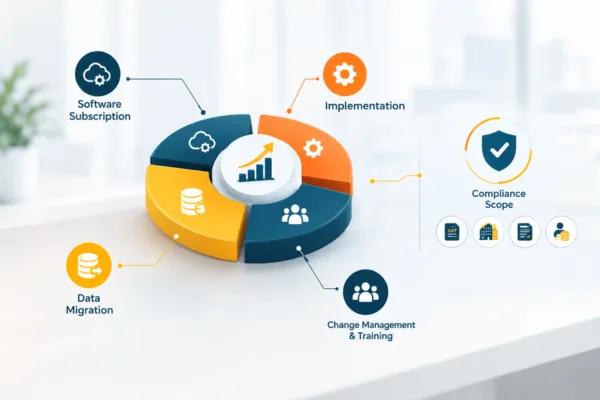
The cost of an SME transformation is not one number and it is not mostly software licences. It breaks into four components that behave differently. Software subscription is the visible one and usually the smallest β€” a recurring per-user cost that scales with headcount and is straightforward to model. Implementation is the larger one and is a one-time cost covering configuration, customisation, integration, and testing; it typically exceeds the first year of subscription and is where quotes diverge most. Data migration is the component most often underestimated, because its cost depends on the condition of data nobody has examined recently β€” a business with clean master data faces a defined task, while one with fifteen years of accumulated duplicates in Tally faces a substantial one. Change management and training is the component most often omitted entirely, and it is the one whose absence most reliably causes a technically successful implementation to deliver nothing, because people continue using the spreadsheet. For a UAE SME there is a fifth: compliance scope. VAT treatment, entity separation for businesses with mainland and free zone licences, bilingual documentation, and WPS payroll outputs are requirements rather than options, and a plan priced without them is priced for a different country.

What’s Driving This Decision?

The trigger is rarely a strategic decision to transform. It is usually an operational failure that has become too expensive to absorb: a finance team spending a week on a VAT return because data sits in four places, stock figures nobody trusts, a customer lost because nobody followed up, an audit that exposed how much of the business runs on spreadsheets, or growth into a second entity that the current setup cannot represent. The immediate question is what fixing it costs, and the anxiety underneath is whether committing to a programme means committing to a number that keeps growing.

That anxiety is reasonable and the answer to it is phasing. A transformation attempted as a single programme β€” every system replaced, every process redesigned, everything live at once β€” carries a cost and risk profile most SMEs cannot support, and it is how these projects acquire their reputation. A phased approach commits a defined cost against a defined scope, delivers a measurable improvement, and lets the return from that phase inform and part-fund the next. It also means the business is never more than a few weeks from a working outcome. The practical starting point is almost always the process causing the most measurable pain, which is not necessarily the one that looks most strategic β€” and identifying it correctly is what makes the first phase pay for itself rather than merely complete.

What Drives Digital Transformation Cost for UAE SMEs

What Drives the Outcome

The outcome of a Zoho implementation depends on more than the software itself. User needs, process scope, data quality, integrations, compliance, and ongoing support all influence cost, adoption, and long-term value. Here are the key factors that shape the outcome:

Number of Users and Licence Model

Subscription scales with headcount and the applications each user needs. The distinction between full access and submit-only users β€” served by a portal or stateless form β€” materially affects recurring cost and should be decided deliberately.

Implementation Depth per Application

Configuration alone is a contained cost. Customisation, integration between applications, and workflow automation add effort. The single most influential factor is how clearly your processes are defined before implementation begins.

Data Migration and Data Condition

The component most often underestimated. Master data quality β€” customers, suppliers, items, chart of accounts β€” determines whether migration is a defined task or a cleanup project. Assessing it early is the cheapest way to avoid a surprise.

UAE Compliance Scope

VAT configuration across supply categories, mainland and free zone entity separation, bilingual documents, and WPS payroll formats. These are requirements, not enhancements, and omitting them signals that the plan was not built for this market.

Number of Processes in Scope

Each additional process β€” sales, purchasing, inventory, HR, projects, support β€” adds configuration, integration, testing, and training. Phasing by process is what keeps each commitment bounded and each outcome measurable.

Integration with Systems You Are Keeping

Banking portals, existing accounting, customs and logistics platforms, and any product you intend to retain. Each connection carries its own effort, and the quality of the API on the other side determines how much.

Change Management and Training

The component whose absence causes the most expensive failures. Role-based training run in the live system on real workflows, plus support through the first operating cycles, is what determines whether the investment produces adoption or shelfware.

Ongoing Support After Go-Live

Enhancement capacity, issue resolution, and extension as processes evolve. Budgeting an annual figure from the start prevents the common pattern where a system is implemented well and then degrades because nobody funded its upkeep.

Zoho Applications We Use for This

A UAE SME transformation is typically assembled from these, phased rather than deployed simultaneously.

zoho books
Zoho Books

UAE VAT, multi-currency accounting, and bilingual invoicing; often an early phase due to immediate compliance needs.

Zoho CRM
Zoho CRM

Customer, pipeline, and quotation management; commonly the first or second phase where lost follow-up is the visible cost

Zoho Inventory
Zoho Inventory

Stock, warehouses, purchasing, and delivery for businesses handling physical goods

Zoho Creator
Zoho Creator

The processes no standard application covers β€” the ones currently running on spreadsheets

zoho people
Zoho People

HR, attendance, leave, and WPS-format payroll outputs

Zoho Desk
Zoho Desk

Customer support ticketing where service volume justifies it

Where This Applies?

This applies to UAE SMEs across sectors where operations have outgrown their systems. Trading and distribution businesses running Tally or QuickBooks alongside spreadsheets for stock and orders. Contracting and construction firms managing site procurement, subcontractors, and project costing manually. Professional services firms with no reliable connection between delivered work and invoicing. Retail and F&B operators with multiple outlets and no consolidated view. Logistics and freight businesses tracking shipments across email and spreadsheets. Manufacturing and light assembly operations with production running outside the accounting system.

It applies with particular relevance to businesses that have recently added an entity β€” a free zone company alongside a mainland licence, or a branch in another emirate β€” and found that the existing setup cannot represent the structure. This is a common growth trigger in the UAE and it usually forces the transformation conversation regardless of whether the business was planning one.

It also applies to businesses that have already bought software and are not getting value from it. This is more common than an absence of systems, and the diagnosis differs: the cost of fixing configuration, integration, and adoption on software already owned is typically far lower than replacing it, and that assessment is worth doing before any new purchase is considered.

Ready to See What It Would Actually Cost?

A transformation review maps your current systems and processes, identifies where the measurable cost is concentrated, and produces a phased roadmap with a costed first phase and indicative figures for what follows. It states what each phase delivers, what it requires from your team, and what the recurring cost looks like afterwards. Where existing software can be made to work with better configuration, we will say so rather than recommending replacement.
Why Choose Techvaria for SME Transformation in the UAE?

Why Choose Techvaria for SME Transformation in the UAE?

Techvaria is a Zoho Premium Partner and Odoo Silver Partner with a Dubai presence and delivery teams in India, working with SMEs across the UAE. We phase deliberately because SMEs cannot absorb programme risk, and we start where the measurable pain is rather than where the largest project is. UAE compliance scope is standard in our plans rather than a discovered complication. Where the honest recommendation is to fix what you already own rather than buy something new, that is what we recommend. We also assess integrations, data migration, reporting, user access, and ongoing support before finalising scope. This gives businesses expectations around cost, implementation effort, and future maintenance, while keeping the solution practical, scalable, and aligned with operational requirements.

Hear From Our Clients

Industries We Serve

Frequently Asked Questions

It depends on scope, user count, data condition, and how many processes are in scope, which is why we produce a costed roadmap rather than a single figure. The useful framing is that it is a sequence of bounded phases, not one commitment β€” each phase has a defined cost and a measurable return, and the first phase should pay for itself. That structure is what makes it affordable for a business that cannot fund a large programme upfront.

With the process where the cost is most measurable β€” usually finance and VAT compliance, or the operational process consuming the most staff hours in manual work. Starting with the most strategic-sounding project is a common error; starting with the most expensive current problem produces a return that funds and justifies the next phase.

No, and we would advise against it. Phased delivery keeps each commitment bounded, keeps the business operating, and lets each phase inform the next. It also means that if priorities change β€” which over a year they usually do β€” you are not locked into a scope defined before the change.

Yes, and the architecture decision β€” separate organisations or locations within one β€” is made during the review based on your VAT filing structure and reporting needs. Getting this right at the start matters, because restructuring entity handling after implementation is considerably more expensive than designing it in.

Implementation typically exceeds the first year’s subscription, sometimes substantially, depending on customisation, integration, and data migration. Subscription then continues as a recurring cost while implementation does not. Businesses comparing options on licence price alone consistently underestimate total first-year cost, which is why we present both components separately in the roadmap.

A single-application phase such as accounting or CRM typically runs four to eight weeks including migration and training. A phase covering an operational process with a custom application and integration runs six to twelve weeks. Whole-business programmes are the sum of their phases and should be planned that way rather than as a single date.

Migration typically covers the chart of accounts, opening balances, and customer, supplier, and item master data, with transaction history for the current financial year where volume permits. The effort depends heavily on master data condition. We assess this early because it is the component most likely to surprise, and because cleaning the master data is worth doing properly β€” every report afterwards depends on it.

Then the first step is a diagnosis rather than a purchase. Frequently the issue is configuration, integration, or adoption rather than the product, and fixing those costs a fraction of replacement. We assess that honestly, including when the conclusion is that the software you own is adequate and the money is better spent on making it work.

Resources

Latest Blogs