
Skip to content

Zoho Creator Payment Gateway Integration

Taking a payment inside a Creator application is a different problem from accepting one on a website. The amount usually comes from a record rather than a cart, the payer is often a known customer rather than an anonymous visitor, reconciliation has to write back to the originating record, and in India and the UAE the gateway choice carries regulatory and settlement consequences that generic payment content ignores entirely. This page covers the gateways that matter regionally and what integrating them properly involves.

Why Regional Gateway Choice Decides the Integration?

Why Regional Gateway Choice Decides the Integration?

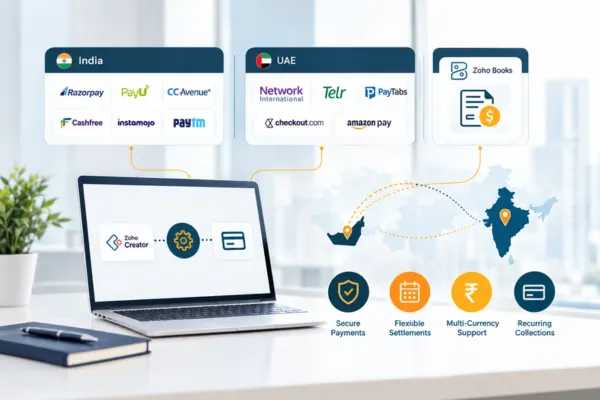
Most payment integration content is written against Stripe and PayPal and is close to useless for a business operating in India or the Gulf. In India the practical options are Razorpay, PayU, CCAvenue, Cashfree, Instamojo, and Paytm, each with different settlement cycles, different handling of UPI and mandate-based recurring collection, and different behaviour on refunds and partial captures. UPI in particular changes the design: it is the dominant collection method for many Indian businesses, it settles differently from card, and collect-request flows behave unlike a hosted checkout. RBI’s tokenisation rules mean card credentials cannot be stored the way older integrations assumed, and e-mandate for recurring collection has its own registration flow.

In the UAE the landscape is different again β€” Network International, Telr, PayTabs, Checkout.com, and Amazon Payment Services dominate, multi-currency settlement is routine, and acquiring relationships and merchant onboarding take longer than developers expect. Zoho Books includes its own gateway connections for invoice payment, which is frequently the right answer and worth checking before building anything custom. Where the payment is tied to a Creator record rather than an invoice β€” a booking, an application fee, a milestone, a deposit β€” the integration is custom, and the gateway you chose determines most of what that involves.

Business Challenges We Solve

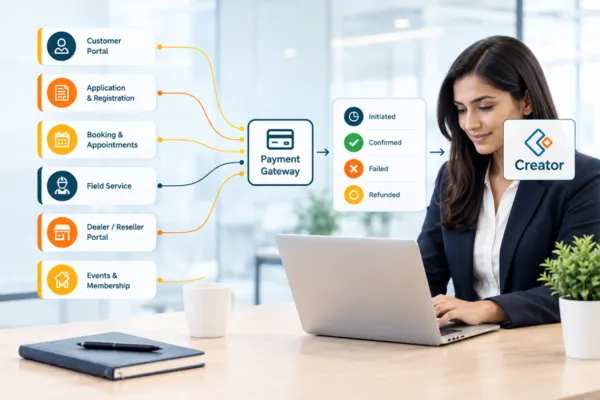
The requirement usually arrives attached to a process rather than to commerce. A customer portal where clients should settle outstanding invoices without a bank transfer. An application or registration form where a fee is due at submission. A booking or appointment workflow needing a deposit to confirm. A field service app where the technician collects payment on completion. A dealer or reseller portal where orders require payment before release. An event or membership process with a fee at a defined stage. In each case, payment needs to become part of the existing workflow rather than sit as a separate transaction. The system must know when payment is initiated, confirmed, failed, or refunded, and update the relevant Creator record accordingly. This keeps payment status visible and reduces manual reconciliation between the application and payment provider.

Zoho Creator Payment Integration Problems Techvaria Solve

What’s Included?

What each needs beyond the payment itself is reconciliation. A payment that succeeds and does not write back to the record is worse than no integration, because now two systems disagree and somebody reconciles manually. So the work concentrates on the parts that are not the payment call: verifying the webhook signature so a forged callback cannot mark an unpaid record as paid, handling the case where the customer closes the browser after paying but before redirect, preventing a duplicate charge when a customer submits twice, recording gateway fees so net settlement reconciles against the bank, and handling refunds and partial refunds as workflow rather than as a gateway dashboard action nobody records. These are the details that determine whether the integration runs unattended or generates a weekly reconciliation task.

Gateway Selection and Merchant Onboarding Support

Choosing the right gateway for your collection, settlement, ticket size, and jurisdiction, with merchant onboarding support β€” often longer than the build in India and the UAE.

Payment Initiation From a Creator Record

Payment requests generated from the record with the amount, reference, and customer detail carried through, so the transaction is tied to its originating record from the outset rather than matched afterwards.

UPI, Card, Net Banking, and Wallet Handling

Collection methods configured to what your customers actually use β€” UPI collect and intent flows in India, card and local methods in the UAE β€” with the flow design matched to each rather than forced into one checkout pattern.

Webhook Handling With Signature Verification

Gateway callbacks received and verified against the provider’s signature before any record is updated, so a payment status can only be set by a genuine gateway notification.

Idempotency and Duplicate Charge Prevention

Every payment attempt carrying a unique reference checked before initiation and before status update, so a double submission or a retry after a timeout cannot produce a second charge.

Reconciliation Write-Back and Fee Recording

Successful payments updating the originating record and posting to Zoho Books with the gateway fee recorded separately, so net settlement reconciles against the bank statement without manual adjustment.

Refund and Partial Refund Workflow

Refunds initiated from the record with approval routing, executed through the gateway API, and recorded against the original transaction β€” rather than performed in the gateway dashboard and noted nowhere.

Recurring Collection and Mandates

E-mandate or standing instruction registration and collection cycles where the business model involves subscriptions or instalments, with failure handling and retry logic appropriate to the mandate type.

Zoho Applications We Use for This

Creator and Books carry most of the payment work; the others come in where the payment touches an order, a customer record, or reporting.

Zoho Creator
Zoho Creator

Payment initiation from records, webhook handling, verification logic, reconciliation write-back, and refund workflow

zoho books
Zoho Books

Invoice payments, gateway fees, and bank reconciliation; Books’ gateway connections often handle collection natively.

Zoho CRM
Zoho CRM

Customer records and payment history where collection is part of the commercial relationship

Zoho Inventory
Zoho Inventory

Order release on payment confirmation where goods dispatch depends on settlement

Zoho Analytics
Zoho Analytics

Collection performance, payment method mix, failure rate by method, and settlement timing

Zoho Flow
Zoho Flow

Gateway connections where a supported connector covers the requirement without custom Deluge

Where This Applies?

This applies wherever a payment sits inside a process rather than at a shopfront. Education and training providers collecting application, admission, and course fees against student records. Membership and association bodies with subscription and renewal collection. Service businesses taking deposits to confirm bookings or collecting on job completion. Distribution and B2B businesses running dealer or customer portals where payment releases an order. Property and facilities operators collecting rent, maintenance charges, or deposits against a unit record. Healthcare and clinic operators taking appointment deposits or package payments. Event organisers with registration and ticketing tied to attendee records.

It applies with particular relevance to Indian businesses where UPI is the dominant collection method. UPI’s economics and customer familiarity make it the default, and an integration designed around card checkout with UPI added as an afterthought produces a worse conversion rate than one designed around UPI from the start.

It also applies to UAE businesses with multi-currency requirements, where the gateway must settle in more than one currency and the merchant arrangement determines what is possible. That constraint is set by the acquiring relationship rather than by the integration, which is why gateway selection precedes development.

Ready to Take Payments From Your Application?

A scoping session establishes what triggers the payment, which collection methods your customers use, what your existing merchant arrangements are, how reconciliation needs to work against your accounting, and whether Zoho Books’ built-in connections already cover the requirement. Where custom integration is needed, most gateway integrations are built and tested in two to four weeks, with merchant onboarding usually the longer lead time.
Why Choose Techvaria for Payment Integration?

Why Choose Techvaria for Payment Integration?

Techvaria is a Zoho Premium Partner with teams in India and Dubai, which means the regional gateways are ones we work with rather than read about. We build these integrations with signature verification, idempotency, and reconciliation write-back as standard, because the failure modes in payment work are not the payment call β€” they are the forged callback, the duplicate charge, and the successful payment that never reached the record. And where Zoho Books’ own gateway connection already does what you need, we will say so rather than building something you did not require. We also account for the operational side of payment integrations, including failed transactions, refunds, partial payments, and clear payment-status handling, so your team has reliable records to work from after the transaction is complete.

Hear From Our Clients

Industries We Serve

Frequently Asked Questions

Any gateway with a documented REST API can be integrated through Deluge. Regionally that means Razorpay, PayU, CCAvenue, Cashfree, Instamojo, and Paytm in India, and Network International, Telr, PayTabs, Checkout.com, and Amazon Payment Services in the UAE. Zoho Books also ships with connections to several providers for invoice payment, which is worth checking first since it needs no development.

Yes, through any Indian gateway supporting it β€” which is all of the major ones. UPI is worth designing for rather than adding: collect-request and intent flows behave differently from hosted card checkout, and for many Indian customer bases UPI is the dominant method. Designing the flow around it typically produces materially better completion than treating it as one option in a card-first checkout.

Signature verification. Every gateway signs its webhook payload, and the integration verifies that signature against your secret before any record is touched. A callback that fails verification is logged and rejected. Without this check, anyone who discovers the endpoint can mark records paid, which is the most serious failure mode in payment integration and the one most often omitted.

The webhook handles it. Payment status is driven by the gateway’s server-to-server notification rather than by the customer’s redirect, so a closed browser does not lose the payment. The redirect is a user experience convenience; the webhook is the record of truth. Integrations that rely on the redirect alone lose payments regularly.

Recorded separately from the payment amount when posting to Zoho Books, so the gross payment, the fee, and the net settlement are all captured. This is what allows net settlement to reconcile against the bank statement without a manual adjusting entry each time, and it is commonly missed in first-pass integrations.

Yes. Refunds are initiated from the originating record with approval routing where your process requires it, executed through the gateway API, and recorded against the original transaction with the accounting effect applied. The alternative β€” refunding in the gateway dashboard β€” leaves your system showing a payment that no longer exists.

Yes, through e-mandate in India or standing instruction arrangements in the UAE, depending on the gateway. Mandate registration has its own flow and approval cycle, and collection failures need defined retry and escalation handling. This is more involved than one-time payment and should be scoped as its own piece of work.

Two to four weeks for the build and testing of a one-time payment flow with reconciliation and refund handling. Recurring collection adds scope. Merchant onboarding with the gateway and acquirer is frequently the longer lead time, particularly in the UAE, so it is worth starting that in parallel with the build rather than after it.

Resources

Latest Blogs