Skip to content

Zoho Creator Portal Development

A portal moves work from your team to the people who generate it. Customers who can check their own order status stop calling. Vendors who submit invoices through a form stop emailing PDFs that someone has to file. Contractors who upload their own certificates stop being chased for them. Techvaria builds portals on Zoho Creator with the parts that decide whether a portal works: correct data scoping, an interface people will actually use, and a deliberate decision about which external parties need a login at all.

What Separates a Used Portal From an Ignored One?

What Separates a Used Portal From an Ignored One?

Most portals that fail do so for one of three reasons, none of which is technical capability. The first is that logging in is more effort than sending an email. If a customer has to remember a password to check something they could ask about in a two-line message, they will send the message β€” so the portal has to offer something the email cannot, such as immediate answers, document access, or the ability to act rather than ask. The second is scoping done badly. A portal where a user sees a record that is not theirs is a serious failure, and one where they cannot see something they should is a support call; getting record-level access right requires deliberate design of the relationship between portal users and data, not a permission setting applied late.

The third is that the portal was built for people who never needed one. Enrolling every external party as a portal user when most only ever submit something creates a recurring licence cost and a population of dormant accounts. The design question is which external parties genuinely need to see records back β€” those need portal access, and the rest are better served by a stateless form or a notification. Deciding that at the start is what makes a portal both useful and proportionate.

Business Challenges We Solve

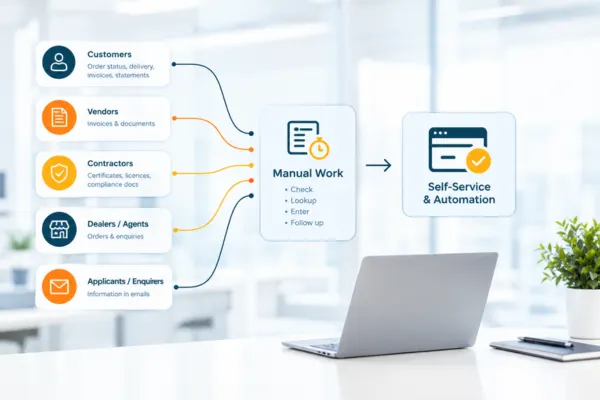
The pattern is usually a team absorbing work that the external party could do themselves. Customers phone or email for order status, delivery dates, invoice copies, and statement balances, and each enquiry takes a staff member several minutes and a system lookup. Vendors email invoices and documents that someone has to open, file, and key in. Contractors have to be chased for insurance certificates, licences, and compliance documents, and nobody knows which are expiring until one has. Dealers and agents phone in orders that are then typed into the system. Applicants and enquirers send information in unstructured emails that has to be transcribed into a form. Each of these is a handoff where the information already exists with the external party and arrives in a format that requires internal effort to process.

Zoho Creator Portal Problems Techvaria Solve

What’s Included

A portal moves that boundary. Customers see their own orders, deliveries, invoices, and documents, and can submit requests directly into the workflow. Vendors acknowledge purchase orders, submit invoices against them, and upload compliance documents with expiry dates the system then tracks. Contractors maintain their own certification records and are prompted before lapse rather than chased after it. Dealers place orders against their own price list, which creates the order record directly. The internal effect is a reduction in routine enquiry handling and transcription; the external effect is usually better service, because the answer is immediate rather than dependent on someone being available.

Portal Structure and Access Design

Deciding which external parties need a login and which are served by stateless forms or notifications, and designing the relationship between portal users and their records β€” the decisions that determine both security and ongoing cost.

Record-Level Data Scoping

Each portal user seeing only their own records, enforced at the data level rather than by interface filtering, with permission testing across every role before go-live.

Branded Portal Interface

Login and portal pages carrying your branding, with a layout designed around the few things the user actually came to do rather than exposing the full application.

Self-Service Views and Status Visibility

Orders, jobs, shipments, tickets, invoices, or whatever the relationship generates, visible with current status and history β€” removing the routine enquiry entirely.

Document Exchange with Expiry Tracking

Two-way document exchange: users download what you issue and upload what you require, with expiry dates tracked and reminders raised before lapse rather than after.

Submission Forms into Internal Workflow

Requests, orders, claims, or applications submitted through the portal creating records that enter your internal workflow directly, with validation applied at entry so incomplete submissions are caught immediately.

Notification and Communication

Status changes pushed by email or WhatsApp rather than requiring the user to log in and check, so the portal serves those who want detail while everyone receives the update.

User Onboarding and Access Management

Invitation, activation, password handling, and deactivation managed as a workflow, so enrolling and removing external users is a defined process rather than an administrative task nobody owns.

Zoho Applications We Use for This

Creator holds the portal and the application behind it. The applications below supply the records the portal exposes, or an alternative channel where a Creator portal is not the right answer.

Zoho Creator
Zoho Creator

Portal pages, portal user management, stateless forms, record scoping, and the internal application behind the portal
Zoho CRM
Zoho CRM

Customer and partner records underlying portal identity, with relationship history and agreed terms
zoho books
Zoho Books

Invoice, statement, and payment visibility; Books’ customer portal may cover the finance need without building it in Creator.
Zoho Inventory
Zoho Inventory

Order and delivery status where the portal exposes fulfilment progress

Zoho Desk
Zoho Desk

Where the external requirement is support rather than transactional access, Desk’s help centre may be the better fit
Zoho Flow
Zoho Flow

Notification delivery and integration with messaging channels so updates reach users without requiring a login

Where This Applies?

This applies wherever a significant volume of routine interaction happens between your team and external parties. Distribution and manufacturing businesses giving trade customers order placement, status, and document access. Service and maintenance businesses giving clients job visibility, service history, and request submission. Logistics operators giving customers shipment tracking and document retrieval. Construction and facilities businesses managing subcontractor compliance, certification, and payment applications. Businesses with dealer, agent, or franchise networks placing orders and accessing price lists and marketing material. Membership, education, and enrolment organisations handling applications and renewals.

It applies most strongly where the external population is engaged repeatedly rather than once. A customer with two orders a year gains little from an account; one with twenty open jobs gains a great deal, and so does the team currently answering their enquiries. This distinction should shape who is enrolled rather than being discovered at renewal.

It also applies as a competitive consideration. Portal visibility is now an expected capability in several sectors, set by larger competitors and by consumer experiences. For businesses whose customers are beginning to ask for tracking or document access as a condition of doing business, the portal is a commercial requirement rather than an efficiency project.

Ready to Move Work to the People Who Generate It?

A portal design session covers who your external parties are, what each group actually needs to do, which of them genuinely need a login, and what the record scoping has to enforce. We scope the portal structure, the interface, the document and notification requirements, and the licence implication of the user population. Most portal builds reach production in four to ten weeks depending on scope and whether the underlying application already exists.
Why Choose Techvaria for Portal Development?

Why Choose Techvaria for Portal Development?

Techvaria is a Zoho Premium Partner building Creator applications and portals for businesses in India and the UAE. We raise the portal-versus-form decision during design with the recurring cost stated, because enrolling external parties who only ever submit is the most common way portal projects become expensive. We design record scoping deliberately and test it across every role before go-live, since a portal exposing the wrong record to the wrong party is a failure no feature set compensates for. And we design the interface around the few actions the user came to perform rather than exposing the application behind it. This keeps the experience focused, reduces unnecessary complexity, and ensures external users see only the information and functions relevant to their role and relationship with the business.

Hear From Our Clients

Industries We Serve

Frequently Asked Questions

Give external users a branded login with access scoped to their own records β€” orders, jobs, shipments, invoices, documents β€” the ability to submit requests, orders, or documents into your internal workflow, and visibility of status and history. It is a controlled window into your application rather than a separate system, so data entered through it is immediately available internally with no transfer step.

No, and this is the decision that most affects ongoing cost. Portal users carry a licence because they have an identity and persistent scoped access. Parties who only need to submit information β€” a document upload, a request, an application β€” can use a stateless form with no per-user cost at all. Most businesses need a mix, and designing for that mix rather than enrolling everyone is what keeps the cost proportionate.

Through data-level scoping tied to the portal user’s identity, not through interface filtering. Every record type accessible in the portal has a defined ownership relationship, and access is enforced against it. We test this explicitly across every role before go-live, including attempts to access records outside scope, because this is the failure mode with the most serious consequences.

Yes. Login and portal pages carry your branding, colours, and logo, and can be accessed on a subdomain of your own domain so the experience is continuous with your website. The interface is designed around the specific actions the user needs rather than presenting the underlying application.

They use it when it is faster than asking. That means immediate answers to the questions they currently phone about, document access without a request, and the ability to act rather than only view. It also means not forcing a login for things that could be pushed β€” a status notification by WhatsApp or email serves the occasional user better than an account they will forget. We design for both rather than assuming everyone will adopt a portal.

Yes, and it is one of the more common requirements. Vendors see their purchase orders, acknowledge them, and submit invoices against specific orders with supporting documents attached. Because the submission references the order, the matching that finance would otherwise do manually is already established, and validation at entry catches incomplete submissions before they enter your process.

Yes. Documents uploaded through the portal carry expiry dates, and reminders are raised to the external party before lapse β€” so they renew proactively rather than being chased afterwards. Outstanding and expiring documents are also visible internally as a list, which replaces the spreadsheet most businesses currently maintain for this.

Four to ten weeks, depending on scope and whether the underlying Creator application already exists. Adding a portal to an existing application is at the shorter end. Building both the application and the portal together runs longer. Document exchange, submission workflows, and notification channels each add scope, as does the number of distinct external user types.

Resources

Latest Blogs